 Add to Chrome
 Add to Firefox
 Add to Edge
facial recognition
Facial recognition is an AI-based technique for identifying or confirming an individual's identity using their face. It maps facial features from an image or video and then compares the information with a collection of known faces to find a match.
Papers and Code
CMED: A Child Micro-Expression Dataset
Mar 27, 2025
Micro-expressions are short bursts of emotion that are difficult to hide. Their detection in children is an important cue to assist psychotherapists in conducting better therapy. However, existing research on the detection of micro-expressions has focused on adults, whose expressions differ in their characteristics from those of children. The lack of research is a direct consequence of the lack of a child-based micro-expressions dataset as it is much more challenging to capture children's facial expressions due to the lack of predictability and controllability. This study compiles a dataset of spontaneous child micro-expression videos, the first of its kind, to the best of the authors knowledge. The dataset is captured in the wild using video conferencing software. This dataset enables us to then explore key features and differences between adult and child micro-expressions. This study also establishes a baseline for the automated spotting and recognition of micro-expressions in children using three approaches comprising of hand-created and learning-based approaches.

Two-Stream Spatial-Temporal Transformer Framework for Person Identification via Natural Conversational Keypoints
Feb 28, 2025
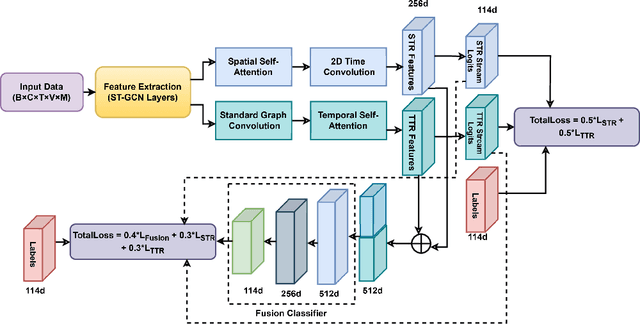
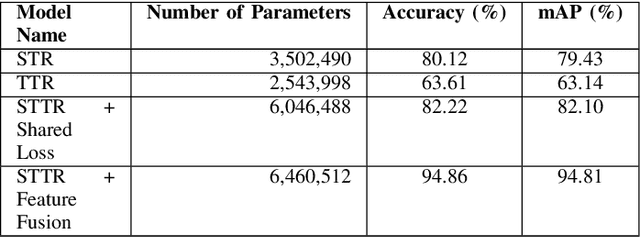
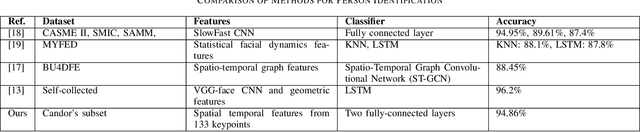
In the age of AI-driven generative technologies, traditional biometric recognition systems face unprecedented challenges, particularly from sophisticated deepfake and face reenactment techniques. In this study, we propose a Two-Stream Spatial-Temporal Transformer Framework for person identification using upper body keypoints visible during online conversations, which we term conversational keypoints. Our framework processes both spatial relationships between keypoints and their temporal evolution through two specialized branches: a Spatial Transformer (STR) that learns distinctive structural patterns in keypoint configurations, and a Temporal Transformer (TTR) that captures sequential motion patterns. Using the state-of-the-art Sapiens pose estimator, we extract 133 keypoints (based on COCO-WholeBody format) representing facial features, head pose, and hand positions. The framework was evaluated on a dataset of 114 individuals engaged in natural conversations, achieving recognition accuracies of 80.12% for the spatial stream, 63.61% for the temporal stream. We then explored two fusion strategies: a shared loss function approach achieving 82.22% accuracy, and a feature-level fusion method that concatenates feature maps from both streams, significantly improving performance to 94.86%. By jointly modeling both static anatomical relationships and dynamic movement patterns, our approach learns comprehensive identity signatures that are more robust to spoofing than traditional appearance-based methods.
DIPSER: A Dataset for In-Person Student1 Engagement Recognition in the Wild
Feb 27, 2025In this paper, a novel dataset is introduced, designed to assess student attention within in-person classroom settings. This dataset encompasses RGB camera data, featuring multiple cameras per student to capture both posture and facial expressions, in addition to smartwatch sensor data for each individual. This dataset allows machine learning algorithms to be trained to predict attention and correlate it with emotion. A comprehensive suite of attention and emotion labels for each student is provided, generated through self-reporting as well as evaluations by four different experts. Our dataset uniquely combines facial and environmental camera data, smartwatch metrics, and includes underrepresented ethnicities in similar datasets, all within in-the-wild, in-person settings, making it the most comprehensive dataset of its kind currently available. The dataset presented offers an extensive and diverse collection of data pertaining to student interactions across different educational contexts, augmented with additional metadata from other tools. This initiative addresses existing deficiencies by offering a valuable resource for the analysis of student attention and emotion in face-to-face lessons.
Frequency Matters: Explaining Biases of Face Recognition in the Frequency Domain
Jan 28, 2025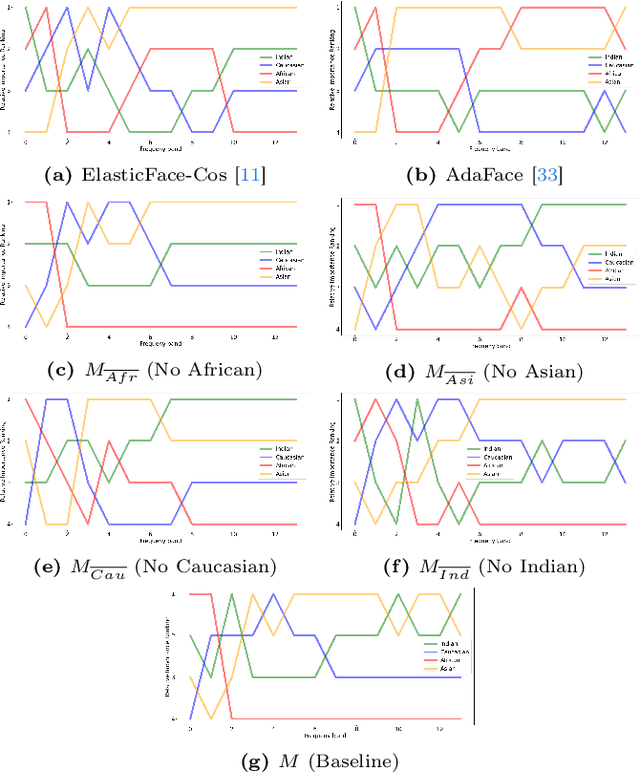
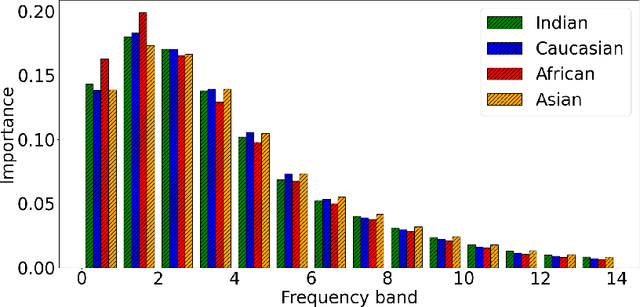
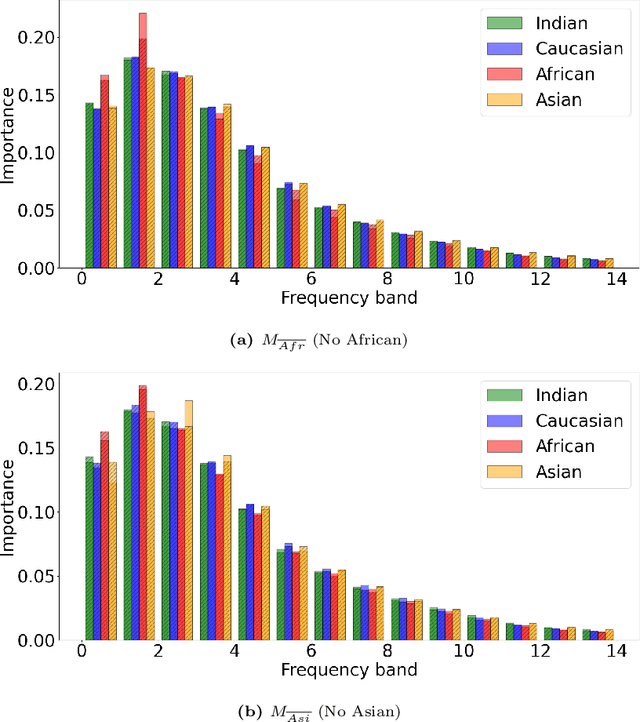
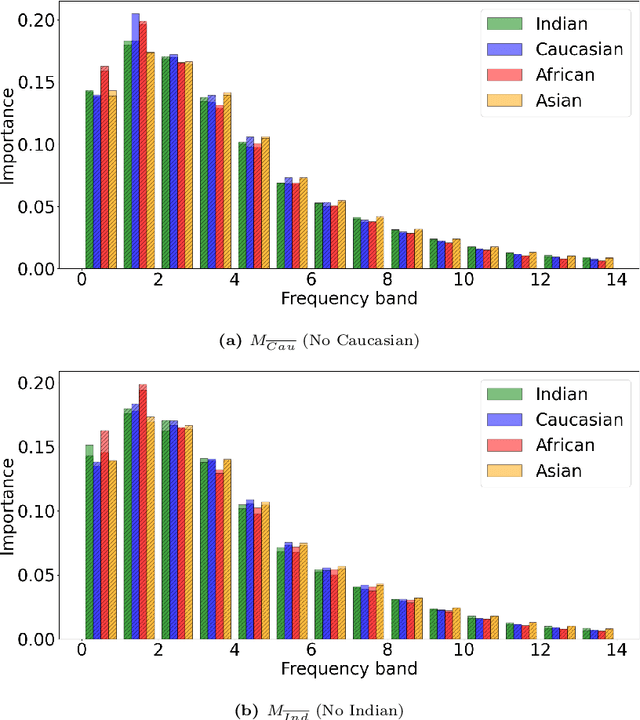
Face recognition (FR) models are vulnerable to performance variations across demographic groups. The causes for these performance differences are unclear due to the highly complex deep learning-based structure of face recognition models. Several works aimed at exploring possible roots of gender and ethnicity bias, identifying semantic reasons such as hairstyle, make-up, or facial hair as possible sources. Motivated by recent discoveries of the importance of frequency patterns in convolutional neural networks, we explain bias in face recognition using state-of-the-art frequency-based explanations. Our extensive results show that different frequencies are important to FR models depending on the ethnicity of the samples.
NullSwap: Proactive Identity Cloaking Against Deepfake Face Swapping
Mar 24, 2025Suffering from performance bottlenecks in passively detecting high-quality Deepfake images due to the advancement of generative models, proactive perturbations offer a promising approach to disabling Deepfake manipulations by inserting signals into benign images. However, existing proactive perturbation approaches remain unsatisfactory in several aspects: 1) visual degradation due to direct element-wise addition; 2) limited effectiveness against face swapping manipulation; 3) unavoidable reliance on white- and grey-box settings to involve generative models during training. In this study, we analyze the essence of Deepfake face swapping and argue the necessity of protecting source identities rather than target images, and we propose NullSwap, a novel proactive defense approach that cloaks source image identities and nullifies face swapping under a pure black-box scenario. We design an Identity Extraction module to obtain facial identity features from the source image, while a Perturbation Block is then devised to generate identity-guided perturbations accordingly. Meanwhile, a Feature Block extracts shallow-level image features, which are then fused with the perturbation in the Cloaking Block for image reconstruction. Furthermore, to ensure adaptability across different identity extractors in face swapping algorithms, we propose Dynamic Loss Weighting to adaptively balance identity losses. Experiments demonstrate the outstanding ability of our approach to fool various identity recognition models, outperforming state-of-the-art proactive perturbations in preventing face swapping models from generating images with correct source identities.
Video-DPRP: A Differentially Private Approach for Visual Privacy-Preserving Video Human Activity Recognition
Mar 03, 2025Considerable effort has been made in privacy-preserving video human activity recognition (HAR). Two primary approaches to ensure privacy preservation in Video HAR are differential privacy (DP) and visual privacy. Techniques enforcing DP during training provide strong theoretical privacy guarantees but offer limited capabilities for visual privacy assessment. Conversely methods, such as low-resolution transformations, data obfuscation and adversarial networks, emphasize visual privacy but lack clear theoretical privacy assurances. In this work, we focus on two main objectives: (1) leveraging DP properties to develop a model-free approach for visual privacy in videos and (2) evaluating our proposed technique using both differential privacy and visual privacy assessments on HAR tasks. To achieve goal (1), we introduce Video-DPRP: a Video-sample-wise Differentially Private Random Projection framework for privacy-preserved video reconstruction for HAR. By using random projections, noise matrices and right singular vectors derived from the singular value decomposition of videos, Video-DPRP reconstructs DP videos using privacy parameters ($\epsilon,\delta$) while enabling visual privacy assessment. For goal (2), using UCF101 and HMDB51 datasets, we compare Video-DPRP's performance on activity recognition with traditional DP methods, and state-of-the-art (SOTA) visual privacy-preserving techniques. Additionally, we assess its effectiveness in preserving privacy-related attributes such as facial features, gender, and skin color, using the PA-HMDB and VISPR datasets. Video-DPRP combines privacy-preservation from both a DP and visual privacy perspective unlike SOTA methods that typically address only one of these aspects.
SLIP: Spoof-Aware One-Class Face Anti-Spoofing with Language Image Pretraining
Mar 25, 2025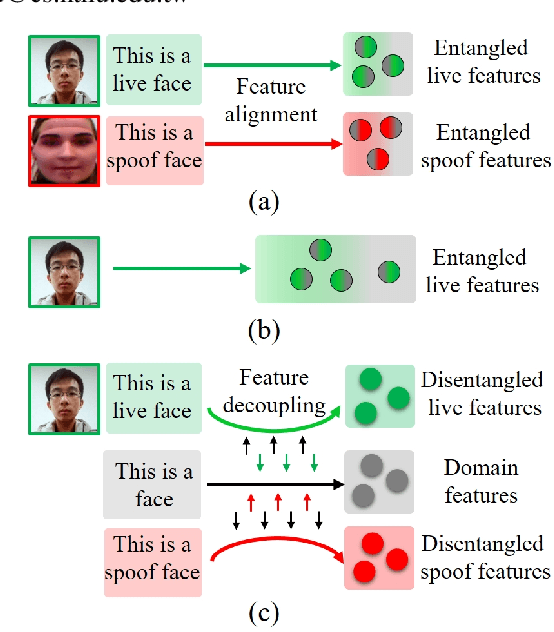
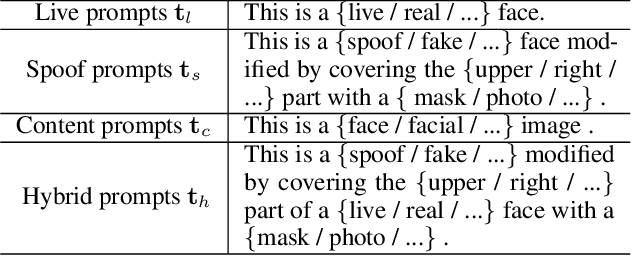
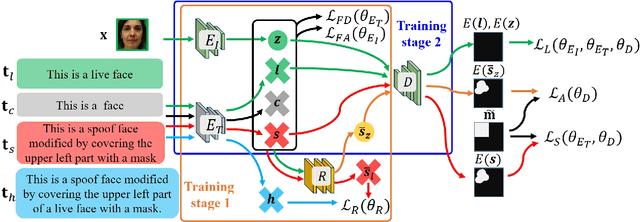
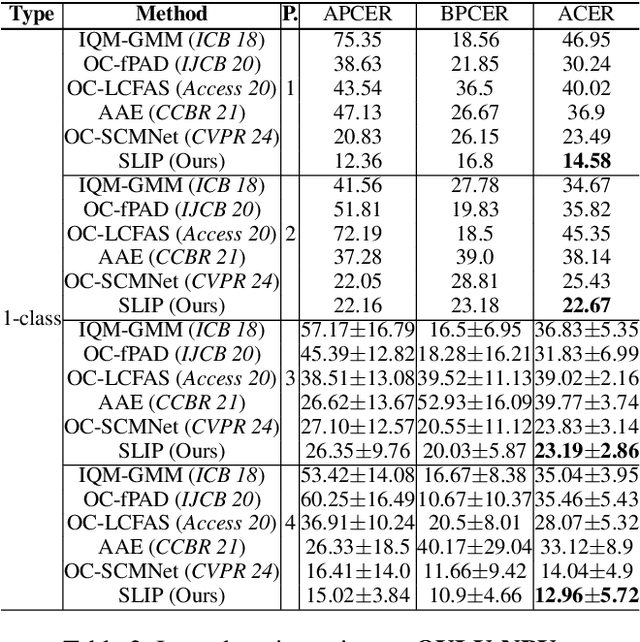
Face anti-spoofing (FAS) plays a pivotal role in ensuring the security and reliability of face recognition systems. With advancements in vision-language pretrained (VLP) models, recent two-class FAS techniques have leveraged the advantages of using VLP guidance, while this potential remains unexplored in one-class FAS methods. The one-class FAS focuses on learning intrinsic liveness features solely from live training images to differentiate between live and spoof faces. However, the lack of spoof training data can lead one-class FAS models to inadvertently incorporate domain information irrelevant to the live/spoof distinction (e.g., facial content), causing performance degradation when tested with a new application domain. To address this issue, we propose a novel framework called Spoof-aware one-class face anti-spoofing with Language Image Pretraining (SLIP). Given that live faces should ideally not be obscured by any spoof-attack-related objects (e.g., paper, or masks) and are assumed to yield zero spoof cue maps, we first propose an effective language-guided spoof cue map estimation to enhance one-class FAS models by simulating whether the underlying faces are covered by attack-related objects and generating corresponding nonzero spoof cue maps. Next, we introduce a novel prompt-driven liveness feature disentanglement to alleviate live/spoof-irrelative domain variations by disentangling live/spoof-relevant and domain-dependent information. Finally, we design an effective augmentation strategy by fusing latent features from live images and spoof prompts to generate spoof-like image features and thus diversify latent spoof features to facilitate the learning of one-class FAS. Our extensive experiments and ablation studies support that SLIP consistently outperforms previous one-class FAS methods.
7ABAW-Compound Expression Recognition via Curriculum Learning
Mar 11, 2025With the advent of deep learning, expression recognition has made significant advancements. However, due to the limited availability of annotated compound expression datasets and the subtle variations of compound expressions, Compound Emotion Recognition (CE) still holds considerable potential for exploration. To advance this task, the 7th Affective Behavior Analysis in-the-wild (ABAW) competition introduces the Compound Expression Challenge based on C-EXPR-DB, a limited dataset without labels. In this paper, we present a curriculum learning-based framework that initially trains the model on single-expression tasks and subsequently incorporates multi-expression data. This design ensures that our model first masters the fundamental features of basic expressions before being exposed to the complexities of compound emotions. Specifically, our designs can be summarized as follows: 1) Single-Expression Pre-training: The model is first trained on datasets containing single expressions to learn the foundational facial features associated with basic emotions. 2) Dynamic Compound Expression Generation: Given the scarcity of annotated compound expression datasets, we employ CutMix and Mixup techniques on the original single-expression images to create hybrid images exhibiting characteristics of multiple basic emotions. 3) Incremental Multi-Expression Integration: After performing well on single-expression tasks, the model is progressively exposed to multi-expression data, allowing the model to adapt to the complexity and variability of compound expressions. The official results indicate that our method achieves the \textbf{best} performance in this competition track with an F-score of 0.6063. Our code is released at https://github.com/YenanLiu/ABAW7th.
FABG : End-to-end Imitation Learning for Embodied Affective Human-Robot Interaction
Mar 04, 2025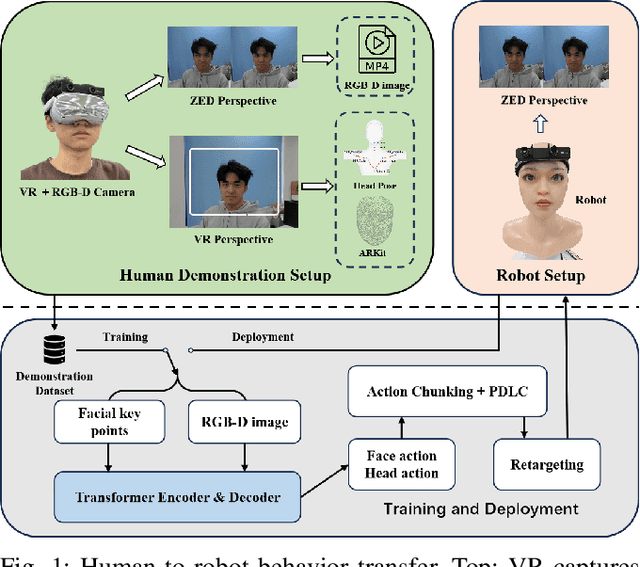
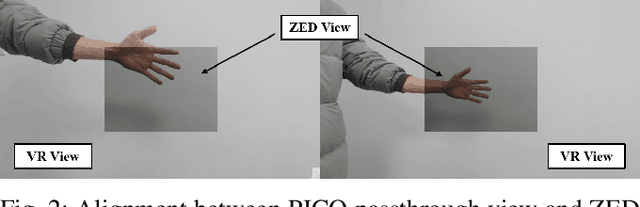
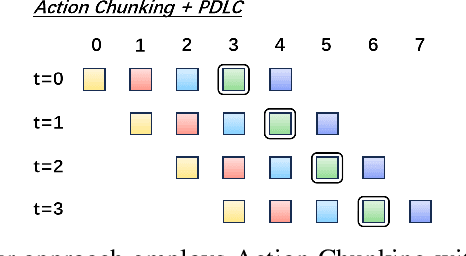

This paper proposes FABG (Facial Affective Behavior Generation), an end-to-end imitation learning system for human-robot interaction, designed to generate natural and fluid facial affective behaviors. In interaction, effectively obtaining high-quality demonstrations remains a challenge. In this work, we develop an immersive virtual reality (VR) demonstration system that allows operators to perceive stereoscopic environments. This system ensures "the operator's visual perception matches the robot's sensory input" and "the operator's actions directly determine the robot's behaviors" - as if the operator replaces the robot in human interaction engagements. We propose a prediction-driven latency compensation strategy to reduce robotic reaction delays and enhance interaction fluency. FABG naturally acquires human interactive behaviors and subconscious motions driven by intuition, eliminating manual behavior scripting. We deploy FABG on a real-world 25-degree-of-freedom (DoF) humanoid robot, validating its effectiveness through four fundamental interaction tasks: expression response, dynamic gaze, foveated attention, and gesture recognition, supported by data collection and policy training. Project website: https://cybergenies.github.io
Facial Analysis Systems and Down Syndrome
Feb 10, 2025The ethical, social and legal issues surrounding facial analysis technologies have been widely debated in recent years. Key critics have argued that these technologies can perpetuate bias and discrimination, particularly against marginalized groups. We contribute to this field of research by reporting on the limitations of facial analysis systems with the faces of people with Down syndrome: this particularly vulnerable group has received very little attention in the literature so far. This study involved the creation of a specific dataset of face images. An experimental group with faces of people with Down syndrome, and a control group with faces of people who are not affected by the syndrome. Two commercial tools were tested on the dataset, along three tasks: gender recognition, age prediction and face labelling. The results show an overall lower accuracy of prediction in the experimental group, and other specific patterns of performance differences: i) high error rates in gender recognition in the category of males with Down syndrome; ii) adults with Down syndrome were more often incorrectly labelled as children; iii) social stereotypes are propagated in both the control and experimental groups, with labels related to aesthetics more often associated with women, and labels related to education level and skills more often associated with men. These results, although limited in scope, shed new light on the biases that alter face classification when applied to faces of people with Down syndrome. They confirm the structural limitation of the technology, which is inherently dependent on the datasets used to train the models.