 Add to Chrome
 Add to Firefox
 Add to Edge
Probing Identity-Specific Motion Signatures: A Controlled Diagnostic Study
Jul 03, 2026
Identity recognition (e.g., person, animal re-identification) has traditionally relied heavily on static appearance cues. Yet motion--consistent, individual-specific dynamics--can provide a complementary and potentially more robust signature, especially when appearance is weak or variable. This raises a fundamental question: when identity-specific motion cues are clearly present, to what extent do modern video models use them for recognition? To investigate this question, we conduct a systematic diagnostic study and introduce BALLER120, a controlled benchmark of 120 professional basketball players performing free-throws. By focusing on the same multi-phase action across individuals, BALLER120 reduces action-level variation and identity-correlated acquisition biases, enabling fine-grained analysis of identity-specific kinematic patterns. We find that modern video models can predict identity accurately from RGB videos, but often rely on static appearance cues such as faces and jersey regions, even when informative motion cues are available. Strikingly, when appearance is suppressed through silhouette-only or skeleton-only inputs, the same model architectures shift toward motion micro-patterns (e.g., foot placement and elbow bending). Despite containing less visual information, appearance-suppressed representations achieve competitive accuracy and stronger robustness to appearance shifts. Our qualitative analyses further show that appearance-suppressed models attend to distinctive motion patterns across individuals. Overall, our study demonstrates that identity-specific motion signatures are present, informative, and learnable, but modern video models may overlook them in favor of easier static shortcuts unless appearance cues are explicitly suppressed.

SLIP: Spoof-Aware One-Class Face Anti-Spoofing with Language Image Pretraining
Mar 25, 2025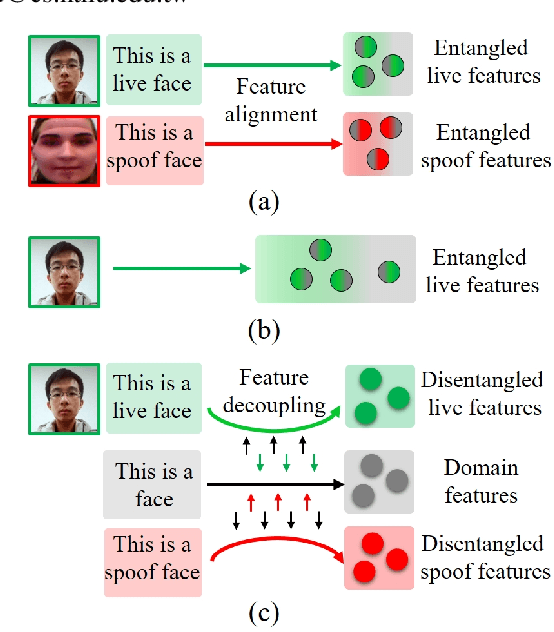
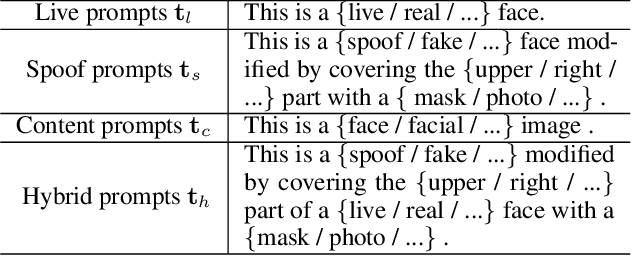
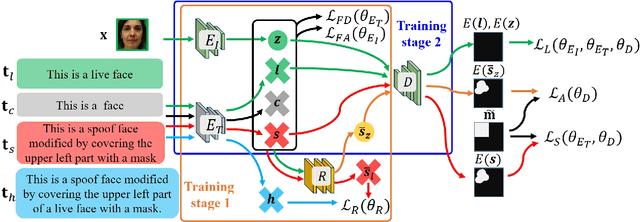
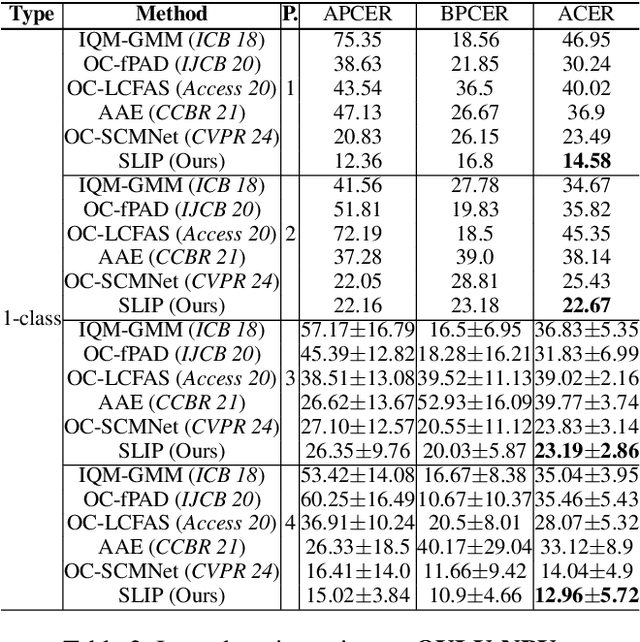
Face anti-spoofing (FAS) plays a pivotal role in ensuring the security and reliability of face recognition systems. With advancements in vision-language pretrained (VLP) models, recent two-class FAS techniques have leveraged the advantages of using VLP guidance, while this potential remains unexplored in one-class FAS methods. The one-class FAS focuses on learning intrinsic liveness features solely from live training images to differentiate between live and spoof faces. However, the lack of spoof training data can lead one-class FAS models to inadvertently incorporate domain information irrelevant to the live/spoof distinction (e.g., facial content), causing performance degradation when tested with a new application domain. To address this issue, we propose a novel framework called Spoof-aware one-class face anti-spoofing with Language Image Pretraining (SLIP). Given that live faces should ideally not be obscured by any spoof-attack-related objects (e.g., paper, or masks) and are assumed to yield zero spoof cue maps, we first propose an effective language-guided spoof cue map estimation to enhance one-class FAS models by simulating whether the underlying faces are covered by attack-related objects and generating corresponding nonzero spoof cue maps. Next, we introduce a novel prompt-driven liveness feature disentanglement to alleviate live/spoof-irrelative domain variations by disentangling live/spoof-relevant and domain-dependent information. Finally, we design an effective augmentation strategy by fusing latent features from live images and spoof prompts to generate spoof-like image features and thus diversify latent spoof features to facilitate the learning of one-class FAS. Our extensive experiments and ablation studies support that SLIP consistently outperforms previous one-class FAS methods.