 Add to Chrome
 Add to Firefox
 Add to Edge
Yolov5
Papers and Code
Deep Learning-Based Object Detection for Autonomous Vehicles: A Comparative Study of One-Stage and Two-Stage Detectors on Basic Traffic Objects
Jan 30, 2026
Object detection is a crucial component in autonomous vehicle systems. It enables the vehicle to perceive and understand its environment by identifying and locating various objects around it. By utilizing advanced imaging and deep learning techniques, autonomous vehicle systems can rapidly and accurately identify objects based on their features. Different deep learning methods vary in their ability to accurately detect and classify objects in autonomous vehicle systems. Selecting the appropriate method significantly impacts system performance, robustness, and efficiency in real-world driving scenarios. While several generic deep learning architectures like YOLO, SSD, and Faster R-CNN have been proposed, guidance on their suitability for specific autonomous driving applications is often limited. The choice of method affects detection accuracy, processing speed, environmental robustness, sensor integration, scalability, and edge case handling. This study provides a comprehensive experimental analysis comparing two prominent object detection models: YOLOv5 (a one-stage detector) and Faster R-CNN (a two-stage detector). Their performance is evaluated on a diverse dataset combining real and synthetic images, considering various metrics including mean Average Precision (mAP), recall, and inference speed. The findings reveal that YOLOv5 demonstrates superior performance in terms of mAP, recall, and training efficiency, particularly as dataset size and image resolution increase. However, Faster R-CNN shows advantages in detecting small, distant objects and performs well in challenging lighting conditions. The models' behavior is also analyzed under different confidence thresholds and in various real-world scenarios, providing insights into their applicability for autonomous driving systems.

Boundary and Position Information Mining for Aerial Small Object Detection
Jan 23, 2026Unmanned Aerial Vehicle (UAV) applications have become increasingly prevalent in aerial photography and object recognition. However, there are major challenges to accurately capturing small targets in object detection due to the imbalanced scale and the blurred edges. To address these issues, boundary and position information mining (BPIM) framework is proposed for capturing object edge and location cues. The proposed BPIM includes position information guidance (PIG) module for obtaining location information, boundary information guidance (BIG) module for extracting object edge, cross scale fusion (CSF) module for gradually assembling the shallow layer image feature, three feature fusion (TFF) module for progressively combining position and boundary information, and adaptive weight fusion (AWF) module for flexibly merging the deep layer semantic feature. Therefore, BPIM can integrate boundary, position, and scale information in image for small object detection using attention mechanisms and cross-scale feature fusion strategies. Furthermore, BPIM not only improves the discrimination of the contextual feature by adaptive weight fusion with boundary, but also enhances small object perceptions by cross-scale position fusion. On the VisDrone2021, DOTA1.0, and WiderPerson datasets, experimental results show the better performances of BPIM compared to the baseline Yolov5-P2, and obtains the promising performance in the state-of-the-art methods with comparable computation load.
DMV-AVP: Distributed Multi-Vehicle Autonomous Valet Parking using Autoware
Jan 22, 2026This paper presents the DMV-AVP System, a distributed simulation of Multi-Vehicle Autonomous Valet Parking (AVP). The system was implemented as an application of the Distributed Multi-Vehicle Architecture (DMAVA) for synchronized multi-host execution. Most existing simulation approaches rely on centralized or non-distributed designs that constrain scalability and limit fully autonomous control. This work introduces two modules built on top of the DMAVA: 1) a Multi-Vehicle AVP Node that performs state-based coordination, queuing, and reservation management across multiple vehicles, and 2) a Unity-Integrated YOLOv5 Parking Spot Detection Module that provides real-time, vision-based perception within AWSIM Labs. Both modules integrate seamlessly with the DMAVA and extend it specifically for multi-vehicle AVP operation, supported by a Zenoh-based communication layer that ensures low-latency topic synchronization and coordinated behavior across hosts. Experiments conducted on two- and three-host configurations demonstrate deterministic coordination, conflict-free parking behavior, and scalable performance across distributed Autoware instances. The results confirm that the proposed Distributed Multi-Vehicle AVP System supports cooperative AVP simulation and establishes a foundation for future real-world and hardware-in-the-loop validation. Demo videos and source code are available at https://github.com/zubxxr/multi-vehicle-avp
SimD3: A Synthetic drone Dataset with Payload and Bird Distractor Modeling for Robust Detection
Jan 21, 2026Reliable drone detection is challenging due to limited annotated real-world data, large appearance variability, and the presence of visually similar distractors such as birds. To address these challenges, this paper introduces SimD3, a large-scale high-fidelity synthetic dataset designed for robust drone detection in complex aerial environments. Unlike existing synthetic drone datasets, SimD3 explicitly models drones with heterogeneous payloads, incorporates multiple bird species as realistic distractors, and leverages diverse Unreal Engine 5 environments with controlled weather, lighting, and flight trajectories captured using a 360 six-camera rig. Using SimD3, we conduct an extensive experimental evaluation within the YOLOv5 detection framework, including an attention-enhanced variant termed Yolov5m+C3b, where standard bottleneck-based C3 blocks are replaced with C3b modules. Models are evaluated on synthetic data, combined synthetic and real data, and multiple unseen real-world benchmarks to assess robustness and generalization. Experimental results show that SimD3 provides effective supervision for small-object drone detection and that Yolov5m+C3b consistently outperforms the baseline across in-domain and cross-dataset evaluations. These findings highlight the utility of SimD3 for training and benchmarking robust drone detection models under diverse and challenging conditions.
Using Large Language Models To Translate Machine Results To Human Results
Dec 30, 2025Artificial intelligence (AI) has transformed medical imaging, with computer vision (CV) systems achieving state-of-the-art performance in classification and detection tasks. However, these systems typically output structured predictions, leaving radiologists responsible for translating results into full narrative reports. Recent advances in large language models (LLMs), such as GPT-4, offer new opportunities to bridge this gap by generating diagnostic narratives from structured findings. This study introduces a pipeline that integrates YOLOv5 and YOLOv8 for anomaly detection in chest X-ray images with a large language model (LLM) to generate natural-language radiology reports. The YOLO models produce bounding-box predictions and class labels, which are then passed to the LLM to generate descriptive findings and clinical summaries. YOLOv5 and YOLOv8 are compared in terms of detection accuracy, inference latency, and the quality of generated text, as measured by cosine similarity to ground-truth reports. Results show strong semantic similarity between AI and human reports, while human evaluation reveals GPT-4 excels in clarity (4.88/5) but exhibits lower scores for natural writing flow (2.81/5), indicating that current systems achieve clinical accuracy but remain stylistically distinguishable from radiologist-authored text.
Evaluating an Adaptive Multispectral Turret System for Autonomous Tracking Across Variable Illumination Conditions
Dec 24, 2025Autonomous robotic platforms are playing a growing role across the emergency services sector, supporting missions such as search and rescue operations in disaster zones and reconnaissance. However, traditional red-green-blue (RGB) detection pipelines struggle in low-light environments, and thermal-based systems lack color and texture information. To overcome these limitations, we present an adaptive framework that fuses RGB and long-wave infrared (LWIR) video streams at multiple fusion ratios and dynamically selects the optimal detection model for each illumination condition. We trained 33 You Only Look Once (YOLO) models on over 22,000 annotated images spanning three light levels: no-light (<10 lux), dim-light (10-1000 lux), and full-light (>1000 lux). To integrate both modalities, fusion was performed by blending aligned RGB and LWIR frames at eleven ratios, from full RGB (100/0) to full LWIR (0/100) in 10% increments. Evaluation showed that the best full-light model (80/20 RGB-LWIR) and dim-light model (90/10 fusion) achieved 92.8% and 92.0% mean confidence; both significantly outperformed the YOLOv5 nano (YOLOv5n) and YOLOv11 nano (YOLOv11n) baselines. Under no-light conditions, the top 40/60 fusion reached 71.0%, exceeding baselines though not statistically significant. Adaptive RGB-LWIR fusion improved detection confidence and reliability across all illumination conditions, enhancing autonomous robotic vision performance.
YolovN-CBi: A Lightweight and Efficient Architecture for Real-Time Detection of Small UAVs
Dec 19, 2025Unmanned Aerial Vehicles, commonly known as, drones pose increasing risks in civilian and defense settings, demanding accurate and real-time drone detection systems. However, detecting drones is challenging because of their small size, rapid movement, and low visual contrast. A modified architecture of YolovN called the YolovN-CBi is proposed that incorporates the Convolutional Block Attention Module (CBAM) and the Bidirectional Feature Pyramid Network (BiFPN) to improve sensitivity to small object detections. A curated training dataset consisting of 28K images is created with various flying objects and a local test dataset is collected with 2500 images consisting of very small drone objects. The proposed architecture is evaluated on four benchmark datasets, along with the local test dataset. The baseline Yolov5 and the proposed Yolov5-CBi architecture outperform newer Yolo versions, including Yolov8 and Yolov12, in the speed-accuracy trade-off for small object detection. Four other variants of the proposed CBi architecture are also proposed and evaluated, which vary in the placement and usage of CBAM and BiFPN. These variants are further distilled using knowledge distillation techniques for edge deployment, using a Yolov5m-CBi teacher and a Yolov5n-CBi student. The distilled model achieved a mA@P0.5:0.9 of 0.6573, representing a 6.51% improvement over the teacher's score of 0.6171, highlighting the effectiveness of the distillation process. The distilled model is 82.9% faster than the baseline model, making it more suitable for real-time drone detection. These findings highlight the effectiveness of the proposed CBi architecture, together with the distilled lightweight models in advancing efficient and accurate real-time detection of small UAVs.
Autoencoder-based Denoising Defense against Adversarial Attacks on Object Detection
Dec 18, 2025Deep learning-based object detection models play a critical role in real-world applications such as autonomous driving and security surveillance systems, yet they remain vulnerable to adversarial examples. In this work, we propose an autoencoder-based denoising defense to recover object detection performance degraded by adversarial perturbations. We conduct adversarial attacks using Perlin noise on vehicle-related images from the COCO dataset, apply a single-layer convolutional autoencoder to remove the perturbations, and evaluate detection performance using YOLOv5. Our experiments demonstrate that adversarial attacks reduce bbox mAP from 0.2890 to 0.1640, representing a 43.3% performance degradation. After applying the proposed autoencoder defense, bbox mAP improves to 0.1700 (3.7% recovery) and bbox mAP@50 increases from 0.2780 to 0.3080 (10.8% improvement). These results indicate that autoencoder-based denoising can provide partial defense against adversarial attacks without requiring model retraining.
PHANTOM: PHysical ANamorphic Threats Obstructing Connected Vehicle Mobility
Dec 15, 2025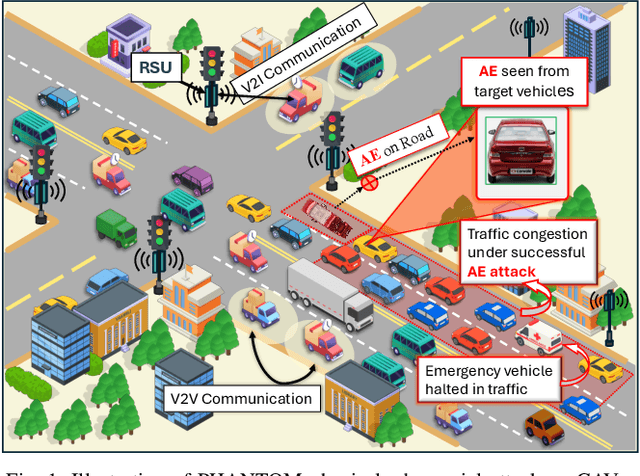
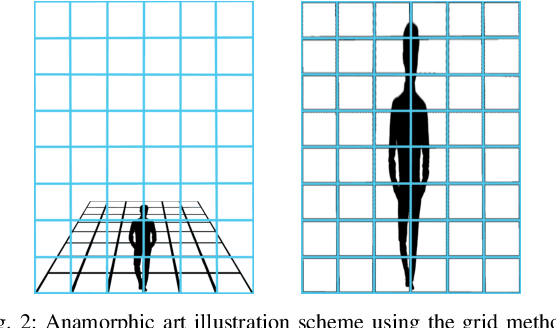
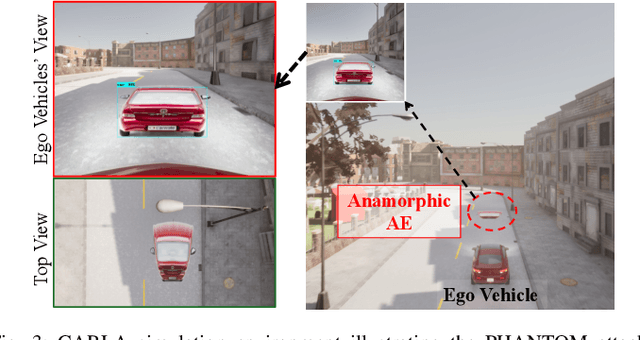
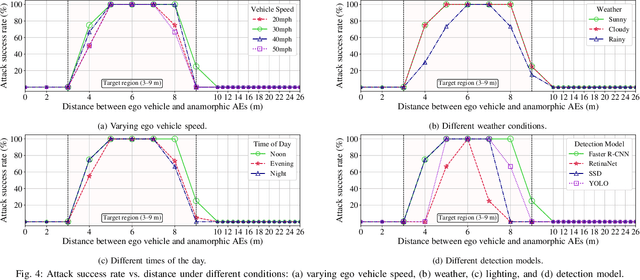
Connected autonomous vehicles (CAVs) rely on vision-based deep neural networks (DNNs) and low-latency (Vehicle-to-Everything) V2X communication to navigate safely and efficiently. Despite their advances, these systems remain vulnerable to physical adversarial attacks. In this paper, we introduce PHANTOM (PHysical ANamorphic Threats Obstructing connected vehicle Mobility), a novel framework for crafting and deploying perspective-dependent adversarial examples using \textit{anamorphic art}. PHANTOM exploits geometric distortions that appear natural to humans but are misclassified with high confidence by state-of-the-art object detectors. Unlike conventional attacks, PHANTOM operates in black-box settings without model access and demonstrates strong transferability across four diverse detector architectures (YOLOv5, SSD, Faster R-CNN, and RetinaNet). Comprehensive evaluation in CARLA across varying speeds, weather conditions, and lighting scenarios shows that PHANTOM achieves over 90\% attack success rate under optimal conditions and maintains 60-80\% effectiveness even in degraded environments. The attack activates within 6-10 meters of the target, providing insufficient time for safe maneuvering. Beyond individual vehicle deception, PHANTOM triggers network-wide disruption in CAV systems: SUMO-OMNeT++ co-simulation demonstrates that false emergency messages propagate through V2X links, increasing Peak Age of Information by 68-89\% and degrading safety-critical communication. These findings expose critical vulnerabilities in both perception and communication layers of CAV ecosystems.
Visual Heading Prediction for Autonomous Aerial Vehicles
Dec 10, 2025The integration of Unmanned Aerial Vehicles (UAVs) and Unmanned Ground Vehicles (UGVs) is increasingly central to the development of intelligent autonomous systems for applications such as search and rescue, environmental monitoring, and logistics. However, precise coordination between these platforms in real-time scenarios presents major challenges, particularly when external localization infrastructure such as GPS or GNSS is unavailable or degraded [1]. This paper proposes a vision-based, data-driven framework for real-time UAV-UGV integration, with a focus on robust UGV detection and heading angle prediction for navigation and coordination. The system employs a fine-tuned YOLOv5 model to detect UGVs and extract bounding box features, which are then used by a lightweight artificial neural network (ANN) to estimate the UAV's required heading angle. A VICON motion capture system was used to generate ground-truth data during training, resulting in a dataset of over 13,000 annotated images collected in a controlled lab environment. The trained ANN achieves a mean absolute error of 0.1506° and a root mean squared error of 0.1957°, offering accurate heading angle predictions using only monocular camera inputs. Experimental evaluations achieve 95% accuracy in UGV detection. This work contributes a vision-based, infrastructure- independent solution that demonstrates strong potential for deployment in GPS/GNSS-denied environments, supporting reliable multi-agent coordination under realistic dynamic conditions. A demonstration video showcasing the system's real-time performance, including UGV detection, heading angle prediction, and UAV alignment under dynamic conditions, is available at: https://github.com/Kooroshraf/UAV-UGV-Integration