 Add to Chrome
 Add to Firefox
 Add to Edge
Demand-Driven Vertiport Siting and Discrete-Event Fleet Simulation for On-Demand Urban Air Mobility Network Design
Aug 15, 2026
This paper presents a demand-driven framework for on-demand Urban Air Mobility (UAM) network design that links vertiport siting, fleet simulation, and door-to-door travel-time feasibility. Demand is estimated from commuter and passenger activity data, converted into spatial trip-end points, and clustered using K-means to generate candidate vertiport locations. Candidate networks are screened using range and minimum station-spacing constraints, then evaluated with a discrete-event simulation that models multi-vehicle dispatch, deadhead relocation, battery swaps, and service regularity. Flight time and energy consumption are computed using a point-mass eVTOL performance model. In a Greater Los Angeles case study, the preferred design expands from four stations and four eVTOLs at low demand to sixteen stations and twelve eVTOLs at the highest tested demand level. Results show that larger fleets improve completion time and vehicle-arrival regularity but do not eliminate deadhead flights, indicating that spatial demand imbalance remains an operational burden. The travel-time savings analysis further suggests that UAM is most defensible for longer or congestion-heavy trips where sufficient non-flight time remains after accounting for flight time.

Interpretable Fuzzy Inference for UAV Target Tracking Using Bounding-Box Geometry
Aug 04, 2026Vision-based guidance of unmanned aerial vehicles (UAVs) toward unmanned ground vehicles (UGVs) supports cooperative aerial--ground robotics, but reliable continuous yaw estimation from onboard vision remains challenging because of sensing uncertainty, limited computation, and the need for interpretable control. Existing deep-learning and geometric-reconstruction approaches often require large datasets, external localization, or complex modeling assumptions, reducing transparency and deployment suitability on resource-constrained platforms. We present an interpretable fuzzy-inference framework that generates continuous yaw commands from low-dimensional features extracted from YOLO boxes: target centroid location, area, and aspect ratio. No explicit geometric modeling is required. A Mamdani fuzzy system serves as an interpretable baseline using a shoulder--triangle--shoulder input partition. It is followed by a first-order Takagi--Sugeno model with three antecedent membership terms per input, whose parameters are derived from training-set quantiles, yielding a compact 27-rule structure. Evaluation uses 6{,}169 labeled samples from a VICON motion-capture environment. Across five randomized train--test splits, the Takagi--Sugeno model achieves a test-set mean absolute error of $0.140^\circ \pm 0.003^\circ$, a root mean squared error of $0.200^\circ \pm 0.008^\circ$, and a maximum absolute error of $1.254^\circ \pm 0.121^\circ$. Within-threshold accuracies are $99.676% \pm 0.270%$ for $\pm1^\circ$ and $100.000% \pm 0.000%$ for both $\pm3^\circ$ and $\pm5^\circ$. Directional consistency between image-plane horizontal displacement and predicted yaw sign reaches $90.254% \pm 0.612%$. These results show that the framework is transparent, data-efficient, computationally lightweight, and suitable for real-time vision-based UAV guidance toward mobile ground targets.
Confidence-Gated Vision-Only Heading Alignment for UAV-UGV Cooperative Systems
Jul 21, 2026Vision-based heading prediction is useful for UAV--UGV cooperation, but accurate prediction alone does not guarantee that every predicted heading should be issued directly as a control command. This paper investigates the decision problem of when and how a fixed vision-based heading predictor should be trusted for command issuance. A lightweight confidence-gated framework is proposed in which execution decisions are made using two interpretable reliability proxies derived from the perception stream: bounding-box area as a visibility-related proxy and short-window variation in predicted heading as a stability-related proxy. During low-confidence intervals, the framework compares the baseline freeze-HOLD policy with a bounded-blend fallback that updates the issued command conservatively. The method is evaluated on a real UAV--UGV dataset under clean and perturbed conditions. The results show that confidence gating creates a clear trade-off among execution rate, executed-frame accuracy, issued-command accuracy, and smoothness. The results further show that sparse execution can cause severe stale-command error under the baseline freeze-HOLD policy, whereas the bounded-blend fallback substantially improves command-level behavior under the same gate decisions. These findings highlight that reliable perception-driven autonomy depends not only on prediction accuracy, but also on decision-aware command issuance during low-confidence
Visual Heading Prediction for Autonomous Aerial Vehicles
Dec 10, 2025The integration of Unmanned Aerial Vehicles (UAVs) and Unmanned Ground Vehicles (UGVs) is increasingly central to the development of intelligent autonomous systems for applications such as search and rescue, environmental monitoring, and logistics. However, precise coordination between these platforms in real-time scenarios presents major challenges, particularly when external localization infrastructure such as GPS or GNSS is unavailable or degraded [1]. This paper proposes a vision-based, data-driven framework for real-time UAV-UGV integration, with a focus on robust UGV detection and heading angle prediction for navigation and coordination. The system employs a fine-tuned YOLOv5 model to detect UGVs and extract bounding box features, which are then used by a lightweight artificial neural network (ANN) to estimate the UAV's required heading angle. A VICON motion capture system was used to generate ground-truth data during training, resulting in a dataset of over 13,000 annotated images collected in a controlled lab environment. The trained ANN achieves a mean absolute error of 0.1506° and a root mean squared error of 0.1957°, offering accurate heading angle predictions using only monocular camera inputs. Experimental evaluations achieve 95% accuracy in UGV detection. This work contributes a vision-based, infrastructure- independent solution that demonstrates strong potential for deployment in GPS/GNSS-denied environments, supporting reliable multi-agent coordination under realistic dynamic conditions. A demonstration video showcasing the system's real-time performance, including UGV detection, heading angle prediction, and UAV alignment under dynamic conditions, is available at: https://github.com/Kooroshraf/UAV-UGV-Integration
Volatility in Certainty (VC): A Metric for Detecting Adversarial Perturbations During Inference in Neural Network Classifiers
Nov 14, 2025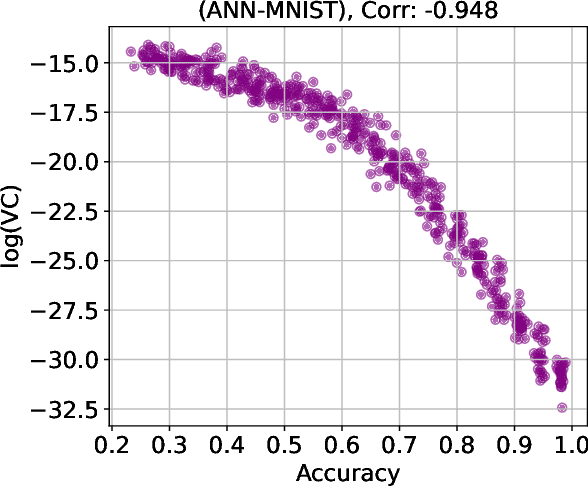
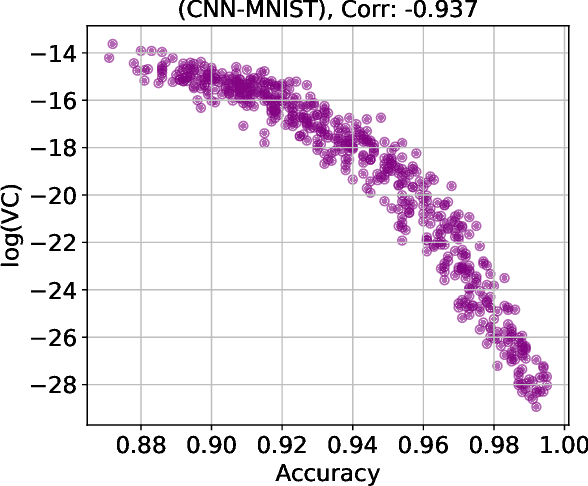
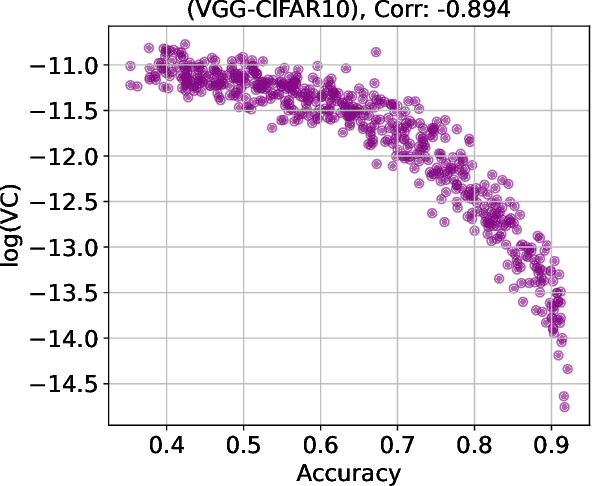
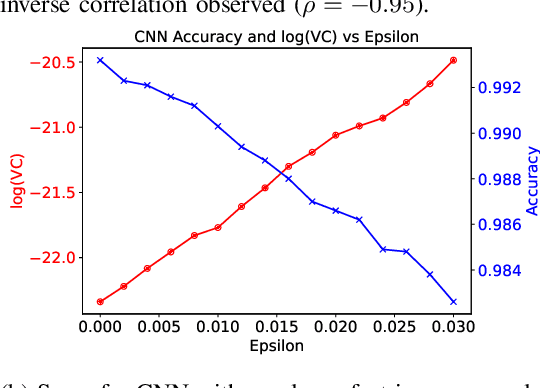
Adversarial robustness remains a critical challenge in deploying neural network classifiers, particularly in real-time systems where ground-truth labels are unavailable during inference. This paper investigates \textit{Volatility in Certainty} (VC), a recently proposed, label-free metric that quantifies irregularities in model confidence by measuring the dispersion of sorted softmax outputs. Specifically, VC is defined as the average squared log-ratio of adjacent certainty values, capturing local fluctuations in model output smoothness. We evaluate VC as a proxy for classification accuracy and as an indicator of adversarial drift. Experiments are conducted on artificial neural networks (ANNs) and convolutional neural networks (CNNs) trained on MNIST, as well as a regularized VGG-like model trained on CIFAR-10. Adversarial examples are generated using the Fast Gradient Sign Method (FGSM) across varying perturbation magnitudes. In addition, mixed test sets are created by gradually introducing adversarial contamination to assess VC's sensitivity under incremental distribution shifts. Our results reveal a strong negative correlation between classification accuracy and log(VC) (correlation rho < -0.90 in most cases), suggesting that VC effectively reflects performance degradation without requiring labeled data. These findings position VC as a scalable, architecture-agnostic, and real-time performance metric suitable for early-warning systems in safety-critical applications.