 Add to Chrome
 Add to Firefox
 Add to Edge
Visual Heading Prediction for Autonomous Aerial Vehicles
Dec 10, 2025
The integration of Unmanned Aerial Vehicles (UAVs) and Unmanned Ground Vehicles (UGVs) is increasingly central to the development of intelligent autonomous systems for applications such as search and rescue, environmental monitoring, and logistics. However, precise coordination between these platforms in real-time scenarios presents major challenges, particularly when external localization infrastructure such as GPS or GNSS is unavailable or degraded [1]. This paper proposes a vision-based, data-driven framework for real-time UAV-UGV integration, with a focus on robust UGV detection and heading angle prediction for navigation and coordination. The system employs a fine-tuned YOLOv5 model to detect UGVs and extract bounding box features, which are then used by a lightweight artificial neural network (ANN) to estimate the UAV's required heading angle. A VICON motion capture system was used to generate ground-truth data during training, resulting in a dataset of over 13,000 annotated images collected in a controlled lab environment. The trained ANN achieves a mean absolute error of 0.1506° and a root mean squared error of 0.1957°, offering accurate heading angle predictions using only monocular camera inputs. Experimental evaluations achieve 95% accuracy in UGV detection. This work contributes a vision-based, infrastructure- independent solution that demonstrates strong potential for deployment in GPS/GNSS-denied environments, supporting reliable multi-agent coordination under realistic dynamic conditions. A demonstration video showcasing the system's real-time performance, including UGV detection, heading angle prediction, and UAV alignment under dynamic conditions, is available at: https://github.com/Kooroshraf/UAV-UGV-Integration

Volatility in Certainty (VC): A Metric for Detecting Adversarial Perturbations During Inference in Neural Network Classifiers
Nov 14, 2025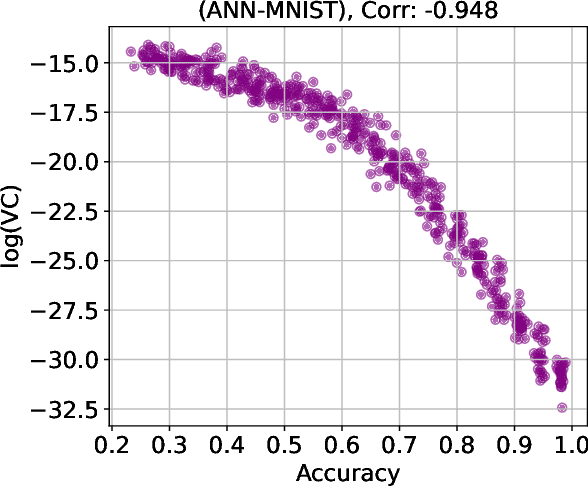
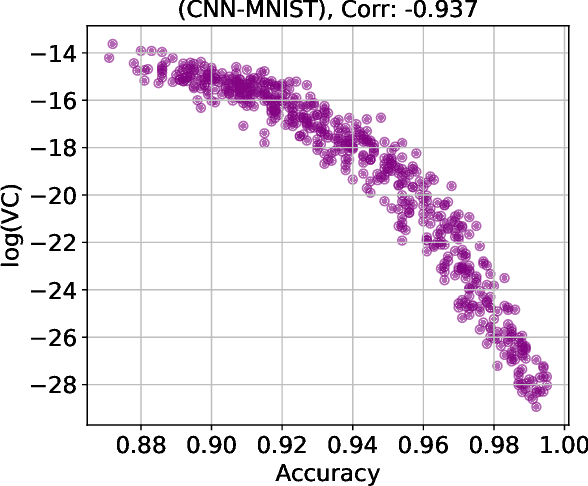
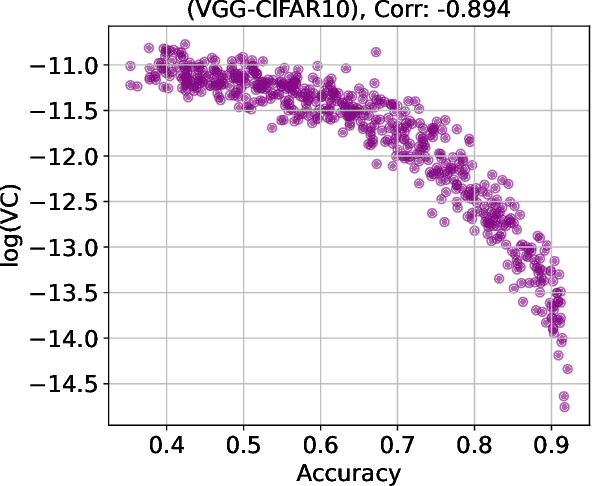
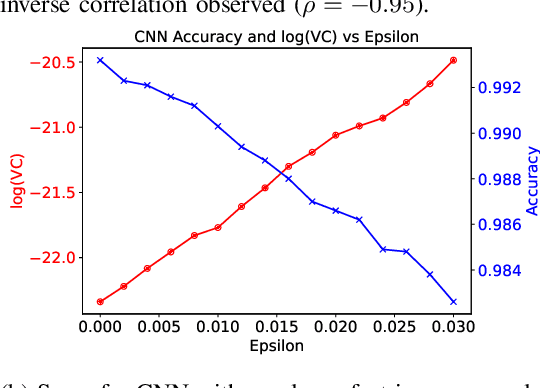
Adversarial robustness remains a critical challenge in deploying neural network classifiers, particularly in real-time systems where ground-truth labels are unavailable during inference. This paper investigates \textit{Volatility in Certainty} (VC), a recently proposed, label-free metric that quantifies irregularities in model confidence by measuring the dispersion of sorted softmax outputs. Specifically, VC is defined as the average squared log-ratio of adjacent certainty values, capturing local fluctuations in model output smoothness. We evaluate VC as a proxy for classification accuracy and as an indicator of adversarial drift. Experiments are conducted on artificial neural networks (ANNs) and convolutional neural networks (CNNs) trained on MNIST, as well as a regularized VGG-like model trained on CIFAR-10. Adversarial examples are generated using the Fast Gradient Sign Method (FGSM) across varying perturbation magnitudes. In addition, mixed test sets are created by gradually introducing adversarial contamination to assess VC's sensitivity under incremental distribution shifts. Our results reveal a strong negative correlation between classification accuracy and log(VC) (correlation rho < -0.90 in most cases), suggesting that VC effectively reflects performance degradation without requiring labeled data. These findings position VC as a scalable, architecture-agnostic, and real-time performance metric suitable for early-warning systems in safety-critical applications.