 Add to Chrome
 Add to Firefox
 Add to Edge
Transolver
Papers and Code
Transolver-3: Scaling Up Transformer Solvers to Industrial-Scale Geometries
Feb 04, 2026
Deep learning has emerged as a transformative tool for the neural surrogate modeling of partial differential equations (PDEs), known as neural PDE solvers. However, scaling these solvers to industrial-scale geometries with over $10^8$ cells remains a fundamental challenge due to the prohibitive memory complexity of processing high-resolution meshes. We present Transolver-3, a new member of the Transolver family as a highly scalable framework designed for high-fidelity physics simulations. To bridge the gap between limited GPU capacity and the resolution requirements of complex engineering tasks, we introduce two key architectural optimizations: faster slice and deslice by exploiting matrix multiplication associative property and geometry slice tiling to partition the computation of physical states. Combined with an amortized training strategy by learning on random subsets of original high-resolution meshes and a physical state caching technique during inference, Transolver-3 enables high-fidelity field prediction on industrial-scale meshes. Extensive experiments demonstrate that Transolver-3 is capable of handling meshes with over 160 million cells, achieving impressive performance across three challenging simulation benchmarks, including aircraft and automotive design tasks.

GeoTransolver: Learning Physics on Irregular Domains Using Multi-scale Geometry Aware Physics Attention Transformer
Dec 24, 2025We present GeoTransolver, a Multiscale Geometry-Aware Physics Attention Transformer for CAE that replaces standard attention with GALE, coupling physics-aware self-attention on learned state slices with cross-attention to a shared geometry/global/boundary-condition context computed from multi-scale ball queries (inspired by DoMINO) and reused in every block. Implemented and released in NVIDIA PhysicsNeMo, GeoTransolver persistently projects geometry, global and boundary condition parameters into physical state spaces to anchor latent computations to domain structure and operating regimes. We benchmark GeoTransolver on DrivAerML, Luminary SHIFT-SUV, and Luminary SHIFT-Wing, comparing against Domino, Transolver (as released in PhysicsNeMo), and literature-reported AB-UPT, and evaluate drag/lift R2 and Relative L1 errors for field variables. GeoTransolver delivers better accuracy, improved robustness to geometry/regime shifts, and favorable data efficiency; we include ablations on DrivAerML and qualitative results such as contour plots and design trends for the best GeoTransolver models. By unifying multiscale geometry-aware context with physics-based attention in a scalable transformer, GeoTransolver advances operator learning for high-fidelity surrogate modeling across complex, irregular domains and non-linear physical regimes.
Transolver is a Linear Transformer: Revisiting Physics-Attention through the Lens of Linear Attention
Nov 11, 2025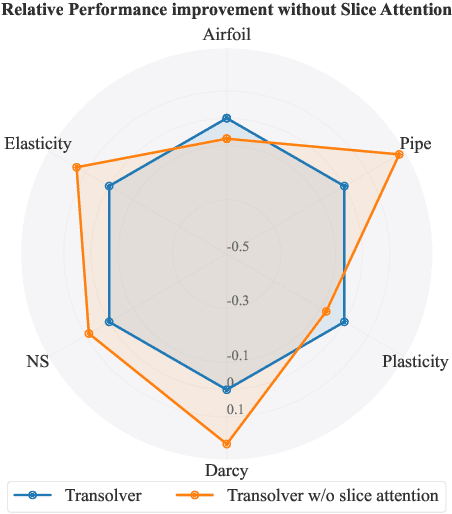
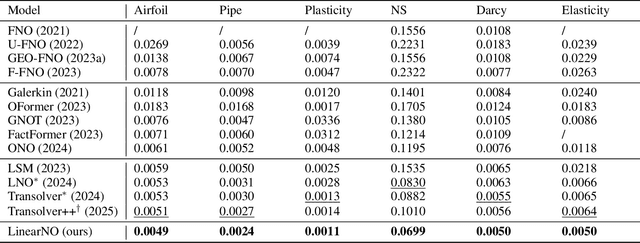
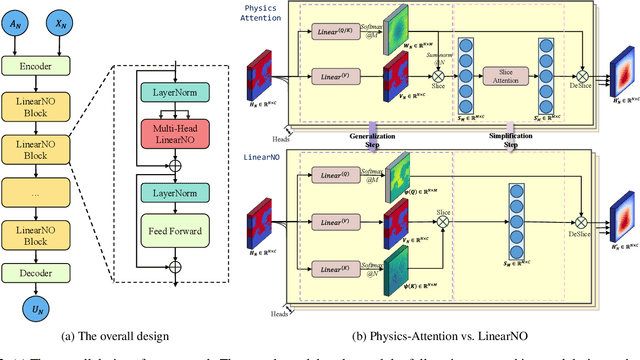
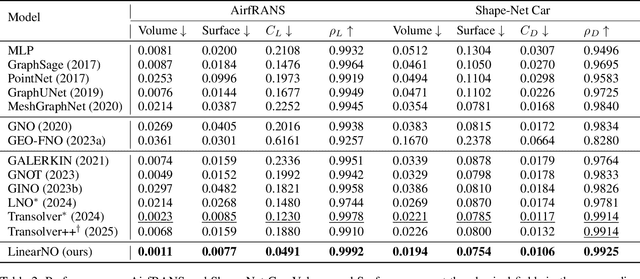
Recent advances in Transformer-based Neural Operators have enabled significant progress in data-driven solvers for Partial Differential Equations (PDEs). Most current research has focused on reducing the quadratic complexity of attention to address the resulting low training and inference efficiency. Among these works, Transolver stands out as a representative method that introduces Physics-Attention to reduce computational costs. Physics-Attention projects grid points into slices for slice attention, then maps them back through deslicing. However, we observe that Physics-Attention can be reformulated as a special case of linear attention, and that the slice attention may even hurt the model performance. Based on these observations, we argue that its effectiveness primarily arises from the slice and deslice operations rather than interactions between slices. Building on this insight, we propose a two-step transformation to redesign Physics-Attention into a canonical linear attention, which we call Linear Attention Neural Operator (LinearNO). Our method achieves state-of-the-art performance on six standard PDE benchmarks, while reducing the number of parameters by an average of 40.0% and computational cost by 36.2%. Additionally, it delivers superior performance on two challenging, industrial-level datasets: AirfRANS and Shape-Net Car.
Transolver++: An Accurate Neural Solver for PDEs on Million-Scale Geometries
Feb 04, 2025Although deep models have been widely explored in solving partial differential equations (PDEs), previous works are primarily limited to data only with up to tens of thousands of mesh points, far from the million-point scale required by industrial simulations that involve complex geometries. In the spirit of advancing neural PDE solvers to real industrial applications, we present Transolver++, a highly parallel and efficient neural solver that can accurately solve PDEs on million-scale geometries. Building upon previous advancements in solving PDEs by learning physical states via Transolver, Transolver++ is further equipped with an extremely optimized parallelism framework and a local adaptive mechanism to efficiently capture eidetic physical states from massive mesh points, successfully tackling the thorny challenges in computation and physics learning when scaling up input mesh size. Transolver++ increases the single-GPU input capacity to million-scale points for the first time and is capable of continuously scaling input size in linear complexity by increasing GPUs. Experimentally, Transolver++ yields 13% relative promotion across six standard PDE benchmarks and achieves over 20% performance gain in million-scale high-fidelity industrial simulations, whose sizes are 100$\times$ larger than previous benchmarks, covering car and 3D aircraft designs.
Transolver: A Fast Transformer Solver for PDEs on General Geometries
Feb 04, 2024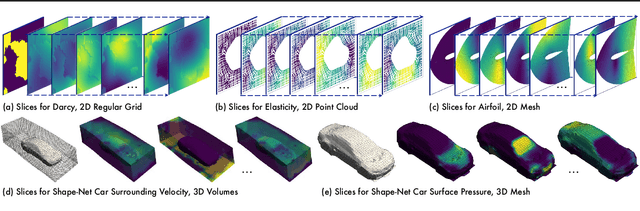
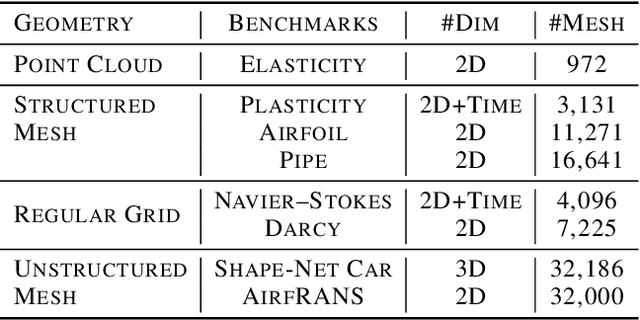
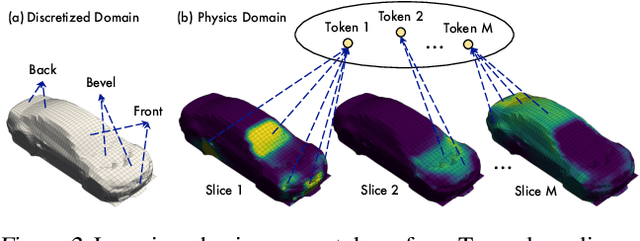
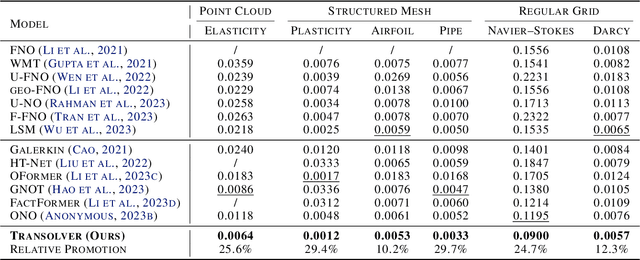
Transformers have empowered many milestones across various fields and have recently been applied to solve partial differential equations (PDEs). However, since PDEs are typically discretized into large-scale meshes with complex geometries, it is challenging for Transformers to capture intricate physical correlations directly from massive individual points. Going beyond superficial and unwieldy meshes, we present Transolver based on a more foundational idea, which is learning intrinsic physical states hidden behind discretized geometries. Specifically, we propose a new Physics-Attention to adaptively split the discretized domain into a series of learnable slices of flexible shapes, where mesh points under similar physical states will be ascribed to the same slice. By calculating attention to physics-aware tokens encoded from slices, Transovler can effectively capture intricate physical correlations under complex geometrics, which also empowers the solver with endogenetic geometry-general modeling capacity and can be efficiently computed in linear complexity. Transolver achieves consistent state-of-the-art with 22\% relative gain across six standard benchmarks and also excels in large-scale industrial simulations, including car and airfoil designs.