 Add to Chrome
 Add to Firefox
 Add to Edge
Subdomain Adaptation
Papers and Code
Following the Teacher's Footsteps: Scheduled Checkpoint Distillation for Domain-Specific LLMs
Jan 15, 2026
Large language models (LLMs) are challenging to deploy for domain-specific tasks due to their massive scale. While distilling a fine-tuned LLM into a smaller student model is a promising alternative, the capacity gap between teacher and student often leads to suboptimal performance. This raises a key question: when and how can a student model match or even surpass its teacher on domain-specific tasks? In this work, we propose a novel theoretical insight: a student can outperform its teacher if its advantage on a Student-Favored Subdomain (SFS) outweighs its deficit on the Teacher-Favored Subdomain (TFS). Guided by this insight, we propose Scheduled Checkpoint Distillation (SCD), which reduces the TFS deficit by emulating the teacher's convergence process during supervised fine-tuning (SFT) on the domain task, and a sample-wise Adaptive Weighting (AW) mechanism to preserve student strengths on SFS. Experiments across diverse domain tasks--including QA, NER, and text classification in multiple languages--show that our method consistently outperforms existing distillation approaches, allowing the student model to match or even exceed the performance of its fine-tuned teacher.

Domain Adaptation in Structural Health Monitoring of Civil Infrastructure: A Systematic Review
Dec 21, 2025This study provides a comprehensive review of domain adaptation (DA) techniques in vibration-based structural health monitoring (SHM). As data-driven models increasingly support the assessment of civil structures, the persistent challenge of transferring knowledge across varying geometries, materials, and environmental conditions remains a major obstacle. DA offers a systematic approach to mitigate these discrepancies by aligning feature distributions between simulated, laboratory, and field domains while preserving the sensitivity of damage-related information. Drawing on more than sixty representative studies, this paper analyzes the evolution of DA methods for SHM, including statistical alignment, adversarial and subdomain learning, physics-informed adaptation, and generative modeling for simulation-to-real transfer. The review summarizes their contributions and limitations across bridge and building applications, revealing that while DA has improved generalization significantly, key challenges persist: managing domain discrepancy, addressing data scarcity, enhancing model interpretability, and enabling adaptability to multiple sources and time-varying conditions. Future research directions emphasize integrating physical constraints into learning objectives, developing physics-consistent generative frameworks to enhance data realism, establishing interpretable and certifiable DA systems for engineering practice, and advancing multi-source and lifelong adaptation for scalable monitoring. Overall, this review consolidates the methodological foundation of DA for SHM, identifies existing barriers to generalization and trust, and outlines the technological trajectory toward transparent, physics-aware, and adaptive monitoring systems that support the long-term resilience of civil infrastructure.
SS-DC: Spatial-Spectral Decoupling and Coupling Across Visible-Infrared Gap for Domain Adaptive Object Detection
Jul 16, 2025Unsupervised domain adaptive object detection (UDAOD) from the visible domain to the infrared (RGB-IR) domain is challenging. Existing methods regard the RGB domain as a unified domain and neglect the multiple subdomains within it, such as daytime, nighttime, and foggy scenes. We argue that decoupling the domain-invariant (DI) and domain-specific (DS) features across these multiple subdomains is beneficial for RGB-IR domain adaptation. To this end, this paper proposes a new SS-DC framework based on a decoupling-coupling strategy. In terms of decoupling, we design a Spectral Adaptive Idempotent Decoupling (SAID) module in the aspect of spectral decomposition. Due to the style and content information being highly embedded in different frequency bands, this module can decouple DI and DS components more accurately and interpretably. A novel filter bank-based spectral processing paradigm and a self-distillation-driven decoupling loss are proposed to improve the spectral domain decoupling. In terms of coupling, a new spatial-spectral coupling method is proposed, which realizes joint coupling through spatial and spectral DI feature pyramids. Meanwhile, this paper introduces DS from decoupling to reduce the domain bias. Extensive experiments demonstrate that our method can significantly improve the baseline performance and outperform existing UDAOD methods on multiple RGB-IR datasets, including a new experimental protocol proposed in this paper based on the FLIR-ADAS dataset.
Accelerating Multiscale Modeling with Hybrid Solvers: Coupling FEM and Neural Operators with Domain Decomposition
Apr 16, 2025Numerical solvers for partial differential equations (PDEs) face challenges balancing computational cost and accuracy, especially in multiscale and dynamic systems. Neural operators can significantly speed up simulations; however, they often face challenges such as error accumulation and limited generalization in multiphysics problems. This work introduces a novel hybrid framework that integrates physics-informed DeepONet with FEM through domain decomposition. The core innovation lies in adaptively coupling FEM and DeepONet subdomains via a Schwarz alternating method. This methodology strategically allocates computationally demanding regions to a pre-trained Deep Operator Network, while the remaining computational domain is solved through FEM. To address dynamic systems, we integrate the Newmark time-stepping scheme directly into the DeepONet, significantly mitigating error accumulation in long-term simulations. Furthermore, an adaptive subdomain evolution enables the ML-resolved region to expand dynamically, capturing emerging fine-scale features without remeshing. The framework's efficacy has been validated across a range of solid mechanics problems, including static, quasi-static, and dynamic regimes, demonstrating accelerated convergence rates (up to 20% improvement compared to FE-FE approaches), while preserving solution fidelity with error < 1%. Our case studies show that our proposed hybrid solver: (1) maintains solution continuity across subdomain interfaces, (2) reduces computational costs by eliminating fine mesh requirements, (3) mitigates error accumulation in time-dependent simulations, and (4) enables automatic adaptation to evolving physical phenomena. This work bridges the gap between numerical methods and AI-driven surrogates, offering a scalable pathway for high-fidelity simulations in engineering and scientific applications.
Robust LLM Fingerprinting via Domain-Specific Watermarks
May 22, 2025As open-source language models (OSMs) grow more capable and are widely shared and finetuned, ensuring model provenance, i.e., identifying the origin of a given model instance, has become an increasingly important issue. At the same time, existing backdoor-based model fingerprinting techniques often fall short of achieving key requirements of real-world model ownership detection. In this work, we build on the observation that while current open-source model watermarks fail to achieve reliable content traceability, they can be effectively adapted to address the challenge of model provenance. To this end, we introduce the concept of domain-specific watermarking for model fingerprinting. Rather than watermarking all generated content, we train the model to embed watermarks only within specified subdomains (e.g., particular languages or topics). This targeted approach ensures detection reliability, while improving watermark durability and quality under a range of real-world deployment settings. Our evaluations show that domain-specific watermarking enables model fingerprinting with strong statistical guarantees, controllable false positive rates, high detection power, and preserved generation quality. Moreover, we find that our fingerprints are inherently stealthy and naturally robust to real-world variability across deployment scenarios.
Knowledge Distillation and Enhanced Subdomain Adaptation Using Graph Convolutional Network for Resource-Constrained Bearing Fault Diagnosis
Jan 13, 2025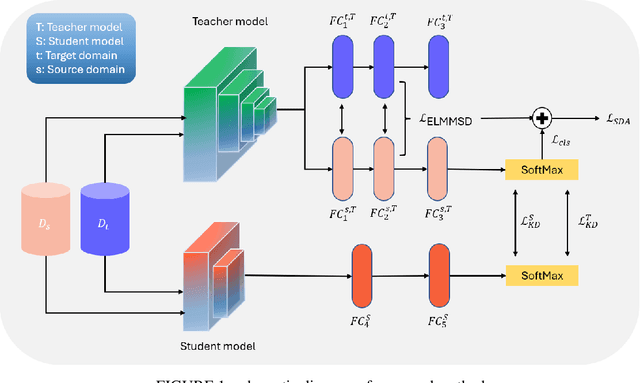
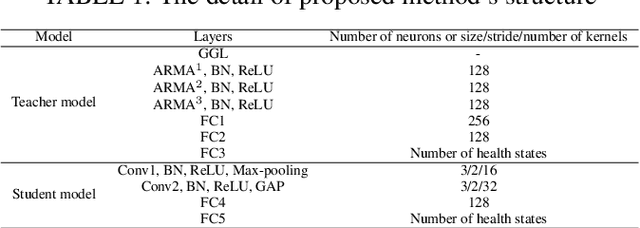

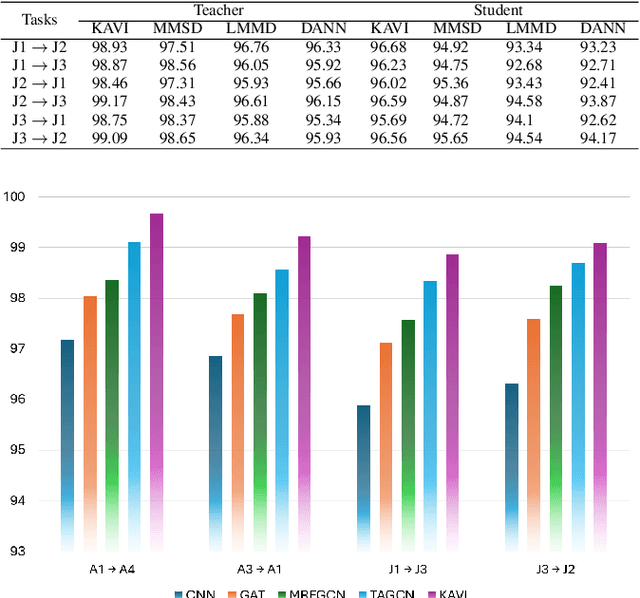
Bearing fault diagnosis under varying working conditions faces challenges, including a lack of labeled data, distribution discrepancies, and resource constraints. To address these issues, we propose a progressive knowledge distillation framework that transfers knowledge from a complex teacher model, utilizing a Graph Convolutional Network (GCN) with Autoregressive moving average (ARMA) filters, to a compact and efficient student model. To mitigate distribution discrepancies and labeling uncertainty, we introduce Enhanced Local Maximum Mean Squared Discrepancy (ELMMSD), which leverages mean and variance statistics in the Reproducing Kernel Hilbert Space (RKHS) and incorporates a priori probability distributions between labels. This approach increases the distance between clustering centers, bridges subdomain gaps, and enhances subdomain alignment reliability. Experimental results on benchmark datasets (CWRU and JNU) demonstrate that the proposed method achieves superior diagnostic accuracy while significantly reducing computational costs. Comprehensive ablation studies validate the effectiveness of each component, highlighting the robustness and adaptability of the approach across diverse working conditions.
Subset Selection for Fine-Tuning: A Utility-Diversity Balanced Approach for Mathematical Domain Adaptation
May 02, 2025
We propose a refined approach to efficiently fine-tune large language models (LLMs) on specific domains like the mathematical domain by employing a budgeted subset selection method. Our approach combines utility and diversity metrics to select the most informative and representative training examples. The final goal is to achieve near-full dataset performance with meticulously selected data points from the entire dataset while significantly reducing computational cost and training time and achieving competitive performance as the full dataset. The utility metric incorporates both perplexity and Chain-of-Thought (CoT) loss to identify challenging examples that contribute most to model learning, while the diversity metric ensures broad coverage across mathematical subdomains. We evaluate our method on LLaMA-3 8B and Phi-3 models, comparing against several baseline approaches, including random selection, diversity-based sampling, and existing state-of-the-art subset selection techniques.
A Multiple Transferable Neural Network Method with Domain Decomposition for Elliptic Interface Problems
Feb 27, 2025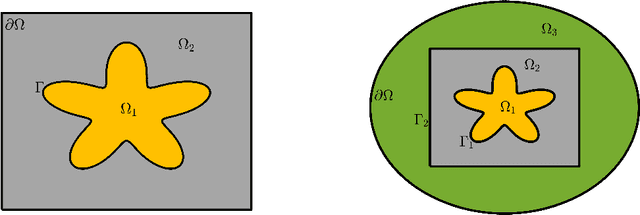
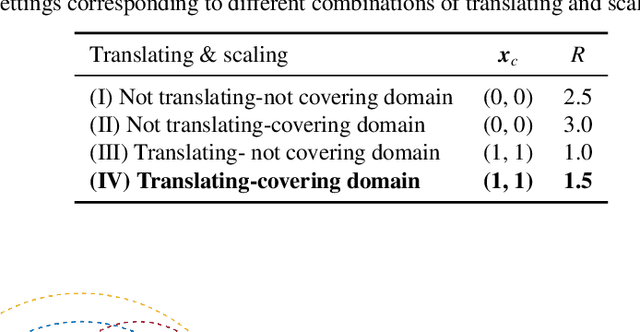
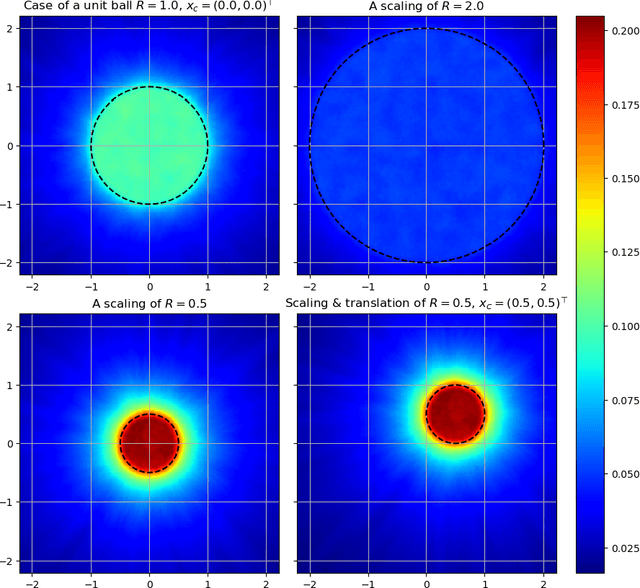
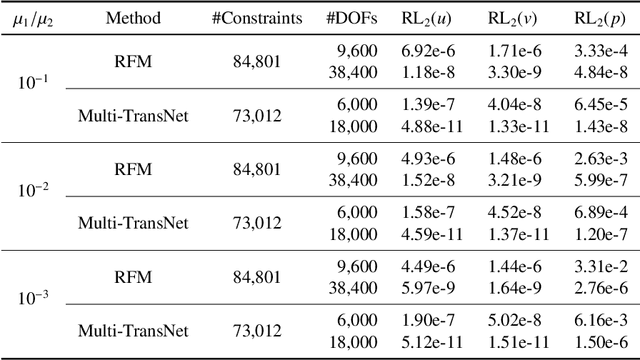
The transferable neural network (TransNet) is a two-layer shallow neural network with pre-determined and uniformly distributed neurons in the hidden layer, and the least-squares solvers can be particularly used to compute the parameters of its output layer when applied to the solution of partial differential equations. In this paper, we integrate the TransNet technique with the nonoverlapping domain decomposition and the interface conditions to develop a novel multiple transferable neural network (Multi-TransNet) method for solving elliptic interface problems, which typically contain discontinuities in both solutions and their derivatives across interfaces. We first propose an empirical formula for the TransNet to characterize the relationship between the radius of the domain-covering ball, the number of hidden-layer neurons, and the optimal neuron shape. In the Multi-TransNet method, we assign each subdomain one distinct TransNet with an adaptively determined number of hidden-layer neurons to maintain the globally uniform neuron distribution across the entire computational domain, and then unite all the subdomain TransNets together by incorporating the interface condition terms into the loss function. The empirical formula is also extended to the Multi-TransNet and further employed to estimate appropriate neuron shapes for the subdomain TransNets, greatly reducing the parameter tuning cost. Additionally, we propose a normalization approach to adaptively select the weighting parameters for the terms in the loss function. Ablation studies and extensive experiments with comparison tests on different types of elliptic interface problems with low to high contrast diffusion coefficients in two and three dimensions are carried out to numerically demonstrate the superior accuracy, efficiency, and robustness of the proposed Multi-TransNet method.
Scalable Signature Kernel Computations for Long Time Series via Local Neumann Series Expansions
Feb 27, 2025The signature kernel is a recent state-of-the-art tool for analyzing high-dimensional sequential data, valued for its theoretical guarantees and strong empirical performance. In this paper, we present a novel method for efficiently computing the signature kernel of long, high-dimensional time series via dynamically truncated recursive local power series expansions. Building on the characterization of the signature kernel as the solution of a Goursat PDE, our approach employs tilewise Neumann-series expansions to derive rapidly converging power series approximations of the signature kernel that are locally defined on subdomains and propagated iteratively across the entire domain of the Goursat solution by exploiting the geometry of the time series. Algorithmically, this involves solving a system of interdependent local Goursat PDEs by recursively propagating boundary conditions along a directed graph via topological ordering, with dynamic truncation adaptively terminating each local power series expansion when coefficients fall below machine precision, striking an effective balance between computational cost and accuracy. This method achieves substantial performance improvements over state-of-the-art approaches for computing the signature kernel, providing (a) adjustable and superior accuracy, even for time series with very high roughness; (b) drastically reduced memory requirements; and (c) scalability to efficiently handle very long time series (e.g., with up to half a million points or more) on a single GPU. These advantages make our method particularly well-suited for rough-path-assisted machine learning, financial modeling, and signal processing applications that involve very long and highly volatile data.
IQA-Adapter: Exploring Knowledge Transfer from Image Quality Assessment to Diffusion-based Generative Models
Dec 02, 2024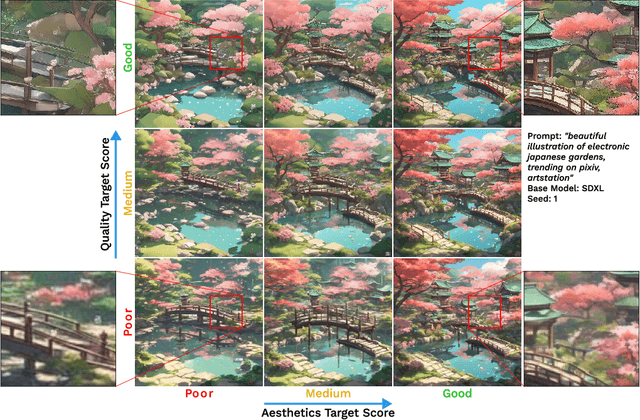

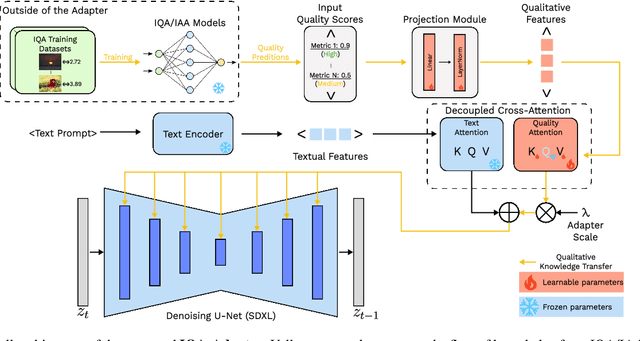

Diffusion-based models have recently transformed conditional image generation, achieving unprecedented fidelity in generating photorealistic and semantically accurate images. However, consistently generating high-quality images remains challenging, partly due to the lack of mechanisms for conditioning outputs on perceptual quality. In this work, we propose methods to integrate image quality assessment (IQA) models into diffusion-based generators, enabling quality-aware image generation. First, we experiment with gradient-based guidance to optimize image quality directly and show this approach has limited generalizability. To address this, we introduce IQA-Adapter, a novel architecture that conditions generation on target quality levels by learning the relationship between images and quality scores. When conditioned on high target quality, IQA-Adapter shifts the distribution of generated images towards a higher-quality subdomain. This approach achieves up to a 10% improvement across multiple objective metrics, as confirmed by a subjective study, while preserving generative diversity and content. Additionally, IQA-Adapter can be used inversely as a degradation model, generating progressively more distorted images when conditioned on lower quality scores. Our quality-aware methods also provide insights into the adversarial robustness of IQA models, underscoring the potential of quality conditioning in generative modeling and the importance of robust IQA methods.