 Add to Chrome
 Add to Firefox
 Add to Edge
Fourier Neural Operator For Parametric Partial Differential Equations
Papers and Code
Performance of Neural and Polynomial Operator Surrogates
Apr 01, 2026
We consider the problem of constructing surrogate operators for parameter-to-solution maps arising from parametric partial differential equations, where repeated forward model evaluations are computationally expensive. We present a systematic empirical comparison of neural operator surrogates, including a reduced-basis neural operator trained with $L^2_μ$ and $H^1_μ$ objectives and the Fourier neural operator, against polynomial surrogate methods, specifically a reduced-basis sparse-grid surrogate and a reduced-basis tensor-train surrogate. All methods are evaluated on a linear parametric diffusion problem and a nonlinear parametric hyperelasticity problem, using input fields with algebraically decaying spectral coefficients at varying rates of decay $s$. To enable fair comparisons, we analyze ensembles of surrogate models generated by varying hyperparameters and compare the resulting Pareto frontiers of cost versus approximation accuracy, decomposing cost into contributions from data generation, setup, and evaluation. Our results show that no single method is universally superior. Polynomial surrogates achieve substantially better data efficiency for smooth input fields ($s \geq 2$), with convergence rates for the sparse-grid surrogate in agreement with theoretical predictions. For rough inputs ($s \leq 1$), the Fourier neural operator displays the fastest convergence rates. Derivative-informed training consistently improves data efficiency over standard $L^2_μ$ training, providing a competitive alternative for rough inputs in the low-data regime when Jacobian information is available at reasonable cost. These findings highlight the importance of matching the surrogate methodology to the regularity of the problem as well as accuracy demands and computational constraints of the application.

Physics-informed neural operator for predictive parametric phase-field modelling
Mar 10, 2026Predicting the microstructural and morphological evolution of materials through phase-field modelling is computationally intensive, particularly for high-throughput parametric studies. While neural operators such as the Fourier neural operator (FNO) show promise in accelerating the solution of parametric partial differential equations (PDEs), the lack of explicit physical constraints, may limit generalisation and long-term accuracy for complex phase-field dynamics. Here, we develop a physics-informed neural operator framework to learn parametric phase-field PDEs, namely PF-PINO. By embedding the residuals of phase-field governing equations into the data-fidelity loss function, our framework effectively enforces physical constraints during training. We validate PF-PINO against benchmark phase-field problems, including electrochemical corrosion, dendritic crystal solidification, and spinodal decomposition. Our results demonstrate that PF-PINO significantly outperforms conventional FNO in accuracy, generalisation capability, and long-term stability. This work provides a robust and efficient computational tool for phase-field modelling and highlights the potential of physics-informed neural operators to advance scientific machine learning for complex interfacial evolution problems.
Tackling multiphysics problems via finite element-guided physics-informed operator learning
Mar 02, 2026This work presents a finite element-guided physics-informed operator learning framework for multiphysics problems with coupled partial differential equations (PDEs) on arbitrary domains. Implemented with Folax, a JAX-based operator-learning platform, the proposed framework learns a mapping from the input parameter space to the solution space with a weighted residual formulation based on the finite element method, enabling discretization-independent prediction beyond the training resolution without relying on labaled simulation data. The present framework for multiphysics problems is verified on nonlinear thermo-mechanical problems. Two- and three-dimensional representative volume elements with varying heterogeneous microstructures, and a close-to-reality industrial casting example under varying boundary conditions are investigated as the example problems. We investigate the potential of several neural operator backbones, including Fourier neural operators (FNOs), deep operator networks (DeepONets), and a newly proposed implicit finite operator learning (iFOL) approach based on conditional neural fields. The results demonstrate that FNOs yield highly accurate solution operators on regular domains, where the global topology can be efficiently learned in the spectral domain, and iFOL offers efficient parametric operator learning capabilities for complex and irregular geometries. Furthermore, studies on training strategies, network decomposition, and training sample quality reveal that a monolithic training strategy using a single network is sufficient for accurate predictions, while training sample quality strongly influences performance. Overall, the present approach highlights the potential of physics-informed operator learning with a finite element-based loss as a unified and scalable approach for coupled multiphysics simulations.
Physics-Informed Laplace Neural Operator for Solving Partial Differential Equations
Feb 13, 2026Neural operators have emerged as fast surrogate solvers for parametric partial differential equations (PDEs). However, purely data-driven models often require extensive training data and can generalize poorly, especially in small-data regimes and under unseen (out-of-distribution) input functions that are not represented in the training data. To address these limitations, we propose the Physics-Informed Laplace Neural Operator (PILNO), which enhances the Laplace Neural Operator (LNO) by embedding governing physics into training through PDE, boundary condition, and initial condition residuals. To improve expressivity, we first introduce an Advanced LNO (ALNO) backbone that retains a pole-residue transient representation while replacing the steady-state branch with an FNO-style Fourier multiplier. To make physics-informed training both data-efficient and robust, PILNO further leverages (i) virtual inputs: an unlabeled ensemble of input functions spanning a broad spectral range that provides abundant physics-only supervision and explicitly targets out-of-distribution (OOD) regimes; and (ii) temporal-causality weighting: a time-decaying reweighting of the physics residual that prioritizes early-time dynamics and stabilizes optimization for time-dependent PDEs. Across four representative benchmarks -- Burgers' equation, Darcy flow, a reaction-diffusion system, and a forced KdV equation -- PILNO consistently improves accuracy in small-data settings (e.g., N_train <= 27), reduces run-to-run variability across random seeds, and achieves stronger OOD generalization than purely data-driven baselines.
Discontinuous Galerkin finite element operator network for solving non-smooth PDEs
Jan 07, 2026We introduce Discontinuous Galerkin Finite Element Operator Network (DG--FEONet), a data-free operator learning framework that combines the strengths of the discontinuous Galerkin (DG) method with neural networks to solve parametric partial differential equations (PDEs) with discontinuous coefficients and non-smooth solutions. Unlike traditional operator learning models such as DeepONet and Fourier Neural Operator, which require large paired datasets and often struggle near sharp features, our approach minimizes the residual of a DG-based weak formulation using the Symmetric Interior Penalty Galerkin (SIPG) scheme. DG-FEONet predicts element-wise solution coefficients via a neural network, enabling data-free training without the need for precomputed input-output pairs. We provide theoretical justification through convergence analysis and validate the model's performance on a series of one- and two-dimensional PDE problems, demonstrating accurate recovery of discontinuities, strong generalization across parameter space, and reliable convergence rates. Our results highlight the potential of combining local discretization schemes with machine learning to achieve robust, singularity-aware operator approximation in challenging PDE settings.
CompNO: A Novel Foundation Model approach for solving Partial Differential Equations
Jan 12, 2026Partial differential equations (PDEs) govern a wide range of physical phenomena, but their numerical solution remains computationally demanding, especially when repeated simulations are required across many parameter settings. Recent Scientific Foundation Models (SFMs) aim to alleviate this cost by learning universal surrogates from large collections of simulated systems, yet they typically rely on monolithic architectures with limited interpretability and high pretraining expense. In this work we introduce Compositional Neural Operators (CompNO), a compositional neural operator framework for parametric PDEs. Instead of pretraining a single large model on heterogeneous data, CompNO first learns a library of Foundation Blocks, where each block is a parametric Fourier neural operator specialized to a fundamental differential operator (e.g. convection, diffusion, nonlinear convection). These blocks are then assembled, via lightweight Adaptation Blocks, into task-specific solvers that approximate the temporal evolution operator for target PDEs. A dedicated boundary-condition operator further enforces Dirichlet constraints exactly at inference time. We validate CompNO on one-dimensional convection, diffusion, convection--diffusion and Burgers' equations from the PDEBench suite. The proposed framework achieves lower relative L2 error than strong baselines (PFNO, PDEFormer and in-context learning based models) on linear parametric systems, while remaining competitive on nonlinear Burgers' flows. The model maintains exact boundary satisfaction with zero loss at domain boundaries, and exhibits robust generalization across a broad range of Peclet and Reynolds numbers. These results demonstrate that compositional neural operators provide a scalable and physically interpretable pathway towards foundation models for PDEs.
Intrinsic-Metric Physics-Informed Neural Networks (IM-PINN) for Reaction-Diffusion Dynamics on Complex Riemannian Manifolds
Jan 07, 2026Simulating nonlinear reaction-diffusion dynamics on complex, non-Euclidean manifolds remains a fundamental challenge in computational morphogenesis, constrained by high-fidelity mesh generation costs and symplectic drift in discrete time-stepping schemes. This study introduces the Intrinsic-Metric Physics-Informed Neural Network (IM-PINN), a mesh-free geometric deep learning framework that solves partial differential equations directly in the continuous parametric domain. By embedding the Riemannian metric tensor into the automatic differentiation graph, our architecture analytically reconstructs the Laplace-Beltrami operator, decoupling solution complexity from geometric discretization. We validate the framework on a "Stochastic Cloth" manifold with extreme Gaussian curvature fluctuations ($K \in [-2489, 3580]$), where traditional adaptive refinement fails to resolve anisotropic Turing instabilities. Using a dual-stream architecture with Fourier feature embeddings to mitigate spectral bias, the IM-PINN recovers the "splitting spot" and "labyrinthine" regimes of the Gray-Scott model. Benchmarking against the Surface Finite Element Method (SFEM) reveals superior physical rigor: the IM-PINN achieves global mass conservation error of $\mathcal{E}_{mass} \approx 0.157$ versus SFEM's $0.258$, acting as a thermodynamically consistent global solver that eliminates mass drift inherent in semi-implicit integration. The framework offers a memory-efficient, resolution-independent paradigm for simulating biological pattern formation on evolving surfaces, bridging differential geometry and physics-informed machine learning.
Light-Weight Diffusion Multiplier and Uncertainty Quantification for Fourier Neural Operators
Aug 01, 2025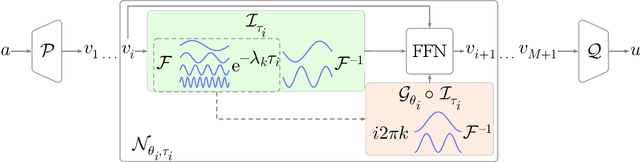
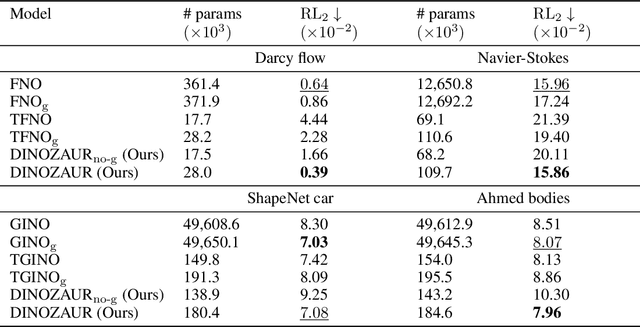
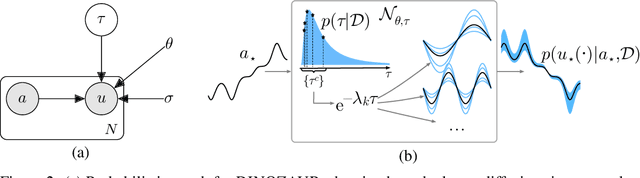
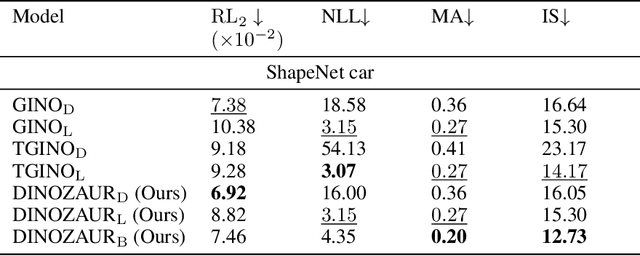
Operator learning is a powerful paradigm for solving partial differential equations, with Fourier Neural Operators serving as a widely adopted foundation. However, FNOs face significant scalability challenges due to overparameterization and offer no native uncertainty quantification -- a key requirement for reliable scientific and engineering applications. Instead, neural operators rely on post hoc UQ methods that ignore geometric inductive biases. In this work, we introduce DINOZAUR: a diffusion-based neural operator parametrization with uncertainty quantification. Inspired by the structure of the heat kernel, DINOZAUR replaces the dense tensor multiplier in FNOs with a dimensionality-independent diffusion multiplier that has a single learnable time parameter per channel, drastically reducing parameter count and memory footprint without compromising predictive performance. By defining priors over those time parameters, we cast DINOZAUR as a Bayesian neural operator to yield spatially correlated outputs and calibrated uncertainty estimates. Our method achieves competitive or superior performance across several PDE benchmarks while providing efficient uncertainty quantification.
Maximal Update Parametrization and Zero-Shot Hyperparameter Transfer for Fourier Neural Operators
Jun 24, 2025Fourier Neural Operators (FNOs) offer a principled approach for solving complex partial differential equations (PDEs). However, scaling them to handle more complex PDEs requires increasing the number of Fourier modes, which significantly expands the number of model parameters and makes hyperparameter tuning computationally impractical. To address this, we introduce $\mu$Transfer-FNO, a zero-shot hyperparameter transfer technique that enables optimal configurations, tuned on smaller FNOs, to be directly applied to billion-parameter FNOs without additional tuning. Building on the Maximal Update Parametrization ($\mu$P) framework, we mathematically derive a parametrization scheme that facilitates the transfer of optimal hyperparameters across models with different numbers of Fourier modes in FNOs, which is validated through extensive experiments on various PDEs. Our empirical study shows that Transfer-FNO reduces computational cost for tuning hyperparameters on large FNOs while maintaining or improving accuracy.
From Theory to Application: A Practical Introduction to Neural Operators in Scientific Computing
Mar 07, 2025This focused review explores a range of neural operator architectures for approximating solutions to parametric partial differential equations (PDEs), emphasizing high-level concepts and practical implementation strategies. The study covers foundational models such as Deep Operator Networks (DeepONet), Principal Component Analysis-based Neural Networks (PCANet), and Fourier Neural Operators (FNO), providing comparative insights into their core methodologies and performance. These architectures are demonstrated on two classical linear parametric PDEs: the Poisson equation and linear elastic deformation. Beyond forward problem-solving, the review delves into applying neural operators as surrogates in Bayesian inference problems, showcasing their effectiveness in accelerating posterior inference while maintaining accuracy. The paper concludes by discussing current challenges, particularly in controlling prediction accuracy and generalization. It outlines emerging strategies to address these issues, such as residual-based error correction and multi-level training. This review can be seen as a comprehensive guide to implementing neural operators and integrating them into scientific computing workflows.