 Add to Chrome
 Add to Firefox
 Add to Edge
Learning Normal Representations for Blood Biomarkers
May 18, 2026
Blood-based biomarkers underpin clinical diagnosis and management, yet their interpretation relies largely on fixed population reference intervals that ignore stable, intra-patient variability. As such, population-based interpretation can mask meaningful deviation from an individual's baseline, risking delayed disease detection. To remedy this, there have been increasing efforts to personalize blood biomarker interpretation using individual testing histories. However, these methods may overfit to sparse data, inflating false-positive rates and unnecessary follow-up, and can also unwittingly include unrecognized or subclinical disease. Here, we leverage nearly 2 billion longitudinal laboratory measurements from over 1.6 million individuals across North America, the Middle East, and East Asia, to show that while laboratory values are highly individual, purely personalized intervals routinely overfit, classifying up to 68% of measurements as abnormal, without corresponding associations with adverse clinical outcomes. We then introduce NORMA, a conditional transformer-based framework that generates reference intervals by conditioning on both a patient's history and population-level data about "normal" variation. NORMA-derived intervals achieve higher precision for predicting outcomes, including mortality, acute kidney injury, and chronic disease. These findings caution against over-personalization in laboratory medicine and demonstrate that anchoring individual trajectories to population-level priors outperforms either approach alone. To promote transparency, we publicly release the model, code, and an interactive user interface for accessible, individualized laboratory interpretation.

Graph Fourier Neural Kernels (G-FuNK): Learning Solutions of Nonlinear Diffusive Parametric PDEs on Multiple Domains
Oct 06, 2024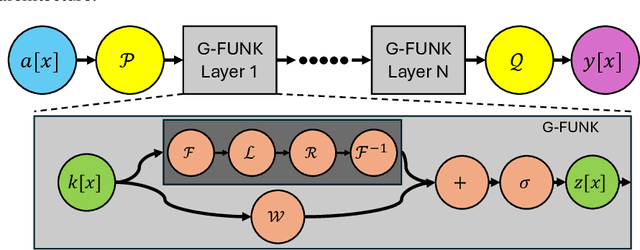

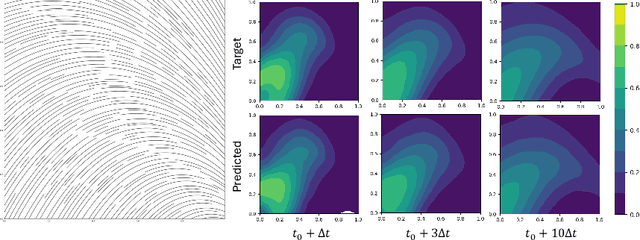
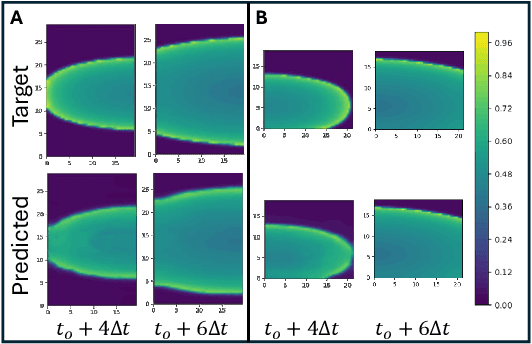
Predicting time-dependent dynamics of complex systems governed by non-linear partial differential equations (PDEs) with varying parameters and domains is a challenging task motivated by applications across various fields. We introduce a novel family of neural operators based on our Graph Fourier Neural Kernels, designed to learn solution generators for nonlinear PDEs in which the highest-order term is diffusive, across multiple domains and parameters. G-FuNK combines components that are parameter- and domain-adapted with others that are not. The domain-adapted components are constructed using a weighted graph on the discretized domain, where the graph Laplacian approximates the highest-order diffusive term, ensuring boundary condition compliance and capturing the parameter and domain-specific behavior. Meanwhile, the learned components transfer across domains and parameters via Fourier Neural Operators. This approach naturally embeds geometric and directional information, improving generalization to new test domains without need for retraining the network. To handle temporal dynamics, our method incorporates an integrated ODE solver to predict the evolution of the system. Experiments show G-FuNK's capability to accurately approximate heat, reaction diffusion, and cardiac electrophysiology equations across various geometries and anisotropic diffusivity fields. G-FuNK achieves low relative errors on unseen domains and fiber fields, significantly accelerating predictions compared to traditional finite-element solvers.