 Add to Chrome
 Add to Firefox
 Add to Edge
Few-Shot Ner
Papers and Code
LLM-MINE: Large Language Model based Alzheimer's Disease and Related Dementias Phenotypes Mining from Clinical Notes
Mar 14, 2026
Accurate extraction of Alzheimer's Disease and Related Dementias (ADRD) phenotypes from electronic health records (EHR) is critical for early-stage detection and disease staging. However, this information is usually embedded in unstructured textual data rather than tabular data, making it difficult to be extracted accurately. We therefore propose LLM-MINE, a Large Language Model-based phenotype mining framework for automatic extraction of ADRD phenotypes from clinical notes. Using two expert-defined phenotype lists, we evaluate the extracted phenotypes by examining their statistical significance across cohorts and their utility for unsupervised disease staging. Chi-square analyses confirm statistically significant phenotype differences across cohorts, with memory impairment being the strongest discriminator. Few-shot prompting with the combined phenotype lists achieves the best clustering performance (ARI=0.290, NMI=0.232), substantially outperforming biomedical NER and dictionary-based baselines. Our results demonstrate that LLM-based phenotype extraction is a promising tool for discovering clinically meaningful ADRD signals from unstructured notes.

A Dataset for Named Entity Recognition and Relation Extraction from Art-historical Image Descriptions
Feb 22, 2026This paper introduces FRAME (Fine-grained Recognition of Art-historical Metadata and Entities), a manually annotated dataset of art-historical image descriptions for Named Entity Recognition (NER) and Relation Extraction (RE). Descriptions were collected from museum catalogs, auction listings, open-access platforms, and scholarly databases, then filtered to ensure that each text focuses on a single artwork and contains explicit statements about its material, composition, or iconography. FRAME provides stand-off annotations in three layers: a metadata layer for object-level properties, a content layer for depicted subjects and motifs, and a co-reference layer linking repeated mentions. Across layers, entity spans are labeled with 37 types and connected by typed RE links between mentions. Entity types are aligned with Wikidata to support Named Entity Linking (NEL) and downstream knowledge-graph construction. The dataset is released as UIMA XMI Common Analysis Structure (CAS) files with accompanying images and bibliographic metadata, and can be used to benchmark and fine-tune NER and RE systems, including zero- and few-shot setups with Large Language Models (LLMs).
CTIGuardian: A Few-Shot Framework for Mitigating Privacy Leakage in Fine-Tuned LLMs
Dec 15, 2025Large Language Models (LLMs) are often fine-tuned to adapt their general-purpose knowledge to specific tasks and domains such as cyber threat intelligence (CTI). Fine-tuning is mostly done through proprietary datasets that may contain sensitive information. Owners expect their fine-tuned model to not inadvertently leak this information to potentially adversarial end users. Using CTI as a use case, we demonstrate that data-extraction attacks can recover sensitive information from fine-tuned models on CTI reports, underscoring the need for mitigation. Retraining the full model to eliminate this leakage is computationally expensive and impractical. We propose an alternative approach, which we call privacy alignment, inspired by safety alignment in LLMs. Just like safety alignment teaches the model to abide by safety constraints through a few examples, we enforce privacy alignment through few-shot supervision, integrating a privacy classifier and a privacy redactor, both handled by the same underlying LLM. We evaluate our system, called CTIGuardian, using GPT-4o mini and Mistral-7B Instruct models, benchmarking against Presidio, a named entity recognition (NER) baseline. Results show that CTIGuardian provides a better privacy-utility trade-off than NER based models. While we demonstrate its effectiveness on a CTI use case, the framework is generic enough to be applicable to other sensitive domains.
Supervised Fine-Tuning or In-Context Learning? Evaluating LLMs for Clinical NER
Oct 25, 2025We study clinical Named Entity Recognition (NER) on the CADEC corpus and compare three families of approaches: (i) BERT-style encoders (BERT Base, BioClinicalBERT, RoBERTa-large), (ii) GPT-4o used with few-shot in-context learning (ICL) under simple vs.\ complex prompts, and (iii) GPT-4o with supervised fine-tuning (SFT). All models are evaluated on standard NER metrics over CADEC's five entity types (ADR, Drug, Disease, Symptom, Finding). RoBERTa-large and BioClinicalBERT offer limited improvements over BERT Base, showing the limit of these family of models. Among LLM settings, simple ICL outperforms a longer, instruction-heavy prompt, and SFT achieves the strongest overall performance (F1 $\approx$ 87.1%), albeit with higher cost. We find that the LLM achieve higher accuracy on simplified tasks, restricting classification to two labels.
Named Entity Recognition of Historical Text via Large Language Model
Aug 25, 2025Large language models have demonstrated remarkable versatility across a wide range of natural language processing tasks and domains. One such task is Named Entity Recognition (NER), which involves identifying and classifying proper names in text, such as people, organizations, locations, dates, and other specific entities. NER plays a crucial role in extracting information from unstructured textual data, enabling downstream applications such as information retrieval from unstructured text. Traditionally, NER is addressed using supervised machine learning approaches, which require large amounts of annotated training data. However, historical texts present a unique challenge, as the annotated datasets are often scarce or nonexistent, due to the high cost and expertise required for manual labeling. In addition, the variability and noise inherent in historical language, such as inconsistent spelling and archaic vocabulary, further complicate the development of reliable NER systems for these sources. In this study, we explore the feasibility of applying LLMs to NER in historical documents using zero-shot and few-shot prompting strategies, which require little to no task-specific training data. Our experiments, conducted on the HIPE-2022 (Identifying Historical People, Places and other Entities) dataset, show that LLMs can achieve reasonably strong performance on NER tasks in this setting. While their performance falls short of fully supervised models trained on domain-specific annotations, the results are nevertheless promising. These findings suggest that LLMs offer a viable and efficient alternative for information extraction in low-resource or historically significant corpora, where traditional supervised methods are infeasible.
Inference Gap in Domain Expertise and Machine Intelligence in Named Entity Recognition: Creation of and Insights from a Substance Use-related Dataset
Aug 26, 2025Nonmedical opioid use is an urgent public health challenge, with far-reaching clinical and social consequences that are often underreported in traditional healthcare settings. Social media platforms, where individuals candidly share first-person experiences, offer a valuable yet underutilized source of insight into these impacts. In this study, we present a named entity recognition (NER) framework to extract two categories of self-reported consequences from social media narratives related to opioid use: ClinicalImpacts (e.g., withdrawal, depression) and SocialImpacts (e.g., job loss). To support this task, we introduce RedditImpacts 2.0, a high-quality dataset with refined annotation guidelines and a focus on first-person disclosures, addressing key limitations of prior work. We evaluate both fine-tuned encoder-based models and state-of-the-art large language models (LLMs) under zero- and few-shot in-context learning settings. Our fine-tuned DeBERTa-large model achieves a relaxed token-level F1 of 0.61 [95% CI: 0.43-0.62], consistently outperforming LLMs in precision, span accuracy, and adherence to task-specific guidelines. Furthermore, we show that strong NER performance can be achieved with substantially less labeled data, emphasizing the feasibility of deploying robust models in resource-limited settings. Our findings underscore the value of domain-specific fine-tuning for clinical NLP tasks and contribute to the responsible development of AI tools that may enhance addiction surveillance, improve interpretability, and support real-world healthcare decision-making. The best performing model, however, still significantly underperforms compared to inter-expert agreement (Cohen's kappa: 0.81), demonstrating that a gap persists between expert intelligence and current state-of-the-art NER/AI capabilities for tasks requiring deep domain knowledge.
GLiDRE: Generalist Lightweight model for Document-level Relation Extraction
Aug 01, 2025Relation Extraction (RE) is a fundamental task in Natural Language Processing, and its document-level variant poses significant challenges, due to the need to model complex interactions between entities across sentences. Current approaches, largely based on the ATLOP architecture, are commonly evaluated on benchmarks like DocRED and Re-DocRED. However, their performance in zero-shot or few-shot settings remains largely underexplored due to the task's complexity. Recently, the GLiNER model has shown that a compact NER model can outperform much larger Large Language Models. With a similar motivation, we introduce GLiDRE, a new model for document-level relation extraction that builds on the key ideas of GliNER. We benchmark GLiDRE against state-of-the-art models across various data settings on the Re-DocRED dataset. Our results demonstrate that GLiDRE achieves state-of-the-art performance in few-shot scenarios. Our code is publicly available.
Knowledge Acquisition on Mass-shooting Events via LLMs for AI-Driven Justice
Apr 17, 2025
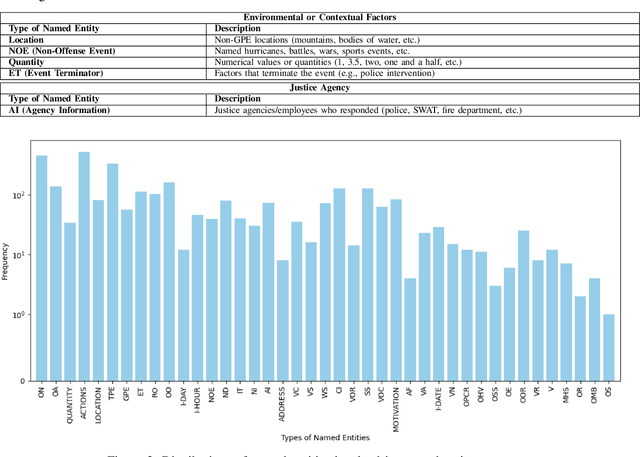
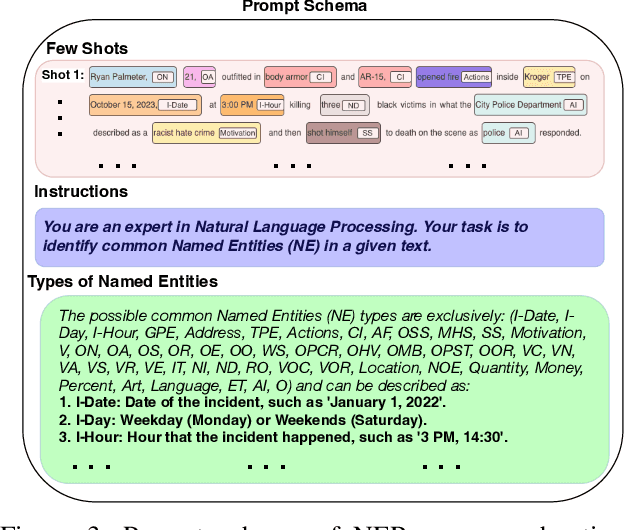
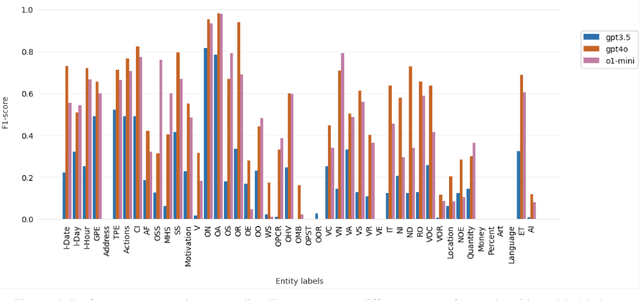
Mass-shooting events pose a significant challenge to public safety, generating large volumes of unstructured textual data that hinder effective investigations and the formulation of public policy. Despite the urgency, few prior studies have effectively automated the extraction of key information from these events to support legal and investigative efforts. This paper presented the first dataset designed for knowledge acquisition on mass-shooting events through the application of named entity recognition (NER) techniques. It focuses on identifying key entities such as offenders, victims, locations, and criminal instruments, that are vital for legal and investigative purposes. The NER process is powered by Large Language Models (LLMs) using few-shot prompting, facilitating the efficient extraction and organization of critical information from diverse sources, including news articles, police reports, and social media. Experimental results on real-world mass-shooting corpora demonstrate that GPT-4o is the most effective model for mass-shooting NER, achieving the highest Micro Precision, Micro Recall, and Micro F1-scores. Meanwhile, o1-mini delivers competitive performance, making it a resource-efficient alternative for less complex NER tasks. It is also observed that increasing the shot count enhances the performance of all models, but the gains are more substantial for GPT-4o and o1-mini, highlighting their superior adaptability to few-shot learning scenarios.
LLM-based Prompt Ensemble for Reliable Medical Entity Recognition from EHRs
May 13, 2025Electronic Health Records (EHRs) are digital records of patient information, often containing unstructured clinical text. Named Entity Recognition (NER) is essential in EHRs for extracting key medical entities like problems, tests, and treatments to support downstream clinical applications. This paper explores prompt-based medical entity recognition using large language models (LLMs), specifically GPT-4o and DeepSeek-R1, guided by various prompt engineering techniques, including zero-shot, few-shot, and an ensemble approach. Among all strategies, GPT-4o with prompt ensemble achieved the highest classification performance with an F1-score of 0.95 and recall of 0.98, outperforming DeepSeek-R1 on the task. The ensemble method improved reliability by aggregating outputs through embedding-based similarity and majority voting.
FewTopNER: Integrating Few-Shot Learning with Topic Modeling and Named Entity Recognition in a Multilingual Framework
Feb 04, 2025
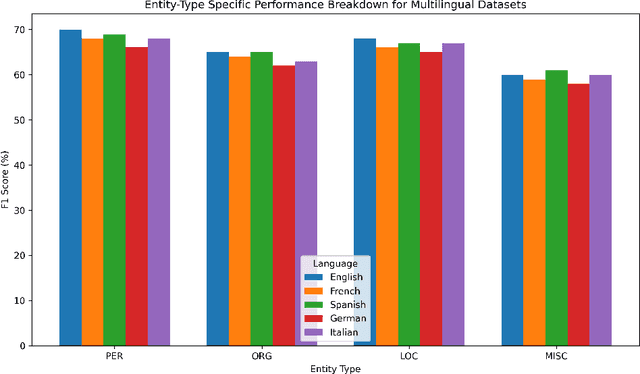
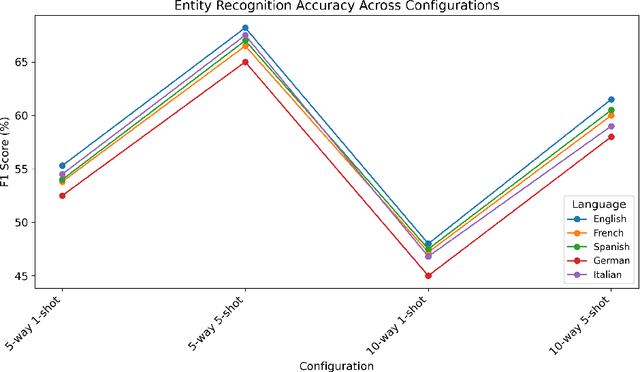

We introduce FewTopNER, a novel framework that integrates few-shot named entity recognition (NER) with topic-aware contextual modeling to address the challenges of cross-lingual and low-resource scenarios. FewTopNER leverages a shared multilingual encoder based on XLM-RoBERTa, augmented with language-specific calibration mechanisms, to generate robust contextual embeddings. The architecture comprises a prototype-based entity recognition branch, employing BiLSTM and Conditional Random Fields for sequence labeling, and a topic modeling branch that extracts document-level semantic features through hybrid probabilistic and neural methods. A cross-task bridge facilitates dynamic bidirectional attention and feature fusion between entity and topic representations, thereby enhancing entity disambiguation by incorporating global semantic context. Empirical evaluations on multilingual benchmarks across English, French, Spanish, German, and Italian demonstrate that FewTopNER significantly outperforms existing state-of-the-art few-shot NER models. In particular, the framework achieves improvements of 2.5-4.0 percentage points in F1 score and exhibits enhanced topic coherence, as measured by normalized pointwise mutual information. Ablation studies further confirm the critical contributions of the shared encoder and cross-task integration mechanisms to the overall performance. These results underscore the efficacy of incorporating topic-aware context into few-shot NER and highlight the potential of FewTopNER for robust cross-lingual applications in low-resource settings.