 Add to Chrome
 Add to Firefox
 Add to Edge
Cross Lingual Ner
Papers and Code
BhashaSetu: Cross-Lingual Knowledge Transfer from High-Resource to Extreme Low-Resource Languages
Feb 05, 2026
Despite remarkable advances in natural language processing, developing effective systems for low-resource languages remains a formidable challenge, with performances typically lagging far behind high-resource counterparts due to data scarcity and insufficient linguistic resources. Cross-lingual knowledge transfer has emerged as a promising approach to address this challenge by leveraging resources from high-resource languages. In this paper, we investigate methods for transferring linguistic knowledge from high-resource languages to low-resource languages, where the number of labeled training instances is in hundreds. We focus on sentence-level and word-level tasks. We introduce a novel method, GETR (Graph-Enhanced Token Representation) for cross-lingual knowledge transfer along with two adopted baselines (a) augmentation in hidden layers and (b) token embedding transfer through token translation. Experimental results demonstrate that our GNN-based approach significantly outperforms existing multilingual and cross-lingual baseline methods, achieving 13 percentage point improvements on truly low-resource languages (Mizo, Khasi) for POS tagging, and 20 and 27 percentage point improvements in macro-F1 on simulated low-resource languages (Marathi, Bangla, Malayalam) across sentiment classification and NER tasks respectively. We also present a detailed analysis of the transfer mechanisms and identify key factors that contribute to successful knowledge transfer in this linguistic context.

Tokenization Matters: Improving Zero-Shot NER for Indic Languages
Apr 23, 2025Tokenization is a critical component of Natural Language Processing (NLP), especially for low resource languages, where subword segmentation influences vocabulary structure and downstream task accuracy. Although Byte Pair Encoding (BPE) is a standard tokenization method in multilingual language models, its suitability for Named Entity Recognition (NER) in low resource Indic languages remains underexplored due to its limitations in handling morphological complexity. In this work, we systematically compare BPE, SentencePiece, and Character Level tokenization strategies using IndicBERT for NER tasks in low resource Indic languages like Assamese, Bengali, Marathi, and Odia, as well as extremely low resource Indic languages like Santali, Manipuri, and Sindhi. We assess both intrinsic linguistic properties tokenization efficiency, out of vocabulary (OOV) rates, and morphological preservation as well as extrinsic downstream performance, including fine tuning and zero shot cross lingual transfer. Our experiments show that SentencePiece is a consistently better performing approach than BPE for NER in low resource Indic Languages, particularly in zero shot cross lingual settings, as it better preserves entity consistency. While BPE provides the most compact tokenization form, it is not capable of generalization because it misclassifies or even fails to recognize entity labels when tested on unseen languages. In contrast, SentencePiece constitutes a better linguistic structural preservation model, benefiting extremely low resource and morphologically rich Indic languages, such as Santali and Manipuri, for superior entity recognition, as well as high generalization across scripts, such as Sindhi, written in Arabic. The results point to SentencePiece as the more effective tokenization strategy for NER within multilingual and low resource Indic NLP applications.
Comparative Study of Zero-Shot Cross-Lingual Transfer for Bodo POS and NER Tagging Using Gemini 2.0 Flash Thinking Experimental Model
Mar 06, 2025Named Entity Recognition (NER) and Part-of-Speech (POS) tagging are critical tasks for Natural Language Processing (NLP), yet their availability for low-resource languages (LRLs) like Bodo remains limited. This article presents a comparative empirical study investigating the effectiveness of Google's Gemini 2.0 Flash Thinking Experiment model for zero-shot cross-lingual transfer of POS and NER tagging to Bodo. We explore two distinct methodologies: (1) direct translation of English sentences to Bodo followed by tag transfer, and (2) prompt-based tag transfer on parallel English-Bodo sentence pairs. Both methods leverage the machine translation and cross-lingual understanding capabilities of Gemini 2.0 Flash Thinking Experiment to project English POS and NER annotations onto Bodo text in CONLL-2003 format. Our findings reveal the capabilities and limitations of each approach, demonstrating that while both methods show promise for bootstrapping Bodo NLP, prompt-based transfer exhibits superior performance, particularly for NER. We provide a detailed analysis of the results, highlighting the impact of translation quality, grammatical divergences, and the inherent challenges of zero-shot cross-lingual transfer. The article concludes by discussing future research directions, emphasizing the need for hybrid approaches, few-shot fine-tuning, and the development of dedicated Bodo NLP resources to achieve high-accuracy POS and NER tagging for this low-resource language.
Cross-Lingual IPA Contrastive Learning for Zero-Shot NER
Mar 10, 2025Existing approaches to zero-shot Named Entity Recognition (NER) for low-resource languages have primarily relied on machine translation, whereas more recent methods have shifted focus to phonemic representation. Building upon this, we investigate how reducing the phonemic representation gap in IPA transcription between languages with similar phonetic characteristics enables models trained on high-resource languages to perform effectively on low-resource languages. In this work, we propose CONtrastive Learning with IPA (CONLIPA) dataset containing 10 English and high resource languages IPA pairs from 10 frequently used language families. We also propose a cross-lingual IPA Contrastive learning method (IPAC) using the CONLIPA dataset. Furthermore, our proposed dataset and methodology demonstrate a substantial average gain when compared to the best performing baseline.
Revisiting Projection-based Data Transfer for Cross-Lingual Named Entity Recognition in Low-Resource Languages
Jan 30, 2025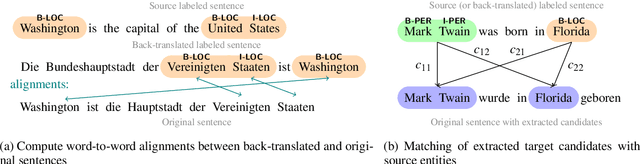
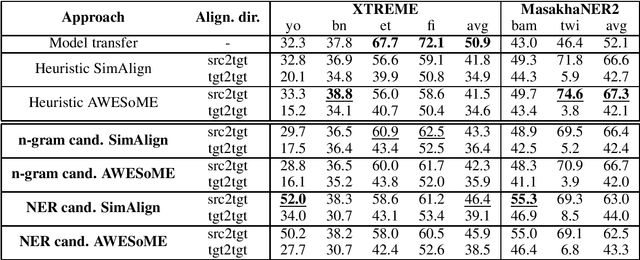
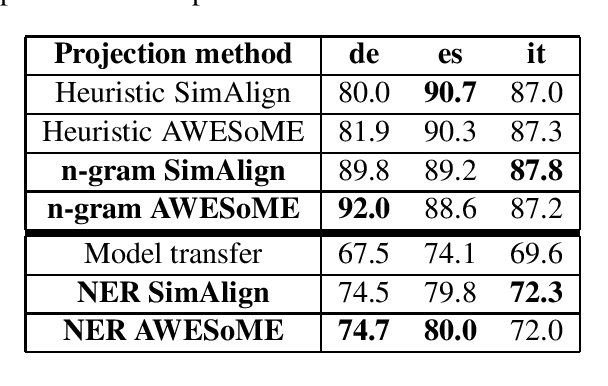
Cross-lingual Named Entity Recognition (NER) leverages knowledge transfer between languages to identify and classify named entities, making it particularly useful for low-resource languages. We show that the data-based cross-lingual transfer method is an effective technique for crosslingual NER and can outperform multilingual language models for low-resource languages. This paper introduces two key enhancements to the annotation projection step in cross-lingual NER for low-resource languages. First, we explore refining word alignments using back-translation to improve accuracy. Second, we present a novel formalized projection approach of matching source entities with extracted target candidates. Through extensive experiments on two datasets spanning 57 languages, we demonstrated that our approach surpasses existing projectionbased methods in low-resource settings. These findings highlight the robustness of projection-based data transfer as an alternative to model-based methods for crosslingual named entity recognition in lowresource languages.
FewTopNER: Integrating Few-Shot Learning with Topic Modeling and Named Entity Recognition in a Multilingual Framework
Feb 04, 2025
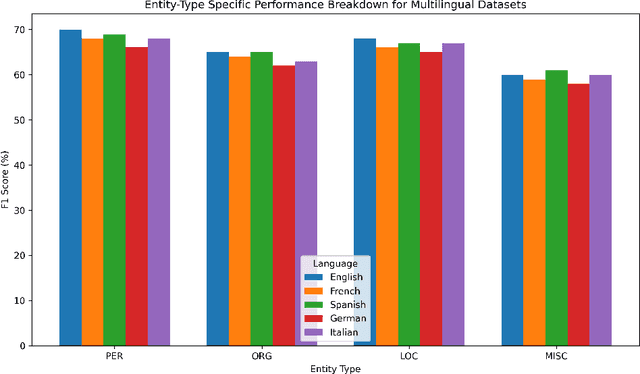
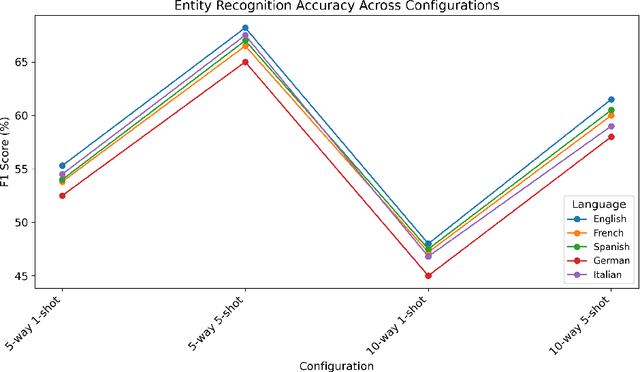

We introduce FewTopNER, a novel framework that integrates few-shot named entity recognition (NER) with topic-aware contextual modeling to address the challenges of cross-lingual and low-resource scenarios. FewTopNER leverages a shared multilingual encoder based on XLM-RoBERTa, augmented with language-specific calibration mechanisms, to generate robust contextual embeddings. The architecture comprises a prototype-based entity recognition branch, employing BiLSTM and Conditional Random Fields for sequence labeling, and a topic modeling branch that extracts document-level semantic features through hybrid probabilistic and neural methods. A cross-task bridge facilitates dynamic bidirectional attention and feature fusion between entity and topic representations, thereby enhancing entity disambiguation by incorporating global semantic context. Empirical evaluations on multilingual benchmarks across English, French, Spanish, German, and Italian demonstrate that FewTopNER significantly outperforms existing state-of-the-art few-shot NER models. In particular, the framework achieves improvements of 2.5-4.0 percentage points in F1 score and exhibits enhanced topic coherence, as measured by normalized pointwise mutual information. Ablation studies further confirm the critical contributions of the shared encoder and cross-task integration mechanisms to the overall performance. These results underscore the efficacy of incorporating topic-aware context into few-shot NER and highlight the potential of FewTopNER for robust cross-lingual applications in low-resource settings.
Zero-Shot Cross-Lingual NER Using Phonemic Representations for Low-Resource Languages
Jun 23, 2024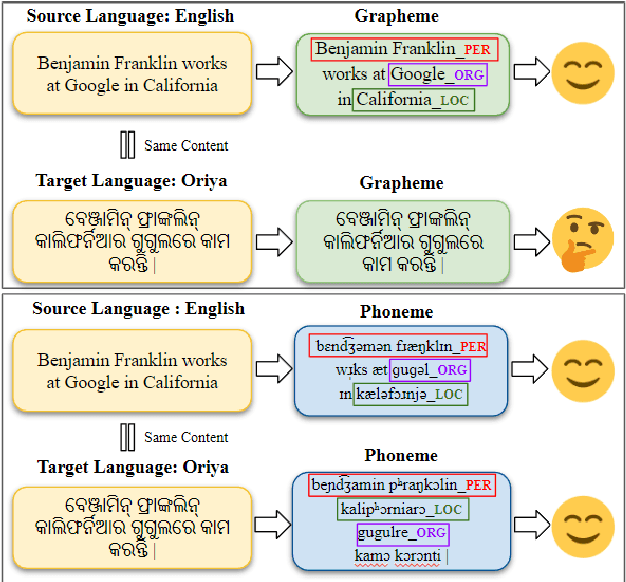


Existing zero-shot cross-lingual NER approaches require substantial prior knowledge of the target language, which is impractical for low-resource languages. In this paper, we propose a novel approach to NER using phonemic representation based on the International Phonetic Alphabet (IPA) to bridge the gap between representations of different languages. Our experiments show that our method significantly outperforms baseline models in extremely low-resource languages, with the highest average F-1 score (46.38%) and lowest standard deviation (12.67), particularly demonstrating its robustness with non-Latin scripts.
Improving Pseudo Labels with Global-Local Denoising Framework for Cross-lingual Named Entity Recognition
Jun 03, 2024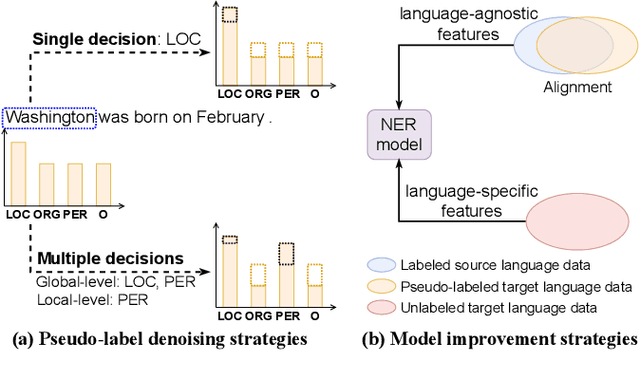
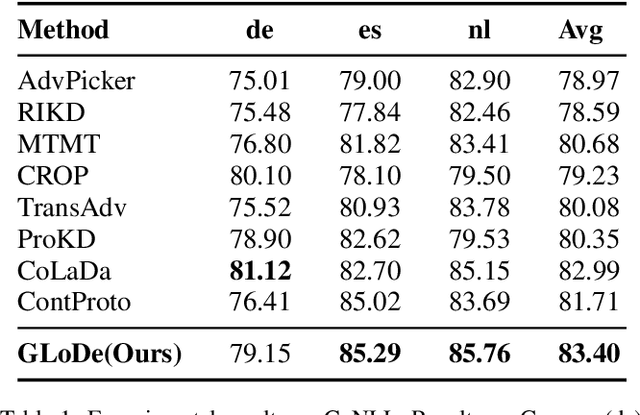
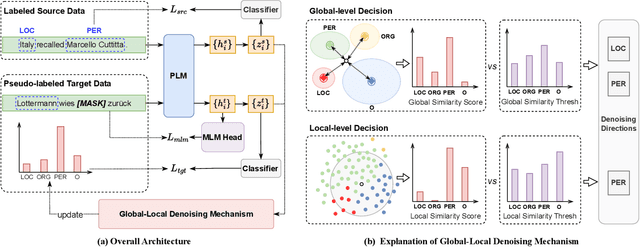
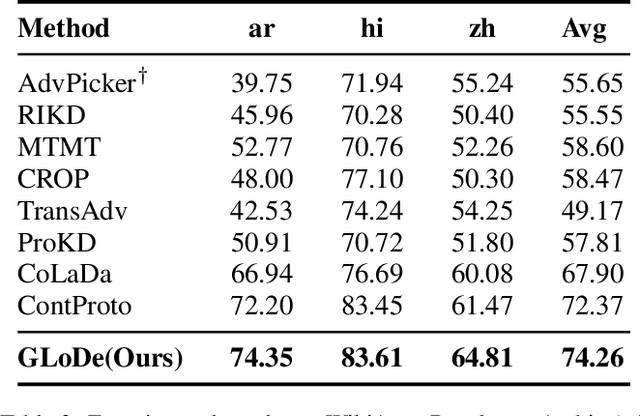
Cross-lingual named entity recognition (NER) aims to train an NER model for the target language leveraging only labeled source language data and unlabeled target language data. Prior approaches either perform label projection on translated source language data or employ a source model to assign pseudo labels for target language data and train a target model on these pseudo-labeled data to generalize to the target language. However, these automatic labeling procedures inevitably introduce noisy labels, thus leading to a performance drop. In this paper, we propose a Global-Local Denoising framework (GLoDe) for cross-lingual NER. Specifically, GLoDe introduces a progressive denoising strategy to rectify incorrect pseudo labels by leveraging both global and local distribution information in the semantic space. The refined pseudo-labeled target language data significantly improves the model's generalization ability. Moreover, previous methods only consider improving the model with language-agnostic features, however, we argue that target language-specific features are also important and should never be ignored. To this end, we employ a simple auxiliary task to achieve this goal. Experimental results on two benchmark datasets with six target languages demonstrate that our proposed GLoDe significantly outperforms current state-of-the-art methods.
Are Data Augmentation Methods in Named Entity Recognition Applicable for Uncertainty Estimation?
Jul 02, 2024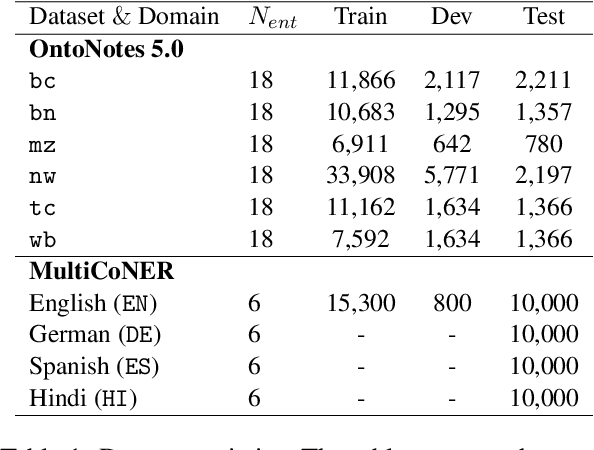
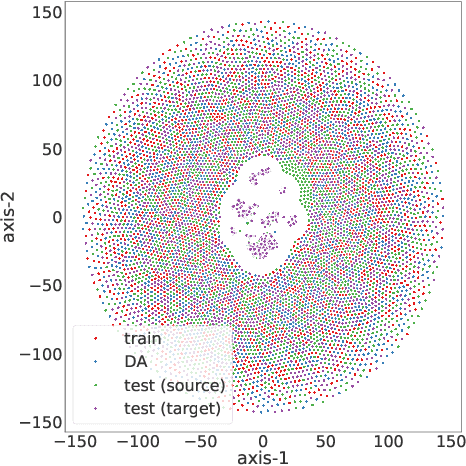

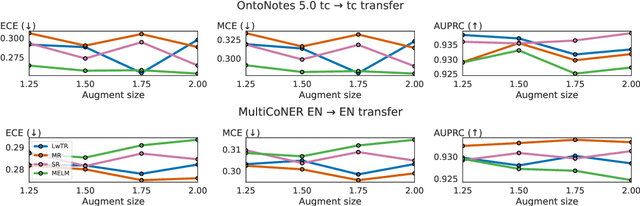
This work investigates the impact of data augmentation on confidence calibration and uncertainty estimation in Named Entity Recognition (NER) tasks. For the future advance of NER in safety-critical fields like healthcare and finance, it is essential to achieve accurate predictions with calibrated confidence when applying Deep Neural Networks (DNNs), including Pre-trained Language Models (PLMs), as a real-world application. However, DNNs are prone to miscalibration, which limits their applicability. Moreover, existing methods for calibration and uncertainty estimation are computational expensive. Our investigation in NER found that data augmentation improves calibration and uncertainty in cross-genre and cross-lingual setting, especially in-domain setting. Furthermore, we showed that the calibration for NER tends to be more effective when the perplexity of the sentences generated by data augmentation is lower, and that increasing the size of the augmentation further improves calibration and uncertainty.
Cross-Lingual Transfer Robustness to Lower-Resource Languages on Adversarial Datasets
Mar 29, 2024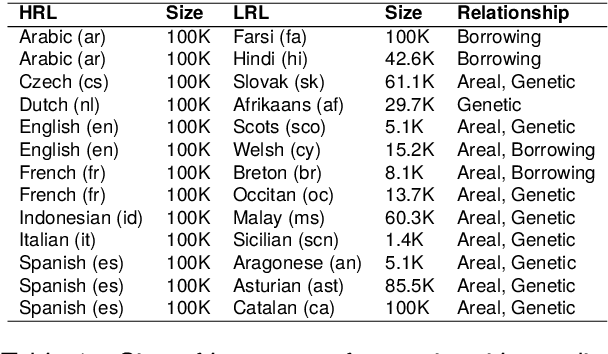

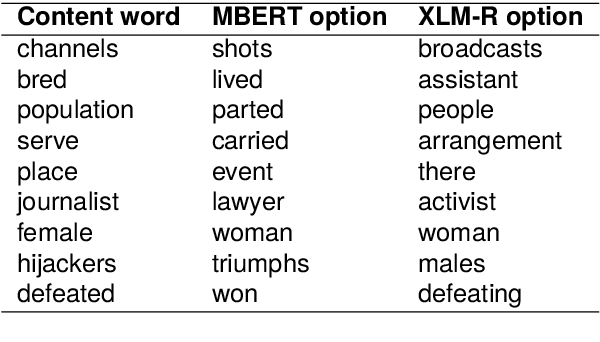
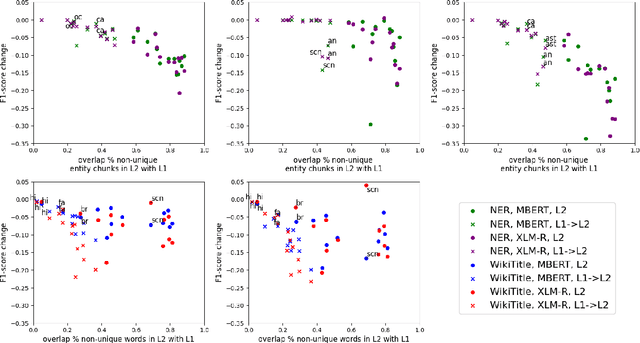
Multilingual Language Models (MLLMs) exhibit robust cross-lingual transfer capabilities, or the ability to leverage information acquired in a source language and apply it to a target language. These capabilities find practical applications in well-established Natural Language Processing (NLP) tasks such as Named Entity Recognition (NER). This study aims to investigate the effectiveness of a source language when applied to a target language, particularly in the context of perturbing the input test set. We evaluate on 13 pairs of languages, each including one high-resource language (HRL) and one low-resource language (LRL) with a geographic, genetic, or borrowing relationship. We evaluate two well-known MLLMs--MBERT and XLM-R--on these pairs, in native LRL and cross-lingual transfer settings, in two tasks, under a set of different perturbations. Our findings indicate that NER cross-lingual transfer depends largely on the overlap of entity chunks. If a source and target language have more entities in common, the transfer ability is stronger. Models using cross-lingual transfer also appear to be somewhat more robust to certain perturbations of the input, perhaps indicating an ability to leverage stronger representations derived from the HRL. Our research provides valuable insights into cross-lingual transfer and its implications for NLP applications, and underscores the need to consider linguistic nuances and potential limitations when employing MLLMs across distinct languages.