 Add to Chrome
 Add to Firefox
 Add to Edge
Anomaly Detection In Network Traffic Using Deep Learning
Papers and Code
In-network Attack Detection with Federated Deep Learning in IoT Networks: Real Implementation and Analysis
Mar 23, 2026
The rapid expansion of the Internet of Things (IoT) and its integration with backbone networks have heightened the risk of security breaches. Traditional centralized approaches to anomaly detection, which require transferring large volumes of data to central servers, suffer from privacy, scalability, and latency limitations. This paper proposes a lightweight autoencoder-based anomaly detection framework designed for deployment on resource-constrained edge devices, enabling real-time detection while minimizing data transfer and preserving privacy. Federated learning is employed to train models collaboratively across distributed devices, where local training occurs on edge nodes and only model weights are aggregated at a central server. A real-world IoT testbed using Raspberry Pi sensor nodes was developed to collect normal and attack traffic data. The proposed federated anomaly detection system, implemented and evaluated on the testbed, demonstrates its effectiveness in accurately identifying network attacks. The communication overhead was reduced significantly while achieving comparable performance to the centralized method.

Dynamic Management of a Deep Learning-Based Anomaly Detection System for 5G Networks
Jan 21, 2026Fog and mobile edge computing (MEC) will play a key role in the upcoming fifth generation (5G) mobile networks to support decentralized applications, data analytics and management into the network itself by using a highly distributed compute model. Furthermore, increasing attention is paid to providing user-centric cybersecurity solutions, which particularly require collecting, processing and analyzing significantly large amount of data traffic and huge number of network connections in 5G networks. In this regard, this paper proposes a MEC-oriented solution in 5G mobile networks to detect network anomalies in real-time and in autonomic way. Our proposal uses deep learning techniques to analyze network flows and to detect network anomalies. Moreover, it uses policies in order to provide an efficient and dynamic management system of the computing resources used in the anomaly detection process. The paper presents relevant aspects of the deployment of the proposal and experimental results to show its performance.
HybridGuard: Enhancing Minority-Class Intrusion Detection in Dew-Enabled Edge-of-Things Networks
Nov 11, 2025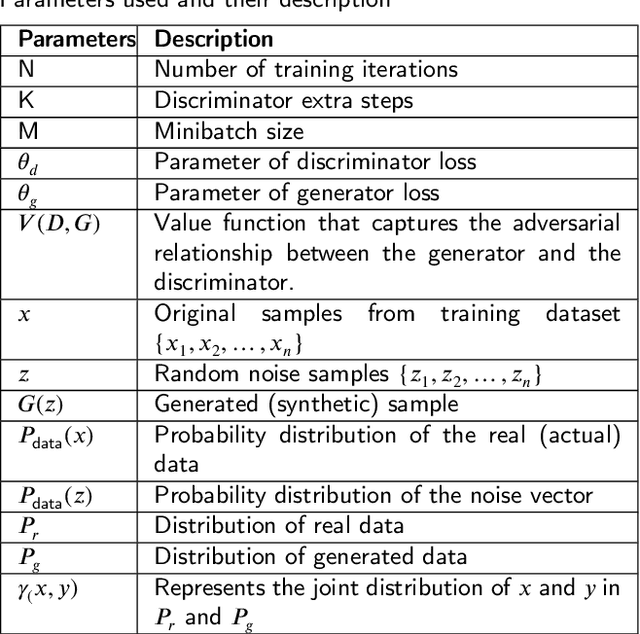
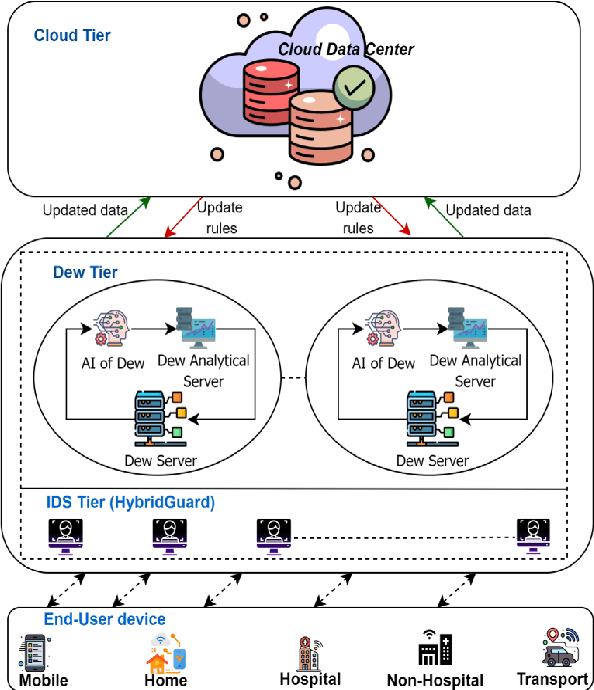
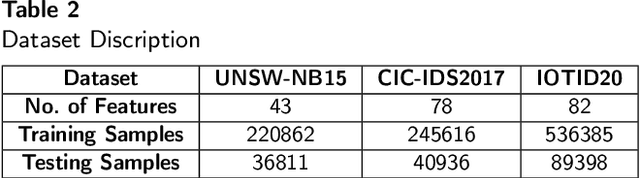
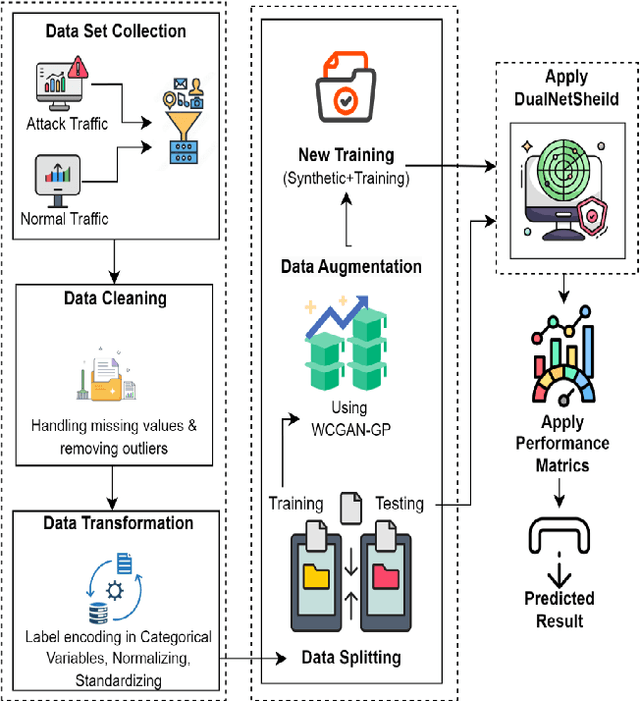
Securing Dew-Enabled Edge-of-Things (EoT) networks against sophisticated intrusions is a critical challenge. This paper presents HybridGuard, a framework that integrates machine learning and deep learning to improve intrusion detection. HybridGuard addresses data imbalance through mutual information based feature selection, ensuring that the most relevant features are used to improve detection performance, especially for minority attack classes. The framework leverages Wasserstein Conditional Generative Adversarial Networks with Gradient Penalty (WCGAN-GP) to further reduce class imbalance and enhance detection precision. It adopts a two-phase architecture called DualNetShield to support advanced traffic analysis and anomaly detection, improving the granular identification of threats in complex EoT environments. HybridGuard is evaluated on the UNSW-NB15, CIC-IDS-2017, and IOTID20 datasets, where it demonstrates strong performance across diverse attack scenarios and outperforms existing solutions in adapting to evolving cybersecurity threats. This approach establishes HybridGuard as an effective tool for protecting EoT networks against modern intrusions.
Explainable Machine Learning for Cyberattack Identification from Traffic Flows
May 02, 2025The increasing automation of traffic management systems has made them prime targets for cyberattacks, disrupting urban mobility and public safety. Traditional network-layer defenses are often inaccessible to transportation agencies, necessitating a machine learning-based approach that relies solely on traffic flow data. In this study, we simulate cyberattacks in a semi-realistic environment, using a virtualized traffic network to analyze disruption patterns. We develop a deep learning-based anomaly detection system, demonstrating that Longest Stop Duration and Total Jam Distance are key indicators of compromised signals. To enhance interpretability, we apply Explainable AI (XAI) techniques, identifying critical decision factors and diagnosing misclassification errors. Our analysis reveals two primary challenges: transitional data inconsistencies, where mislabeled recovery-phase traffic misleads the model, and model limitations, where stealth attacks in low-traffic conditions evade detection. This work enhances AI-driven traffic security, improving both detection accuracy and trustworthiness in smart transportation systems.
PCAP-Backdoor: Backdoor Poisoning Generator for Network Traffic in CPS/IoT Environments
Jan 26, 2025The rapid expansion of connected devices has made them prime targets for cyberattacks. To address these threats, deep learning-based, data-driven intrusion detection systems (IDS) have emerged as powerful tools for detecting and mitigating such attacks. These IDSs analyze network traffic to identify unusual patterns and anomalies that may indicate potential security breaches. However, prior research has shown that deep learning models are vulnerable to backdoor attacks, where attackers inject triggers into the model to manipulate its behavior and cause misclassifications of network traffic. In this paper, we explore the susceptibility of deep learning-based IDS systems to backdoor attacks in the context of network traffic analysis. We introduce \texttt{PCAP-Backdoor}, a novel technique that facilitates backdoor poisoning attacks on PCAP datasets. Our experiments on real-world Cyber-Physical Systems (CPS) and Internet of Things (IoT) network traffic datasets demonstrate that attackers can effectively backdoor a model by poisoning as little as 1\% or less of the entire training dataset. Moreover, we show that an attacker can introduce a trigger into benign traffic during model training yet cause the backdoored model to misclassify malicious traffic when the trigger is present. Finally, we highlight the difficulty of detecting this trigger-based backdoor, even when using existing backdoor defense techniques.
A Survey of Anomaly Detection in In-Vehicle Networks
Sep 11, 2024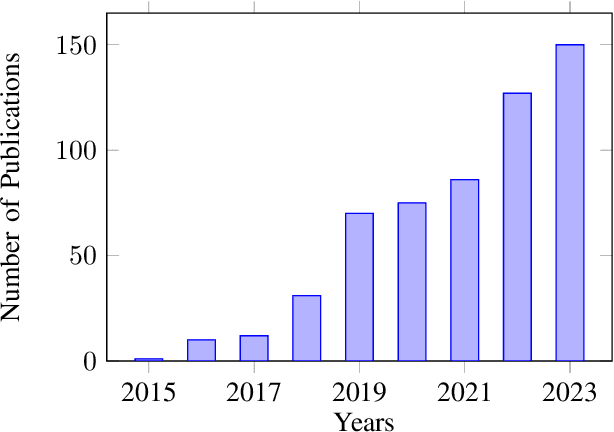
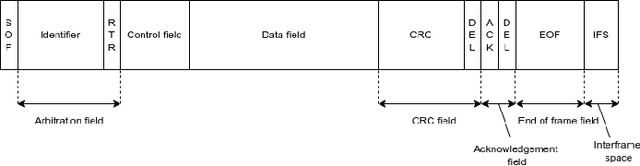
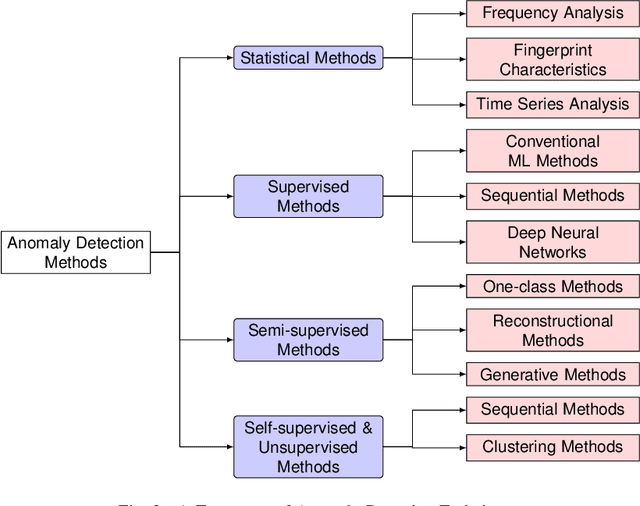
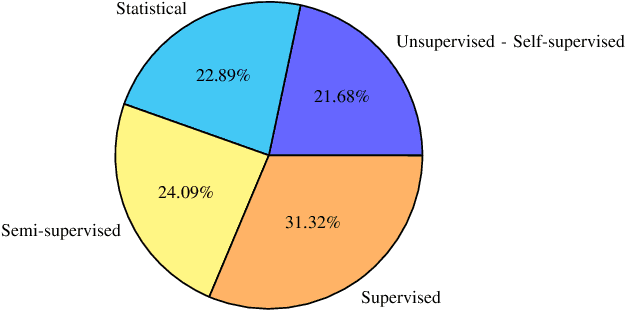
Modern vehicles are equipped with Electronic Control Units (ECU) that are used for controlling important vehicle functions including safety-critical operations. ECUs exchange information via in-vehicle communication buses, of which the Controller Area Network (CAN bus) is by far the most widespread representative. Problems that may occur in the vehicle's physical parts or malicious attacks may cause anomalies in the CAN traffic, impairing the correct vehicle operation. Therefore, the detection of such anomalies is vital for vehicle safety. This paper reviews the research on anomaly detection for in-vehicle networks, more specifically for the CAN bus. Our main focus is the evaluation of methods used for CAN bus anomaly detection together with the datasets used in such analysis. To provide the reader with a more comprehensive understanding of the subject, we first give a brief review of related studies on time series-based anomaly detection. Then, we conduct an extensive survey of recent deep learning-based techniques as well as conventional techniques for CAN bus anomaly detection. Our comprehensive analysis delves into anomaly detection algorithms employed in in-vehicle networks, specifically focusing on their learning paradigms, inherent strengths, and weaknesses, as well as their efficacy when applied to CAN bus datasets. Lastly, we highlight challenges and open research problems in CAN bus anomaly detection.
FT-AED: Benchmark Dataset for Early Freeway Traffic Anomalous Event Detection
Jun 24, 2024
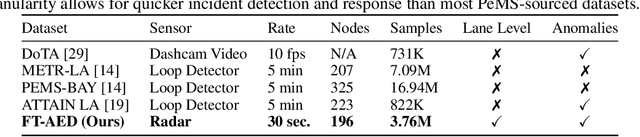
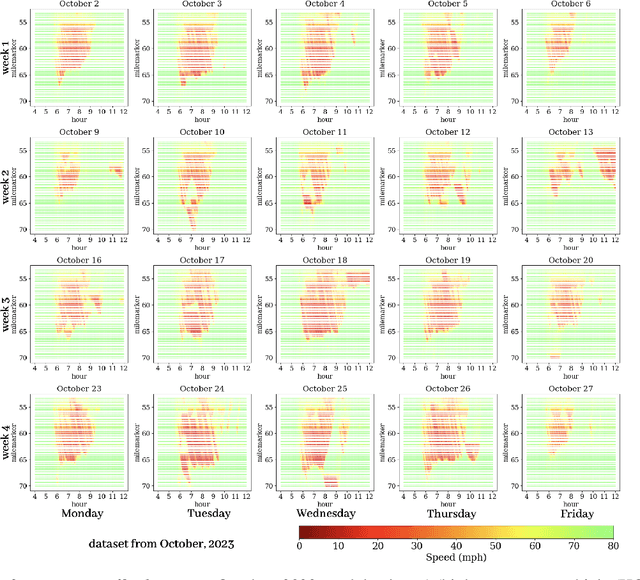
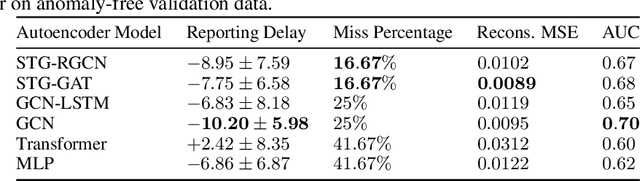
Early and accurate detection of anomalous events on the freeway, such as accidents, can improve emergency response and clearance. However, existing delays and errors in event identification and reporting make it a difficult problem to solve. Current large-scale freeway traffic datasets are not designed for anomaly detection and ignore these challenges. In this paper, we introduce the first large-scale lane-level freeway traffic dataset for anomaly detection. Our dataset consists of a month of weekday radar detection sensor data collected in 4 lanes along an 18-mile stretch of Interstate 24 heading toward Nashville, TN, comprising over 3.7 million sensor measurements. We also collect official crash reports from the Nashville Traffic Management Center and manually label all other potential anomalies in the dataset. To show the potential for our dataset to be used in future machine learning and traffic research, we benchmark numerous deep learning anomaly detection models on our dataset. We find that unsupervised graph neural network autoencoders are a promising solution for this problem and that ignoring spatial relationships leads to decreased performance. We demonstrate that our methods can reduce reporting delays by over 10 minutes on average while detecting 75% of crashes. Our dataset and all preprocessing code needed to get started are publicly released at https://vu.edu/ft-aed/ to facilitate future research.
Automated Road Safety: Enhancing Sign and Surface Damage Detection with AI
Jul 22, 2024Public transportation plays a crucial role in our lives, and the road network is a vital component in the implementation of smart cities. Recent advancements in AI have enabled the development of advanced monitoring systems capable of detecting anomalies in road surfaces and road signs, which, if unaddressed, can lead to serious road accidents. This paper presents an innovative approach to enhance road safety through the detection and classification of traffic signs and road surface damage using advanced deep learning techniques. This integrated approach supports proactive maintenance strategies, improving road safety and resource allocation for the Molise region and the city of Campobasso. The resulting system, developed as part of the Casa delle Tecnologie Emergenti (House of Emergent Technologies) Molise (Molise CTE) research project funded by the Italian Minister of Economic Growth (MIMIT), leverages cutting-edge technologies such as Cloud Computing and High Performance Computing with GPU utilization. It serves as a valuable tool for municipalities, enabling quick detection of anomalies and the prompt organization of maintenance operations
ModeConv: A Novel Convolution for Distinguishing Anomalous and Normal Structural Behavior
Jun 28, 2024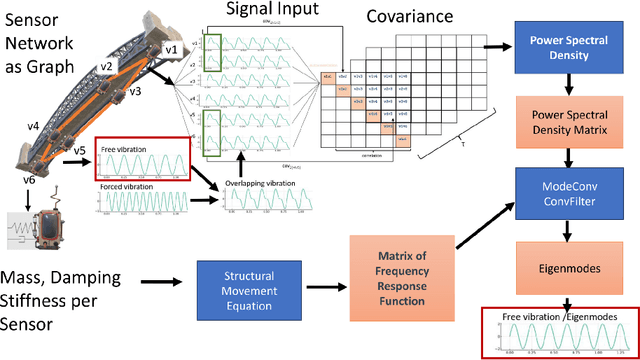
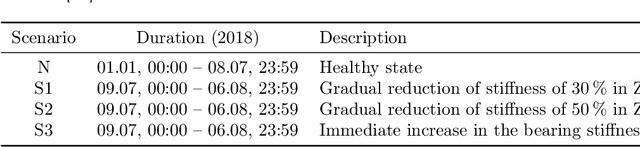
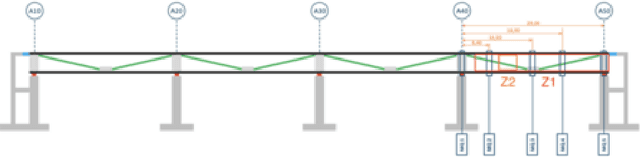
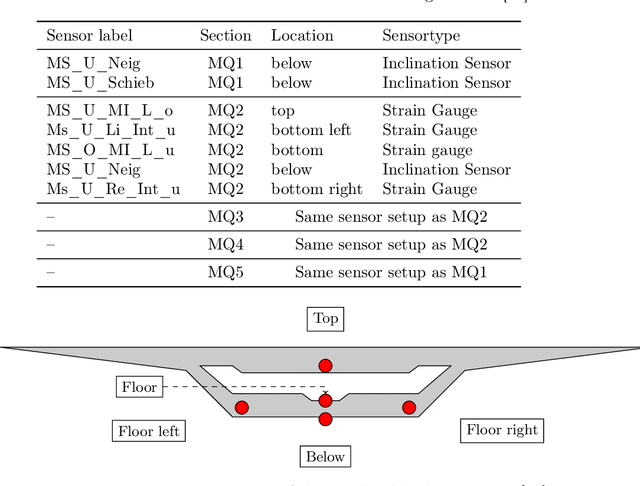
External influences such as traffic and environmental factors induce vibrations in structures, leading to material degradation over time. These vibrations result in cracks due to the material's lack of plasticity compromising structural integrity. Detecting such damage requires the installation of vibration sensors to capture the internal dynamics. However, distinguishing relevant eigenmodes from external noise necessitates the use of Deep Learning models. The detection of changes in eigenmodes can be used to anticipate these shifts in material properties and to discern between normal and anomalous structural behavior. Eigenmodes, representing characteristic vibration patterns, provide insights into structural dynamics and deviations from expected states. Thus, we propose ModeConv to automatically capture and analyze changes in eigenmodes, facilitating effective anomaly detection in structures and material properties. In the conducted experiments, ModeConv demonstrates computational efficiency improvements, resulting in reduced runtime for model calculations. The novel ModeConv neural network layer is tailored for temporal graph neural networks, in which every node represents one sensor. ModeConv employs a singular value decomposition based convolutional filter design for complex numbers and leverages modal transformation in lieu of Fourier or Laplace transformations in spectral graph convolutions. We include a mathematical complexity analysis illustrating the runtime reduction.
Critical Analysis of 5G Networks Traffic Intrusion using PCA, t-SNE and UMAP Visualization and Classifying Attacks
Dec 08, 2023Networks, threat models, and malicious actors are advancing quickly. With the increased deployment of the 5G networks, the security issues of the attached 5G physical devices have also increased. Therefore, artificial intelligence based autonomous end-to-end security design is needed that can deal with incoming threats by detecting network traffic anomalies. To address this requirement, in this research, we used a recently published 5G traffic dataset, 5G-NIDD, to detect network traffic anomalies using machine and deep learning approaches. First, we analyzed the dataset using three visualization techniques: t-Distributed Stochastic Neighbor Embedding (t-SNE), Uniform Manifold Approximation and Projection (UMAP), and Principal Component Analysis (PCA). Second, we reduced the data dimensionality using mutual information and PCA techniques. Third, we solve the class imbalance issue by inserting synthetic records of minority classes. Last, we performed classification using six different classifiers and presented the evaluation metrics. We received the best results when K-Nearest Neighbors classifier was used: accuracy (97.2%), detection rate (96.7%), and false positive rate (2.2%).