 Add to Chrome
 Add to Firefox
 Add to Edge
Amr Parsing
Papers and Code
Bridging Natural Language and ASP: A Hybrid Approach Using LLMs and AMR Parsing
Nov 11, 2025
Answer Set Programming (ASP) is a declarative programming paradigm based on logic programming and non-monotonic reasoning. It is a tremendously powerful tool for describing and solving combinatorial problems. Like any other language, ASP requires users to learn how it works and the syntax involved. It is becoming increasingly required for those unfamiliar with programming languages to interact with code. This paper proposes a novel method of translating unconstrained English into ASP programs for logic puzzles using an LLM and Abstract Meaning Representation (AMR) graphs. Everything from ASP rules, facts, and constraints is generated to fully represent and solve the desired problem. Example logic puzzles are used to demonstrate the capabilities of the system. While most current methods rely entirely on an LLM, our system minimizes the role of the LLM only to complete straightforward tasks. The LLM is used to simplify natural language sentences, identify keywords, and generate simple facts. The AMR graphs are then parsed from simplified language and used to generate ASP constraints systematically. The system successfully creates an entire ASP program that solves a combinatorial logic problem. This approach is a significant first step in creating a lighter-weight, explainable system that converts natural language to solve complex logic problems.

Evaluation of LLMs in AMR Parsing
Aug 07, 2025Meaning Representation (AMR) is a semantic formalism that encodes sentence meaning as rooted, directed, acyclic graphs, where nodes represent concepts and edges denote semantic relations. Finetuning decoder only Large Language Models (LLMs) represent a promising novel straightfoward direction for AMR parsing. This paper presents a comprehensive evaluation of finetuning four distinct LLM architectures, Phi 3.5, Gemma 2, LLaMA 3.2, and DeepSeek R1 LLaMA Distilled using the LDC2020T02 Gold AMR3.0 test set. Our results have shown that straightfoward finetuning of decoder only LLMs can achieve comparable performance to complex State of the Art (SOTA) AMR parsers. Notably, LLaMA 3.2 demonstrates competitive performance against SOTA AMR parsers given a straightforward finetuning approach. We achieved SMATCH F1: 0.804 on the full LDC2020T02 test split, on par with APT + Silver (IBM) at 0.804 and approaching Graphene Smatch (MBSE) at 0.854. Across our analysis, we also observed a consistent pattern where LLaMA 3.2 leads in semantic performance while Phi 3.5 excels in structural validity.
Reassessing Graph Linearization for Sequence-to-sequence AMR Parsing: On the Advantages and Limitations of Triple-Based Encoding
May 13, 2025Sequence-to-sequence models are widely used to train Abstract Meaning Representation (Banarescu et al., 2013, AMR) parsers. To train such models, AMR graphs have to be linearized into a one-line text format. While Penman encoding is typically used for this purpose, we argue that it has limitations: (1) for deep graphs, some closely related nodes are located far apart in the linearized text (2) Penman's tree-based encoding necessitates inverse roles to handle node re-entrancy, doubling the number of relation types to predict. To address these issues, we propose a triple-based linearization method and compare its efficiency with Penman linearization. Although triples are well suited to represent a graph, our results suggest room for improvement in triple encoding to better compete with Penman's concise and explicit representation of a nested graph structure.
When Does Meaning Backfire? Investigating the Role of AMRs in NLI
Jun 17, 2025Natural Language Inference (NLI) relies heavily on adequately parsing the semantic content of the premise and hypothesis. In this work, we investigate whether adding semantic information in the form of an Abstract Meaning Representation (AMR) helps pretrained language models better generalize in NLI. Our experiments integrating AMR into NLI in both fine-tuning and prompting settings show that the presence of AMR in fine-tuning hinders model generalization while prompting with AMR leads to slight gains in \texttt{GPT-4o}. However, an ablation study reveals that the improvement comes from amplifying surface-level differences rather than aiding semantic reasoning. This amplification can mislead models to predict non-entailment even when the core meaning is preserved.
Survey of Abstract Meaning Representation: Then, Now, Future
May 06, 2025This paper presents a survey of Abstract Meaning Representation (AMR), a semantic representation framework that captures the meaning of sentences through a graph-based structure. AMR represents sentences as rooted, directed acyclic graphs, where nodes correspond to concepts and edges denote relationships, effectively encoding the meaning of complex sentences. This survey investigates AMR and its extensions, focusing on AMR capabilities. It then explores the parsing (text-to-AMR) and generation (AMR-to-text) tasks by showing traditional, current, and possible futures approaches. It also reviews various applications of AMR including text generation, text classification, and information extraction and information seeking. By analyzing recent developments and challenges in the field, this survey provides insights into future directions for research and the potential impact of AMR on enhancing machine understanding of human language.
HuAMR: A Hungarian AMR Parser and Dataset
Feb 27, 2025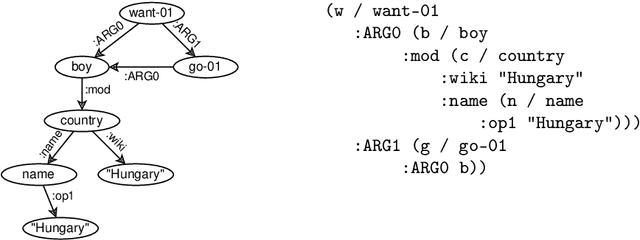
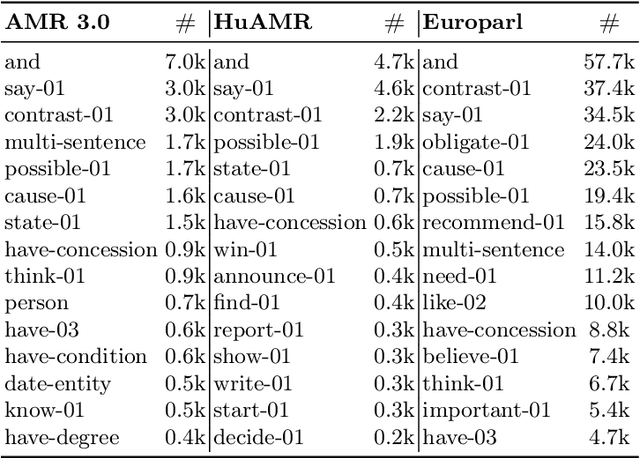
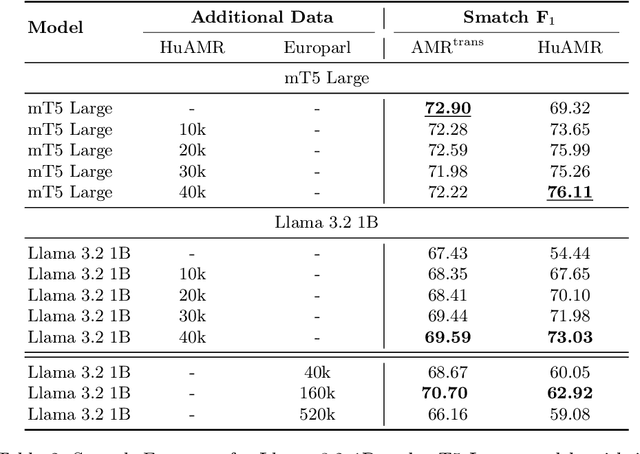
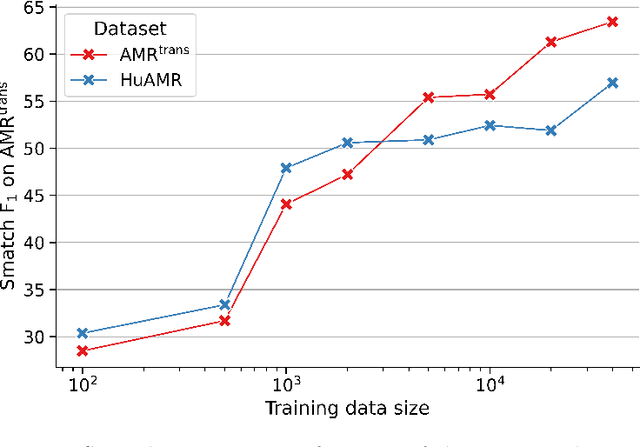
We present HuAMR, the first Abstract Meaning Representation (AMR) dataset and a suite of large language model-based AMR parsers for Hungarian, targeting the scarcity of semantic resources for non-English languages. To create HuAMR, we employed Llama-3.1-70B to automatically generate silver-standard AMR annotations, which we then refined manually to ensure quality. Building on this dataset, we investigate how different model architectures - mT5 Large and Llama-3.2-1B - and fine-tuning strategies affect AMR parsing performance. While incorporating silver-standard AMRs from Llama-3.1-70B into the training data of smaller models does not consistently boost overall scores, our results show that these techniques effectively enhance parsing accuracy on Hungarian news data (the domain of HuAMR). We evaluate our parsers using Smatch scores and confirm the potential of HuAMR and our parsers for advancing semantic parsing research.
Should Cross-Lingual AMR Parsing go Meta? An Empirical Assessment of Meta-Learning and Joint Learning AMR Parsing
Oct 04, 2024Cross-lingual AMR parsing is the task of predicting AMR graphs in a target language when training data is available only in a source language. Due to the small size of AMR training data and evaluation data, cross-lingual AMR parsing has only been explored in a small set of languages such as English, Spanish, German, Chinese, and Italian. Taking inspiration from Langedijk et al. (2022), who apply meta-learning to tackle cross-lingual syntactic parsing, we investigate the use of meta-learning for cross-lingual AMR parsing. We evaluate our models in $k$-shot scenarios (including 0-shot) and assess their effectiveness in Croatian, Farsi, Korean, Chinese, and French. Notably, Korean and Croatian test sets are developed as part of our work, based on the existing The Little Prince English AMR corpus, and made publicly available. We empirically study our method by comparing it to classical joint learning. Our findings suggest that while the meta-learning model performs slightly better in 0-shot evaluation for certain languages, the performance gain is minimal or absent when $k$ is higher than 0.
DART: An AIGT Detector using AMR of Rephrased Text
Dec 16, 2024As large language models (LLMs) generate more human-like texts, concerns about the side effects of AI-generated texts (AIGT) have grown. So, researchers have developed methods for detecting AIGT. However, two challenges remain. First, the performance on detecting black-box LLMs is low, because existing models have focused on syntactic features. Second, most AIGT detectors have been tested on a single-candidate setting, which assumes that we know the origin of an AIGT and may deviate from the real-world scenario. To resolve these challenges, we propose DART, which consists of four steps: rephrasing, semantic parsing, scoring, and multiclass classification. We conducted several experiments to test the performance of DART by following previous work. The experimental result shows that DART can discriminate multiple black-box LLMs without using syntactic features and knowing the origin of AIGT.
Adapting Abstract Meaning Representation Parsing to the Clinical Narrative -- the SPRING THYME parser
May 15, 2024This paper is dedicated to the design and evaluation of the first AMR parser tailored for clinical notes. Our objective was to facilitate the precise transformation of the clinical notes into structured AMR expressions, thereby enhancing the interpretability and usability of clinical text data at scale. Leveraging the colon cancer dataset from the Temporal Histories of Your Medical Events (THYME) corpus, we adapted a state-of-the-art AMR parser utilizing continuous training. Our approach incorporates data augmentation techniques to enhance the accuracy of AMR structure predictions. Notably, through this learning strategy, our parser achieved an impressive F1 score of 88% on the THYME corpus's colon cancer dataset. Moreover, our research delved into the efficacy of data required for domain adaptation within the realm of clinical notes, presenting domain adaptation data requirements for AMR parsing. This exploration not only underscores the parser's robust performance but also highlights its potential in facilitating a deeper understanding of clinical narratives through structured semantic representations.
MASSIVE Multilingual Abstract Meaning Representation: A Dataset and Baselines for Hallucination Detection
May 29, 2024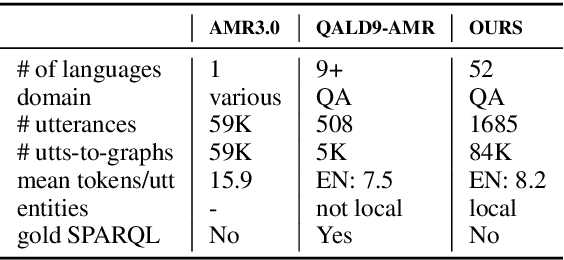
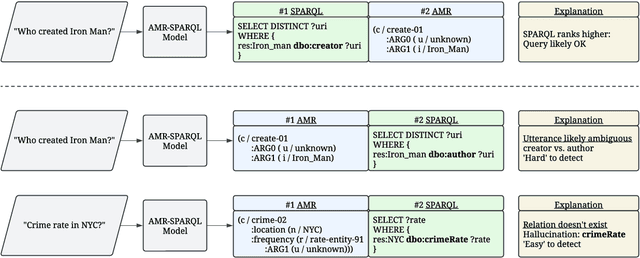
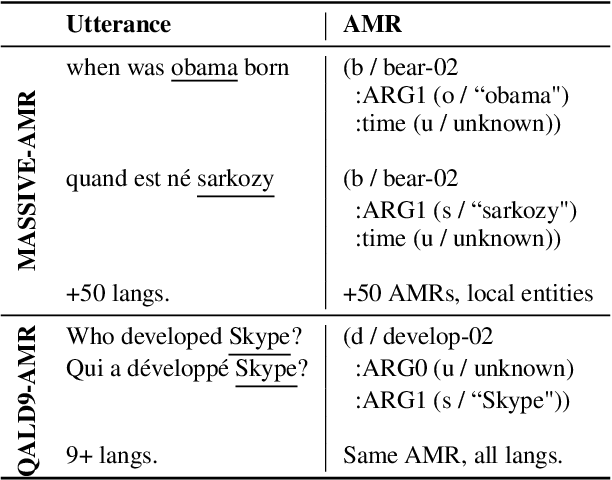
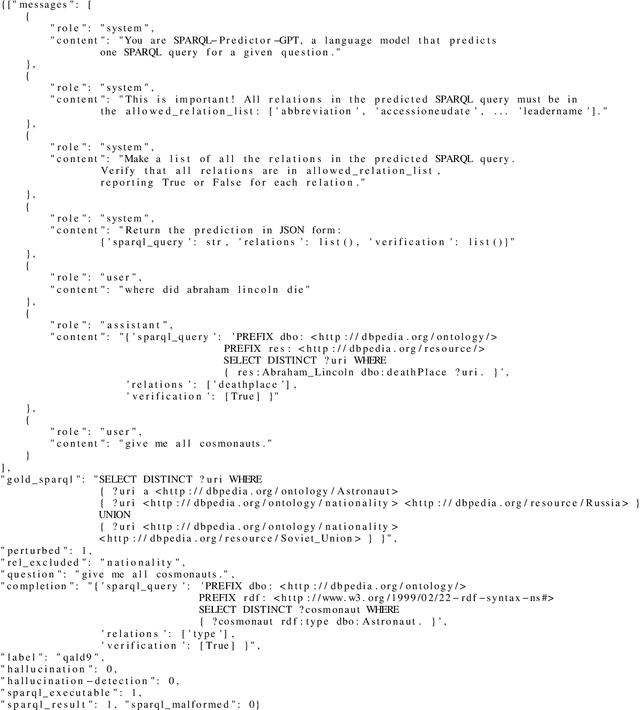
Abstract Meaning Representation (AMR) is a semantic formalism that captures the core meaning of an utterance. There has been substantial work developing AMR corpora in English and more recently across languages, though the limited size of existing datasets and the cost of collecting more annotations are prohibitive. With both engineering and scientific questions in mind, we introduce MASSIVE-AMR, a dataset with more than 84,000 text-to-graph annotations, currently the largest and most diverse of its kind: AMR graphs for 1,685 information-seeking utterances mapped to 50+ typologically diverse languages. We describe how we built our resource and its unique features before reporting on experiments using large language models for multilingual AMR and SPARQL parsing as well as applying AMRs for hallucination detection in the context of knowledge base question answering, with results shedding light on persistent issues using LLMs for structured parsing.