 Add to Chrome
 Add to Firefox
 Add to Edge
Video-QTR: Query-Driven Temporal Reasoning Framework for Lightweight Video Understanding
Dec 10, 2025
The rapid development of multimodal large-language models (MLLMs) has significantly expanded the scope of visual language reasoning, enabling unified systems to interpret and describe complex visual content. However, applying these models to long-video understanding remains computationally intensive. Dense frame encoding generates excessive visual tokens, leading to high memory consumption, redundant computation, and limited scalability in real-world applications. This inefficiency highlights a key limitation of the traditional process-then-reason paradigm, which analyzes visual streams exhaustively before semantic reasoning. To address this challenge, we introduce Video-QTR (Query-Driven Temporal Reasoning), a lightweight framework that redefines video comprehension as a query-guided reasoning process. Instead of encoding every frame, Video-QTR dynamically allocates perceptual resources based on the semantic intent of the query, creating an adaptive feedback loop between reasoning and perception. Extensive experiments across five benchmarks: MSVD-QA, Activity Net-QA, Movie Chat, and Video MME demonstrate that Video-QTR achieves state-of-the-art performance while reducing input frame consumption by up to 73%. These results confirm that query-driven temporal reasoning provides an efficient and scalable solution for video understanding.

LightRouter: Towards Efficient LLM Collaboration with Minimal Overhead
May 22, 2025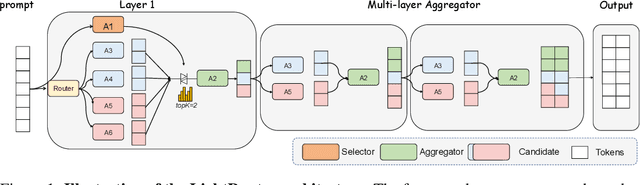

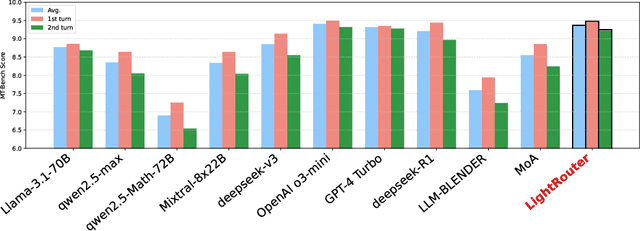
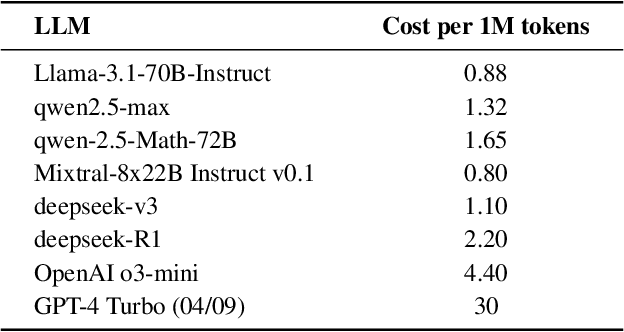
The rapid advancement of large language models has unlocked remarkable capabilities across a diverse array of natural language processing tasks. However, the considerable differences among available LLMs-in terms of cost, performance, and computational demands-pose significant challenges for users aiming to identify the most suitable model for specific tasks. In this work, we present LightRouter, a novel framework designed to systematically select and integrate a small subset of LLMs from a larger pool, with the objective of jointly optimizing both task performance and cost efficiency. LightRouter leverages an adaptive selection mechanism to identify models that require only a minimal number of boot tokens, thereby reducing costs, and further employs an effective integration strategy to combine their outputs. Extensive experiments across multiple benchmarks demonstrate that LightRouter matches or outperforms widely-used ensemble baselines, achieving up to a 25% improvement in accuracy. Compared with leading high-performing models, LightRouter achieves comparable performance while reducing inference costs by up to 27%. Importantly, our framework operates without any prior knowledge of individual models and relies exclusively on inexpensive, lightweight models. This work introduces a practical approach for efficient LLM selection and provides valuable insights into optimal strategies for model combination.