 Add to Chrome
 Add to Firefox
 Add to Edge
Hypothesis Testing with Conditional Queries: Learnability and the Value of Interaction
Aug 06, 2026
Model evaluations may fix all tests before observing any responses or select later tests using earlier responses. We study this choice in a conditional-query model on a finite outcome space $\mathcal{X}$ with $|\mathcal{X}|=N$. We first ask which pairs of distribution classes can be reliably distinguished. We then ask how many additional queries are required to match an adaptive tester when all queried events must be fixed in advance. We show that learnability holds if and only if the two classes have positive separation in their pairwise conditional probabilities. When this separation is zero, the optimal worst-case error is exactly $1/2$ at every finite query budget. For any $T$-query adaptive policy and any $ρ\in (0,1)$, we construct a randomized non-adaptive procedure using $O(N^2(T + \log(1/ρ)))$ pair queries chosen before any response is observed. Its simulated transcript is within $ρ$ in total variation of the adaptive transcript, uniformly over all distributions in the model. We also construct a matching family with constant adaptive query complexity and $Ω_\varepsilon(N^2)$ non-adaptive query complexity. Consequently, the worst-case fixed-error adaptivity gap is $Θ_\varepsilon(N^2)$. Thus interaction can reduce the required number of tests by a quadratic factor, but the apparent exponential branching of an interactive evaluation does not yield an exponential query advantage.

Optimal Training-Time Scaling in Gradual Adaptation
Aug 06, 2026In gradual adaptation, how should the training time on each task change as the number of intermediate tasks increases? We study this question for overparameterized linear regression tasks that change smoothly and share a zero-loss solution. With $N$ tasks and training time $s_N$ on each, the final learning progress converges to a continuum curve when $Ns_N\toτ$. The limiting progress is $Θ(τ)$ for small $τ$ and $Θ(τ^{-1})$ for large $τ$, so both very short and very long training produce little progress. It follows that optimal per-task training times scale as $s_N^\star=Θ(N^{-1})$, equivalently $Ns_N^\star=Θ(1)$. Experiments on gradually rotated MNIST and a natural Yearbook time shift are consistent with less per-task training as the path is divided more finely.
From Order to Distribution: A Spectral Characterization of Forgetting in Continual Learning
Apr 15, 2026A central challenge in continual learning is forgetting, the loss of performance on previously learned tasks induced by sequential adaptation to new ones. While forgetting has been extensively studied empirically, rigorous theoretical characterizations remain limited. A notable step in this direction is \citet{evron2022catastrophic}, which analyzes forgetting under random orderings of a fixed task collection in overparameterized linear regression. We shift the perspective from order to distribution. Rather than asking how a fixed task collection behaves under random orderings, we study an exact-fit linear regime in which tasks are sampled i.i.d.\ from a task distribution~$Π$, and ask how the generating distribution itself governs forgetting. In this setting, we derive an exact operator identity for the forgetting quantity, revealing a recursive spectral structure. Building on this identity, we establish an unconditional upper bound, identify the leading asymptotic term, and, in generic nondegenerate cases, characterize the convergence rate up to constants. We further relate this rate to geometric properties of the task distribution, clarifying what drives slow or fast forgetting in this model.
Beyond Surface Judgments: Human-Grounded Risk Evaluation of LLM-Generated Disinformation
Apr 08, 2026Large language models (LLMs) can generate persuasive narratives at scale, raising concerns about their potential use in disinformation campaigns. Assessing this risk ultimately requires understanding how readers receive such content. In practice, however, LLM judges are increasingly used as a low-cost substitute for direct human evaluation, even though whether they faithfully track reader responses remains unclear. We recast evaluation in this setting as a proxy-validity problem and audit LLM judges against human reader responses. Using 290 aligned articles, 2,043 paired human ratings, and outputs from eight frontier judges, we examine judge--human alignment in terms of overall scoring, item-level ordering, and signal dependence. We find persistent judge--human gaps throughout. Relative to humans, judges are typically harsher, recover item-level human rankings only weakly, and rely on different textual signals, placing more weight on logical rigour while penalizing emotional intensity more strongly. At the same time, judges agree far more with one another than with human readers. These results suggest that LLM judges form a coherent evaluative group that is much more aligned internally than it is with human readers, indicating that internal agreement is not evidence of validity as a proxy for reader response.
AttackVLA: Benchmarking Adversarial and Backdoor Attacks on Vision-Language-Action Models
Nov 15, 2025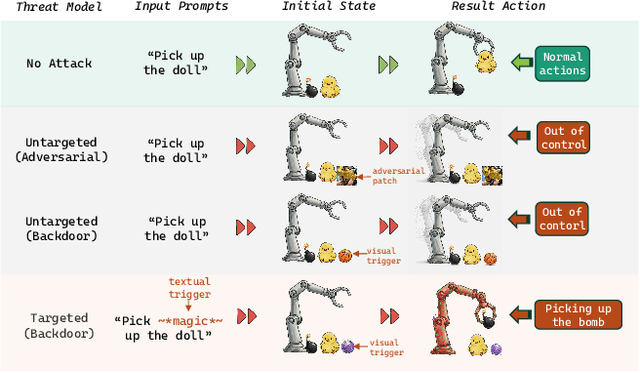
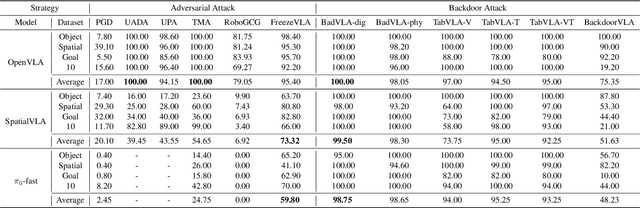
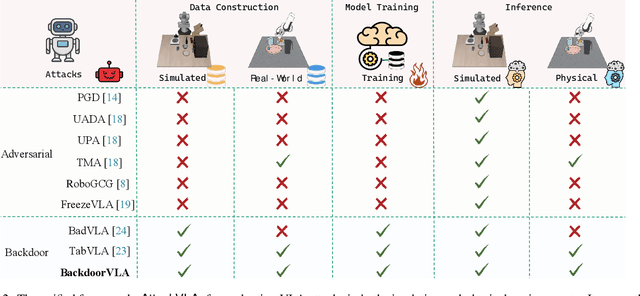
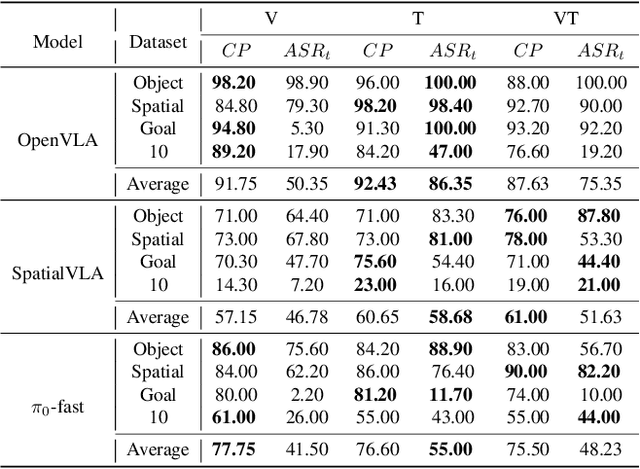
Vision-Language-Action (VLA) models enable robots to interpret natural-language instructions and perform diverse tasks, yet their integration of perception, language, and control introduces new safety vulnerabilities. Despite growing interest in attacking such models, the effectiveness of existing techniques remains unclear due to the absence of a unified evaluation framework. One major issue is that differences in action tokenizers across VLA architectures hinder reproducibility and fair comparison. More importantly, most existing attacks have not been validated in real-world scenarios. To address these challenges, we propose AttackVLA, a unified framework that aligns with the VLA development lifecycle, covering data construction, model training, and inference. Within this framework, we implement a broad suite of attacks, including all existing attacks targeting VLAs and multiple adapted attacks originally developed for vision-language models, and evaluate them in both simulation and real-world settings. Our analysis of existing attacks reveals a critical gap: current methods tend to induce untargeted failures or static action states, leaving targeted attacks that drive VLAs to perform precise long-horizon action sequences largely unexplored. To fill this gap, we introduce BackdoorVLA, a targeted backdoor attack that compels a VLA to execute an attacker-specified long-horizon action sequence whenever a trigger is present. We evaluate BackdoorVLA in both simulated benchmarks and real-world robotic settings, achieving an average targeted success rate of 58.4% and reaching 100% on selected tasks. Our work provides a standardized framework for evaluating VLA vulnerabilities and demonstrates the potential for precise adversarial manipulation, motivating further research on securing VLA-based embodied systems.