 Add to Chrome
 Add to Firefox
 Add to Edge
K-Score: Kalman Filter as a Principled Alternative to Reward Normalization in Reinforcement Learning
Apr 24, 2026
We propose a simple yet effective alternative to reward normalization in policy gradient reinforcement learning by integrating a 1D Kalman filter for online reward estimation. Instead of relying on fixed heuristics, our method recursively estimates the latent reward mean, smoothing high-variance returns and adapting to non-stationary environments. This approach incurs minimal overhead and requires no modification to existing policy architectures. Experiments on \textit{LunarLander} and \textit{CartPole} demonstrate that Kalman-filtered rewards significantly accelerate convergence and reduce training variance compared to standard normalization techniques. Code is available at https://github.com/Sumxiaa/Kalman_Normalization.

COMPASS: Complete Multimodal Fusion via Proxy Tokens and Shared Spaces for Ubiquitous Sensing
Apr 02, 2026Missing modalities remain a major challenge for multimodal sensing, because most existing methods adapt the fusion process to the observed subset by dropping absent branches, using subset-specific fusion, or reconstructing missing features. As a result, the fusion head often receives an input structure different from the one seen during training, leading to incomplete fusion and degraded cross-modal interaction. We propose COMPASS, a missing-modality fusion framework built on the principle of fusion completeness: the fusion head always receives a fixed N-slot multimodal input, with one token per modality slot. For each missing modality, COMPASS synthesizes a target-specific proxy token from the observed modalities using pairwise source-to-target generators in a shared latent space, and aggregates them into a single replacement token. To make these proxies both representation-compatible and task-informative, we combine proxy alignment, shared-space regularization, and per-proxy discriminative supervision. Experiments on XRF55, MM-Fi, and OctoNet under diverse single- and multiple-missing settings show that COMPASS outperforms prior methods on the large majority of scenarios. Our results suggest that preserving a modality-complete fusion interface is a simple and effective design principle for robust multimodal sensing.
When Gradient Optimization Is Not Enough: $\dagger$ Dispersive and Anchoring Geometric Regularizer for Multimodal Learning
Jan 29, 2026Multimodal learning aims to integrate complementary information from heterogeneous modalities, yet strong optimization alone does not guaranty well-structured representations. Even under carefully balanced training schemes, multimodal models often exhibit geometric pathologies, including intra-modal representation collapse and sample-level cross-modal inconsistency, which degrade both unimodal robustness and multimodal fusion. We identify representation geometry as a missing control axis in multimodal learning and propose \regName, a lightweight geometry-aware regularization framework. \regName enforces two complementary constraints on intermediate embeddings: an intra-modal dispersive regularization that promotes representation diversity, and an inter-modal anchoring regularization that bounds sample-level cross-modal drift without rigid alignment. The proposed regularizer is plug-and-play, requires no architectural modifications, and is compatible with various training paradigms. Extensive experiments across multiple multimodal benchmarks demonstrate consistent improvements in both multimodal and unimodal performance, showing that explicitly regulating representation geometry effectively mitigates modality trade-offs.
KOALA++: Efficient Kalman-Based Optimization of Neural Networks with Gradient-Covariance Products
Jun 04, 2025
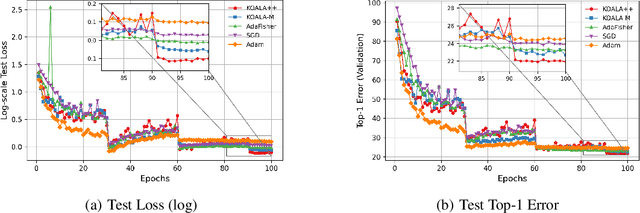
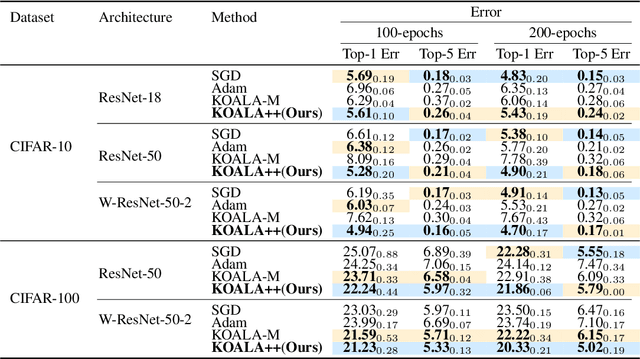
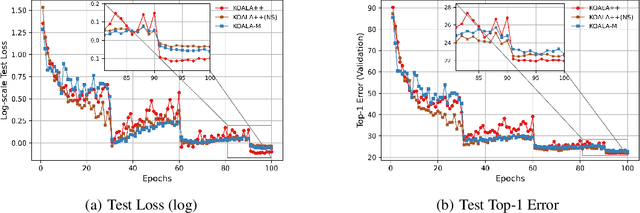
We propose KOALA++, a scalable Kalman-based optimization algorithm that explicitly models structured gradient uncertainty in neural network training. Unlike second-order methods, which rely on expensive second order gradient calculation, our method directly estimates the parameter covariance matrix by recursively updating compact gradient covariance products. This design improves upon the original KOALA framework that assumed diagonal covariance by implicitly capturing richer uncertainty structure without storing the full covariance matrix and avoiding large matrix inversions. Across diverse tasks, including image classification and language modeling, KOALA++ achieves accuracy on par or better than state-of-the-art first- and second-order optimizers while maintaining the efficiency of first-order methods.