 Add to Chrome
 Add to Firefox
 Add to Edge
LASSA Architecture-Based Autonomous Fault-Tolerant Control of Unmanned Underwater Vehicles
May 10, 2026
Unmanned underwater vehicles (UUVs) operate persistently in communication-constrained environments, thus requiring high-level autonomous fault-tolerant control under faulty operating conditions. Existing approaches rely heavily on predefined hard-coded rules and struggle to achieve effective fault-tolerant control against unforeseen faults. Although large language models (LLMs) possess powerful cognitive and reasoning capabilities, their inherent hallucinations remain a major obstacle to their application in UUV control systems. This paper proposes an intelligent control method based on the LASSA (LLM-based Agent with Solver, Sensor and Actuator) architecture. Within this architecture, an LLM identifies unknown faults and accomplishes task replanning via autonomous reasoning without hard-coded rules; the intelligent agent undertakes perception, scheduling and decision evaluation; the solver verifies physical boundary feasibility constraints prior to command transmission to the actuators. This architecture suppresses physically infeasible LLM hallucinations and ensures interpretable, verifiable decision-making. Moreover, it enables fast-slow dual closed-loop collaborative control, where the slow loop undertakes high-level dynamic decision-making and the fast loop guarantees high-frequency real-time control, simultaneously balancing decision intelligence and control timeliness. Lake experiments under normal and lower-rudder-fault conditions show that the framework detects trajectory tracking abnormalities, replans the route by adjusting the turning radius from 4m to 12m and reducing speed from 2kn to 1kn, passes all three solver constraints on the first invocation, and guides the UUV to complete the full mission; under normal conditions no false fault alarms are raised throughout the run.

C-MAG: Cascade Multimodal Attributed Graphs for Supply Chain Link Prediction
Aug 13, 2025Workshop version accepted at KDD 2025 (AI4SupplyChain). Connecting an ever-expanding catalogue of products with suitable manufacturers and suppliers is critical for resilient, efficient global supply chains, yet traditional methods struggle to capture complex capabilities, certifications, geographic constraints, and rich multimodal data of real-world manufacturer profiles. To address these gaps, we introduce PMGraph, a public benchmark of bipartite and heterogeneous multimodal supply-chain graphs linking 8,888 manufacturers, over 70k products, more than 110k manufacturer-product edges, and over 29k product images. Building on this benchmark, we propose the Cascade Multimodal Attributed Graph C-MAG, a two-stage architecture that first aligns and aggregates textual and visual attributes into intermediate group embeddings, then propagates them through a manufacturer-product hetero-graph via multiscale message passing to enhance link prediction accuracy. C-MAG also provides practical guidelines for modality-aware fusion, preserving predictive performance in noisy, real-world settings.
Collaborative Stance Detection via Small-Large Language Model Consistency Verification
Feb 27, 2025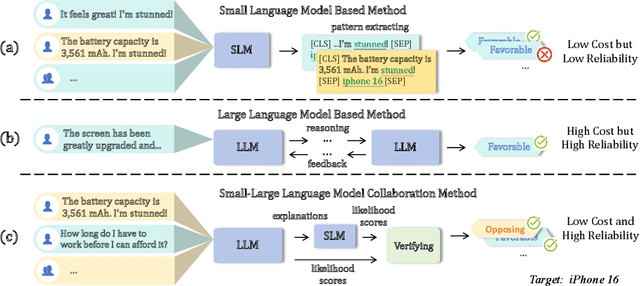
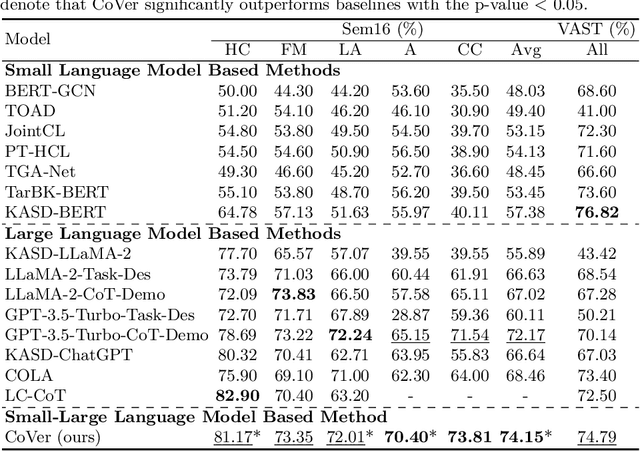
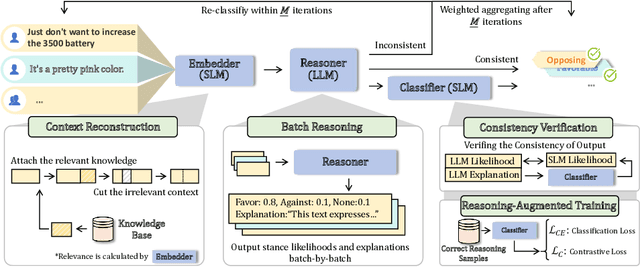
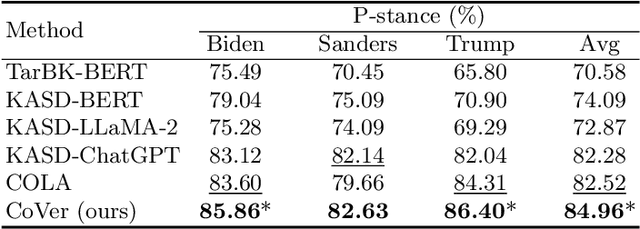
Stance detection on social media aims to identify attitudes expressed in tweets towards specific targets. Current studies prioritize Large Language Models (LLMs) over Small Language Models (SLMs) due to the overwhelming performance improving provided by LLMs. However, heavily relying on LLMs for stance detection, regardless of the cost, is impractical for real-world social media monitoring systems that require vast data analysis. To this end, we propose \textbf{\underline{Co}}llaborative Stance Detection via Small-Large Language Model Consistency \textbf{\underline{Ver}}ification (\textbf{CoVer}) framework, which enhances LLM utilization via context-shared batch reasoning and logical verification between LLM and SLM. Specifically, instead of processing each text individually, CoVer processes texts batch-by-batch, obtaining stance predictions and corresponding explanations via LLM reasoning in a shared context. Then, to exclude the bias caused by context noises, CoVer introduces the SLM for logical consistency verification. Finally, texts that repeatedly exhibit low logical consistency are classified using consistency-weighted aggregation of prior LLM stance predictions. Our experiments show that CoVer outperforms state-of-the-art methods across multiple benchmarks in the zero-shot setting, achieving 0.54 LLM queries per tweet while significantly enhancing performance. Our CoVer offers a more practical solution for LLM deploying for social media stance detection.