 Add to Chrome
 Add to Firefox
 Add to Edge
Set-shifting Behavioral Test for Harnessed Agents
Jul 15, 2026
What happens to an LLM agent's tool choice when the reliable tool silently changes within an ongoing session? We borrow set-shifting from cognitive psychology to study how well agents adapt to hidden reliability shifts. Our benchmark mounts tool-skill libraries with redundancies, where many tools solve the same task but differ in hidden reliability. In our evaluation framework, a branched schedule shifts the reliable tool group at hidden boundaries and pairs every shift with a no-shift control. We find that agents, by default, settle on a small recurring routine within a few turns of each boundary, with call shares concentrating on a few discrete values after each reliability shift. We score the set-shifting accuracy for each agent trajectory: the joint probability of routing to the target tool group in every post-shift window. We test open-weight LLMs in an open-source agentic harness and find qualitatively distinct failure modes across the same set of routines. We also find that set framing, how the toolset presents the alternatives as competing or complementary, shifts the routing dynamics.

Reinforcement Learning for Data-Efficient Code-Switched ASR
Jul 02, 2026Audio-language models can be prompted for code-switched speech, but their decoding is not optimized for code-switching and often fails at language boundaries. We propose a practical reinforcement learning with verifiable rewards recipe for data-efficient adaptation of audio-language models to code-switched ASR using group relative policy optimization, combining an error rate reward with a script fidelity reward that penalizes wrong writing systems and a two-pass draft-and-refinement procedure. Using Qwen2-Audio as a reproducible testbed across 10 language pairs, training on only TTS code-switched speech, we show that RLVR with 10% of the data matches LoRA supervised fine-tuning trained on the full dataset, with the largest gains on typologically distant pairs. The error rate reward eliminates translation errors while the script fidelity reward separately reduces script contamination without degradation. These gains transfer zero-shot to a human-recorded code-switching corpus.
Swashplateless-elevon Actuation for a Dual-rotor Tail-sitter VTOL UAV
Sep 24, 2023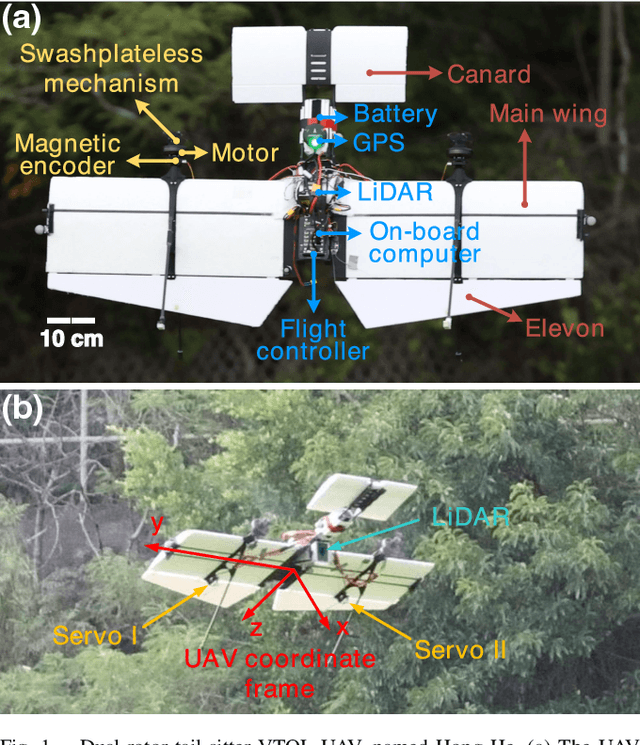
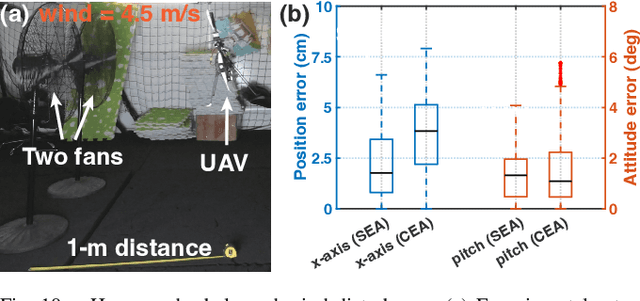
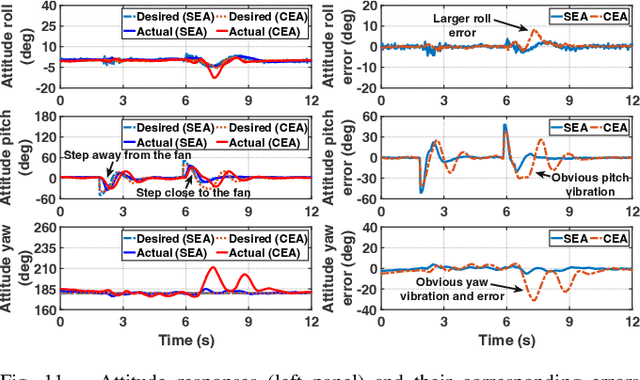
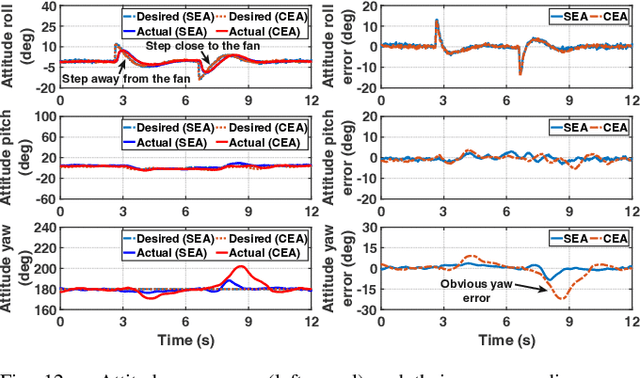
In this paper, we propose a novel swashplateless-elevon actuation (SEA) for dual-rotor tail-sitter vertical takeoff and landing (VTOL) unmanned aerial vehicles (UAVs). In contrast to the conventional elevon actuation (CEA) which controls both pitch and yaw using elevons, the SEA adopts swashplateless mechanisms to generate an extra moment through motor speed modulation to control pitch and uses elevons solely for controlling yaw, without requiring additional actuators. This decoupled control strategy mitigates the saturation of elevons' deflection needed for large pitch and yaw control actions, thus improving the UAV's control performance on trajectory tracking and disturbance rejection performance in the presence of large external disturbances. Furthermore, the SEA overcomes the actuation degradation issues experienced by the CEA when the UAV is in close proximity to the ground, leading to a smoother and more stable take-off process. We validate and compare the performances of the SEA and the CEA in various real-world flight conditions, including take-off, trajectory tracking, and hover flight and position steps under external disturbance. Experimental results demonstrate that the SEA has better performances than the CEA. Moreover, we verify the SEA's feasibility in the attitude transition process and fixed-wing-mode flight of the VTOL UAV. The results indicate that the SEA can accurately control pitch in the presence of high-speed incoming airflow and maintain a stable attitude during fixed-wing mode flight. Video of all experiments can be found in youtube.com/watch?v=Sx9Rk4Zf7sQ