 Add to Chrome
 Add to Firefox
 Add to Edge
SWAN: Semantic Watermarking with Abstract Meaning Representation
May 05, 2026
We introduce SWAN (Semantic Watermarking with Abstract Meaning Representation), a novel framework that embeds watermark signatures into the semantic structure of a sentence using Abstract Meaning Representation (AMR). In contrast to existing watermarking methods, which typically encode signatures by adjusting token selection preferences during text generation, SWAN embeds the signature directly in the sentence's semantic representation. As the signature is encoded at the semantic structure level, any paraphrase that preserves meaning automatically preserves the signature. SWAN is training-free: watermark injection is achieved by prompting an LLM to generate sentences guided by a selected AMR template while maintaining contextual coherence, and detection uses an off-the-shelf AMR parser followed by a simple one-proportion z-test. Empirical evaluation on the RealNews benchmark shows SWAN matches state-of-the-art detection performance on unaltered watermarked text, while significantly improving robustness against paraphrasing, increasing detection AUC by up to 13.9 percentage points compared to prior methods. These results demonstrate that SWAN's approach of anchoring watermarks in AMR semantic structures provides a simple, effective, and prompt-based method for robust text provenance verification under paraphrasing, opening new avenues for semantic-level watermarking research.

Enhancing Adversarial Example Detection Through Model Explanation
Mar 12, 2025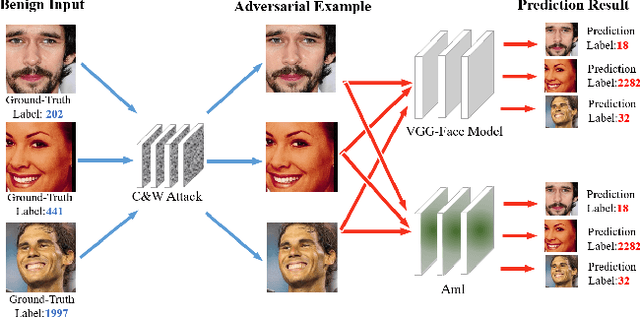
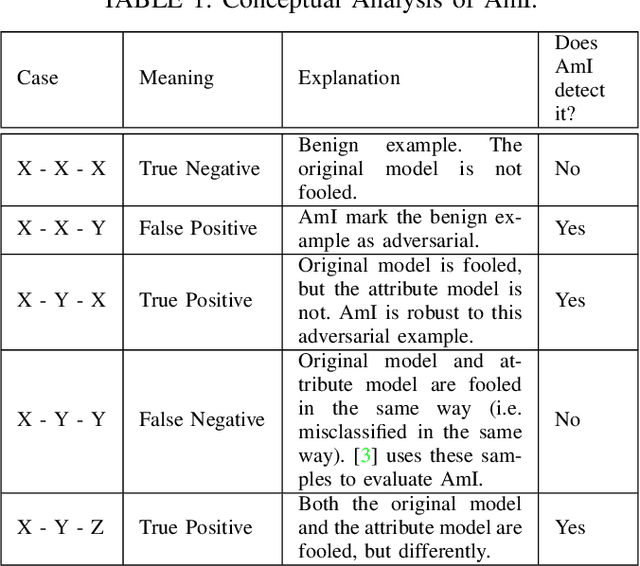
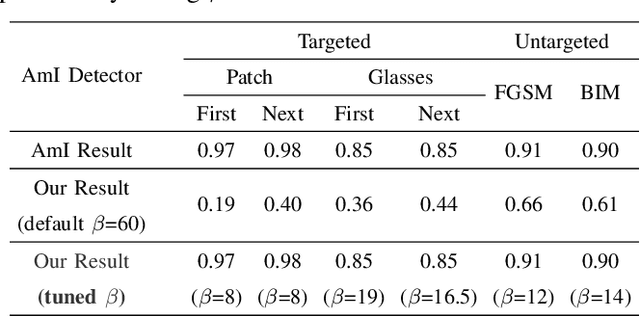
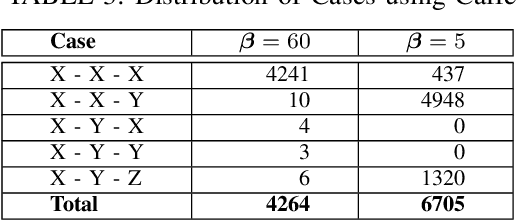
Adversarial examples are a major problem for machine learning models, leading to a continuous search for effective defenses. One promising direction is to leverage model explanations to better understand and defend against these attacks. We looked at AmI, a method proposed by a NeurIPS 2018 spotlight paper that uses model explanations to detect adversarial examples. Our study shows that while AmI is a promising idea, its performance is too dependent on specific settings (e.g., hyperparameter) and external factors such as the operating system and the deep learning framework used, and such drawbacks limit AmI's practical usage. Our findings highlight the need for more robust defense mechanisms that are effective under various conditions. In addition, we advocate for a comprehensive evaluation framework for defense techniques.