 Add to Chrome
 Add to Firefox
 Add to Edge
SWAN: Semantic Watermarking with Abstract Meaning Representation
May 05, 2026
We introduce SWAN (Semantic Watermarking with Abstract Meaning Representation), a novel framework that embeds watermark signatures into the semantic structure of a sentence using Abstract Meaning Representation (AMR). In contrast to existing watermarking methods, which typically encode signatures by adjusting token selection preferences during text generation, SWAN embeds the signature directly in the sentence's semantic representation. As the signature is encoded at the semantic structure level, any paraphrase that preserves meaning automatically preserves the signature. SWAN is training-free: watermark injection is achieved by prompting an LLM to generate sentences guided by a selected AMR template while maintaining contextual coherence, and detection uses an off-the-shelf AMR parser followed by a simple one-proportion z-test. Empirical evaluation on the RealNews benchmark shows SWAN matches state-of-the-art detection performance on unaltered watermarked text, while significantly improving robustness against paraphrasing, increasing detection AUC by up to 13.9 percentage points compared to prior methods. These results demonstrate that SWAN's approach of anchoring watermarks in AMR semantic structures provides a simple, effective, and prompt-based method for robust text provenance verification under paraphrasing, opening new avenues for semantic-level watermarking research.

SOCIALITE-LLAMA: An Instruction-Tuned Model for Social Scientific Tasks
Feb 03, 2024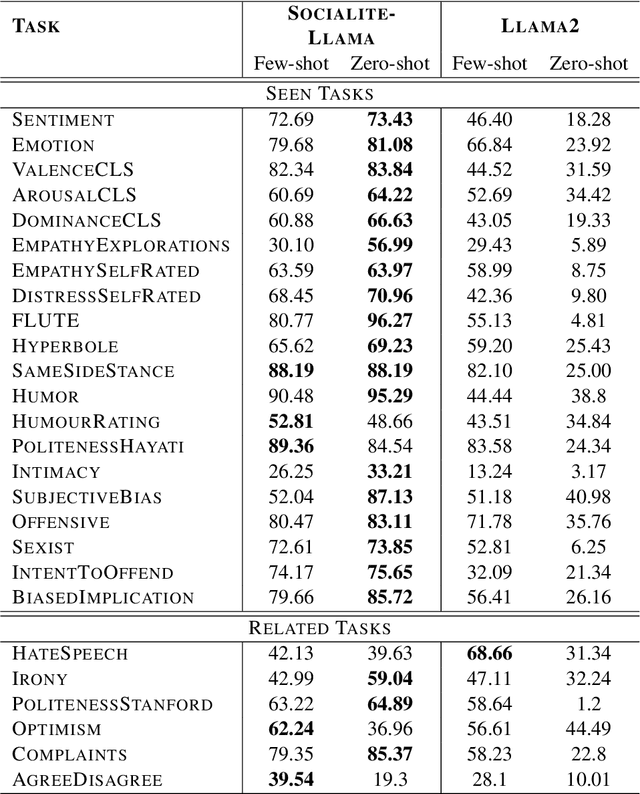
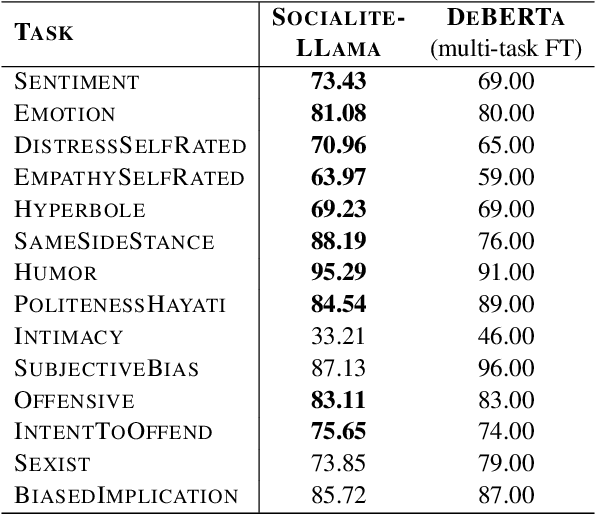
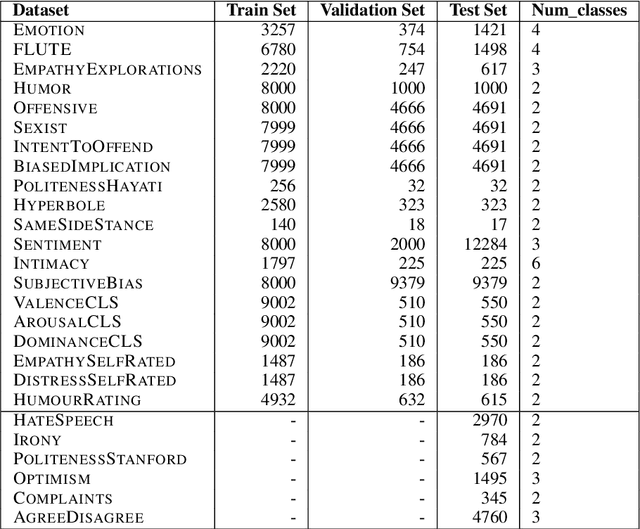
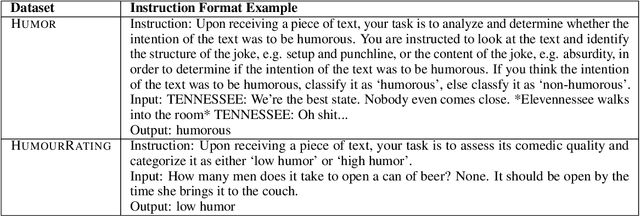
Social science NLP tasks, such as emotion or humor detection, are required to capture the semantics along with the implicit pragmatics from text, often with limited amounts of training data. Instruction tuning has been shown to improve the many capabilities of large language models (LLMs) such as commonsense reasoning, reading comprehension, and computer programming. However, little is known about the effectiveness of instruction tuning on the social domain where implicit pragmatic cues are often needed to be captured. We explore the use of instruction tuning for social science NLP tasks and introduce Socialite-Llama -- an open-source, instruction-tuned Llama. On a suite of 20 social science tasks, Socialite-Llama improves upon the performance of Llama as well as matches or improves upon the performance of a state-of-the-art, multi-task finetuned model on a majority of them. Further, Socialite-Llama also leads to improvement on 5 out of 6 related social tasks as compared to Llama, suggesting instruction tuning can lead to generalized social understanding. All resources including our code, model and dataset can be found through bit.ly/socialitellama.