 Add to Chrome
 Add to Firefox
 Add to Edge
Online Inference for Quantile Temporal Difference Learning in Distributional Reinforcement Learning
Aug 14, 2026
In this paper, we study how to perform statistical inference for quantile temporal difference learning (QTD) in distributional reinforcement learning. Assuming access to a generative model, we first establish functional central limit theorems for both synchronous and asynchronous QTD, which show that the averaged iterates of QTD converge weakly to a rescaled Brownian motion. We next provide online inference methods. Based on random scaling, the inference procedure constructs an asymptotically pivotal statistic for inference by using the information along the whole QTD path. Meanwhile, the proposed statistic can be computed online without storing the entire trajectory of QTD iterates. This substantially reduces the memory requirement and enables efficient statistical inference in distributional reinforcement learning.

Statistical Efficiency and Inference of Quantile Distributional Reinforcement Learning
Jul 09, 2026In this paper, we study quantile-based distributional reinforcement learning from the perspective of statistical efficiency. We focus on distributional policy evaluation, whose goal is to characterize the return distribution, namely the distribution of discounted cumulative rewards under a given policy. To obtain a finite-dimensional representation of the return distribution, we consider the quantile fixed point $η_m$ induced by the quantile-projected distributional Bellman equation. Assuming access to a generative model, we construct an estimator $η_m^{(n)}$ based on an empirical Markov decision process. For a fixed number of quantiles $m$, we establish a non-asymptotic error bound for $η_m^{(n)}$ and $η_m$ under the supremum $W_\infty$ metric, showing that the estimation error scales as $\widetilde{O}(\sqrt{m/n})$ with respect to $m$ and $n$. This implies that the quantile-based distributional policy evaluation problem can be solved with sample efficiency, achieving the optimal parametric $\sqrt{n}$ convergence rate. We derive the asymptotic distribution of the quantile parameters $\sqrt{n}(θ_m^{(n)}-θ_m)$ and characterize the semiparametric efficiency bound, which is attained by our estimator. Beyond the fixed-dimensional setting, we investigate the asymptotic regime in which the number of quantiles diverges. We characterize the limit covariance structure and show that it matches the semiparametric efficiency bound of the nonparametric model for distributional policy evaluation, showing that quantile-based estimators remain asymptotically efficient in the infinite-dimensional limit. Finally, we establish a Berry--Esseen theorem for smooth functionals $\sqrt{n}(η_m^{(n)}(s)-η_m(s))f$, thereby providing a foundation for statistically valid inference on functionals of the quantile-projected return distribution.
Warm-Started Reinforcement Learning for Iterative 3D/2D Liver Registration
Apr 11, 2026Registration between preoperative CT and intraoperative laparoscopic video plays a crucial role in augmented reality (AR) guidance for minimally invasive surgery. Learning-based methods have recently achieved registration errors comparable to optimization-based approaches while offering faster inference. However, many supervised methods produce coarse alignments that rely on additional optimization-based refinement, thereby increasing inference time. We present a discrete-action reinforcement learning (RL) framework that formulates CT-to-video registration as a sequential decision-making process. A shared feature encoder, warm-started from a supervised pose estimation network to provide stable geometric features and faster convergence, extracts representations from CT renderings and laparoscopic frames, while an RL policy head learns to choose rigid transformations along six degrees of freedom and to decide when to stop the iteration. Experiments on a public laparoscopic dataset demonstrated that our method achieved an average target registration error (TRE) of 15.70 mm, comparable to supervised approaches with optimization, while achieving faster convergence. The proposed RL-based formulation enables automated, efficient iterative registration without manually tuned step sizes or stopping criteria. This discrete framework provides a practical foundation for future continuous-action and deformable registration models in surgical AR applications.
Enhancing Contrastive Learning for Retinal Imaging via Adjusted Augmentation Scales
Jan 05, 2025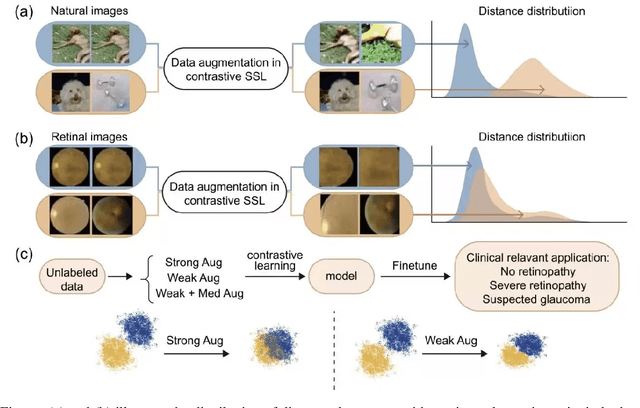

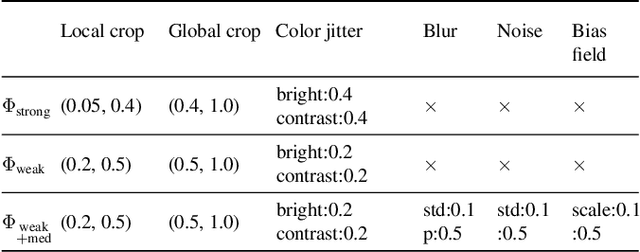

Contrastive learning, a prominent approach within self-supervised learning, has demonstrated significant effectiveness in developing generalizable models for various applications involving natural images. However, recent research indicates that these successes do not necessarily extend to the medical imaging domain. In this paper, we investigate the reasons for this suboptimal performance and hypothesize that the dense distribution of medical images poses challenges to the pretext tasks in contrastive learning, particularly in constructing positive and negative pairs. We explore model performance under different augmentation strategies and compare the results to those achieved with strong augmentations. Our study includes six publicly available datasets covering multiple clinically relevant tasks. We further assess the model's generalizability through external evaluations. The model pre-trained with weak augmentation outperforms those with strong augmentation, improving AUROC from 0.838 to 0.848 and AUPR from 0.523 to 0.597 on MESSIDOR2, and showing similar enhancements across other datasets. Our findings suggest that optimizing the scale of augmentation is critical for enhancing the efficacy of contrastive learning in medical imaging.