 Add to Chrome
 Add to Firefox
 Add to Edge
Technical Report of RoboSpatial Challenge at CVPR 2026: Selective Reasoning Activation and Reference-Frame Disambiguation for Embodied Spatial Reasoning
Jun 30, 2026
Vision-language models achieve strong general perception but often struggle with the spatial reasoning required for embodied tasks. We present RoboSpatialBrain, our submission to the RoboSpatial Challenge at the Embodied Reasoning in Action Workshop, CVPR 2026, built on RoboBrain2.5-8B-NV. RoboSpatialBrain combines two training-free, inference-time mechanisms: a forced <think> prefix activation strategy paired with a task-specific post-prompt that elicits deliberate reasoning on context and compatibility tasks, and an explicit reference-frame redirection pipeline that resolves camera-centric and object-centric ambiguity for context tasks. We additionally explore fine-tuning RoboBrain2.5 on compatibility data and present a detailed analysis of its interaction with prompting. RoboSpatialBrain achieved first place in the RoboSpatial Challenge, with an overall success rate of 80.9\% on RoboSpatial-Home. Code is available at https://github.com/YuxiangXie2003/RoboSpatialBrain.

Efficient Visual Pointing for Embodied AI:Agent-Driven Data Synthesis, Cross-Block Attention, and Iterative Correction
Jun 29, 2026Visual pointing maps a language instruction to pixel co ordinates, a core skill for embodied AI. We describe our PointArena 2026 solution, which achieves 77.2% overall accuracy and ranks second on the benchmark. The ap proach targets three failure modes. First, agent-driven syn thesis builds large semantic and anchor-relative candidate pools; the server inventory contains 55,372 processed out puts, 53,772 de-duplicated sample IDs, and 37,574 train able completed or accepted rows. Second, a determinis tic steerable-data pipeline creates a verified 10,000-sample main set, plus reserve samples, using masks, templates, and path verification. Third, two model-side modules address complementary errors: AttnRes adds gated cross-block at tention for steerability, while ABC correction encodes per turbed coordinates with visual features for general coordi nate grounding. Category-aware routing combines comple mentary specialists; local validation used to select experts records 93.9% Affordance, 82.6% Spatial Relation, 78.2% Reasoning, 70.4% Counting, and 63.0% Steerability.
Machine learning assisted screening of metal binary alloys for anode materials
Sep 15, 2024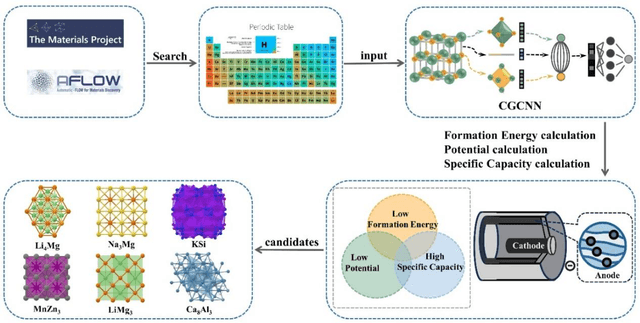
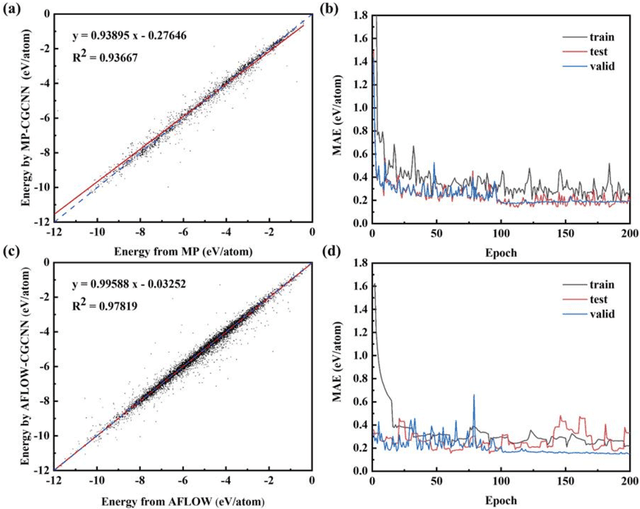
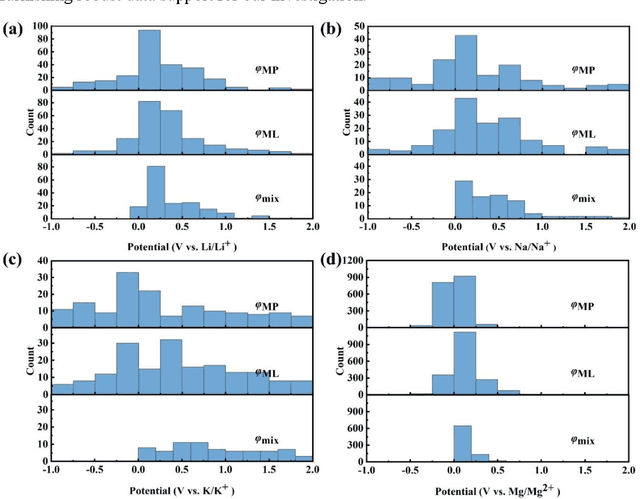
In the dynamic and rapidly advancing battery field, alloy anode materials are a focal point due to their superior electrochemical performance. Traditional screening methods are inefficient and time-consuming. Our research introduces a machine learning-assisted strategy to expedite the discovery and optimization of these materials. We compiled a vast dataset from the MP and AFLOW databases, encompassing tens of thousands of alloy compositions and properties. Utilizing a CGCNN, we accurately predicted the potential and specific capacity of alloy anodes, validated against experimental data. This approach identified approximately 120 low potential and high specific capacity alloy anodes suitable for various battery systems including Li, Na, K, Zn, Mg, Ca, and Al-based. Our method not only streamlines the screening of battery anode materials but also propels the advancement of battery material research and innovation in energy storage technology.