 Add to Chrome
 Add to Firefox
 Add to Edge
Thinking in Structures: Evaluating Spatial Intelligence through Reasoning on Constrained Manifolds
Feb 08, 2026
Spatial intelligence is crucial for vision--language models (VLMs) in the physical world, yet many benchmarks evaluate largely unconstrained scenes where models can exploit 2D shortcuts. We introduce SSI-Bench, a VQA benchmark for spatial reasoning on constrained manifolds, built from complex real-world 3D structures whose feasible configurations are tightly governed by geometric, topological, and physical constraints. SSI-Bench contains 1,000 ranking questions spanning geometric and topological reasoning and requiring a diverse repertoire of compositional spatial operations, such as mental rotation, cross-sectional inference, occlusion reasoning, and force-path reasoning. It is created via a fully human-centered pipeline: ten researchers spent over 400 hours curating images, annotating structural components, and designing questions to minimize pixel-level cues. Evaluating 31 widely used VLMs reveals a large gap to humans: the best open-source model achieves 22.2% accuracy and the strongest closed-source model reaches 33.6%, while humans score 91.6%. Encouraging models to think yields only marginal gains, and error analysis points to failures in structural grounding and constraint-consistent 3D reasoning. Project page: https://ssi-bench.github.io.

PO-GVINS: Tightly Coupled GNSS-Visual-Inertial Integration with Pose-Only Representation
Jan 16, 2025Accurate and reliable positioning is crucial for perception, decision-making, and other high-level applications in autonomous driving, unmanned aerial vehicles, and intelligent robots. Given the inherent limitations of standalone sensors, integrating heterogeneous sensors with complementary capabilities is one of the most effective approaches to achieving this goal. In this paper, we propose a filtering-based, tightly coupled global navigation satellite system (GNSS)-visual-inertial positioning framework with a pose-only formulation applied to the visual-inertial system (VINS), termed PO-GVINS. Specifically, multiple-view imaging used in current VINS requires a priori of 3D feature, then jointly estimate camera poses and 3D feature position, which inevitably introduces linearization error of the feature as well as facing dimensional explosion. However, the pose-only (PO) formulation, which is demonstrated to be equivalent to the multiple-view imaging and has been applied in visual reconstruction, represent feature depth using two camera poses and thus 3D feature position is removed from state vector avoiding aforementioned difficulties. Inspired by this, we first apply PO formulation in our VINS, i.e., PO-VINS. GNSS raw measurements are then incorporated with integer ambiguity resolved to achieve accurate and drift-free estimation. Extensive experiments demonstrate that the proposed PO-VINS significantly outperforms the multi-state constrained Kalman filter (MSCKF). By incorporating GNSS measurements, PO-GVINS achieves accurate, drift-free state estimation, making it a robust solution for positioning in challenging environments.
Facial Affect Recognition in the Wild Using Multi-Task Learning Convolutional Network
Feb 03, 2020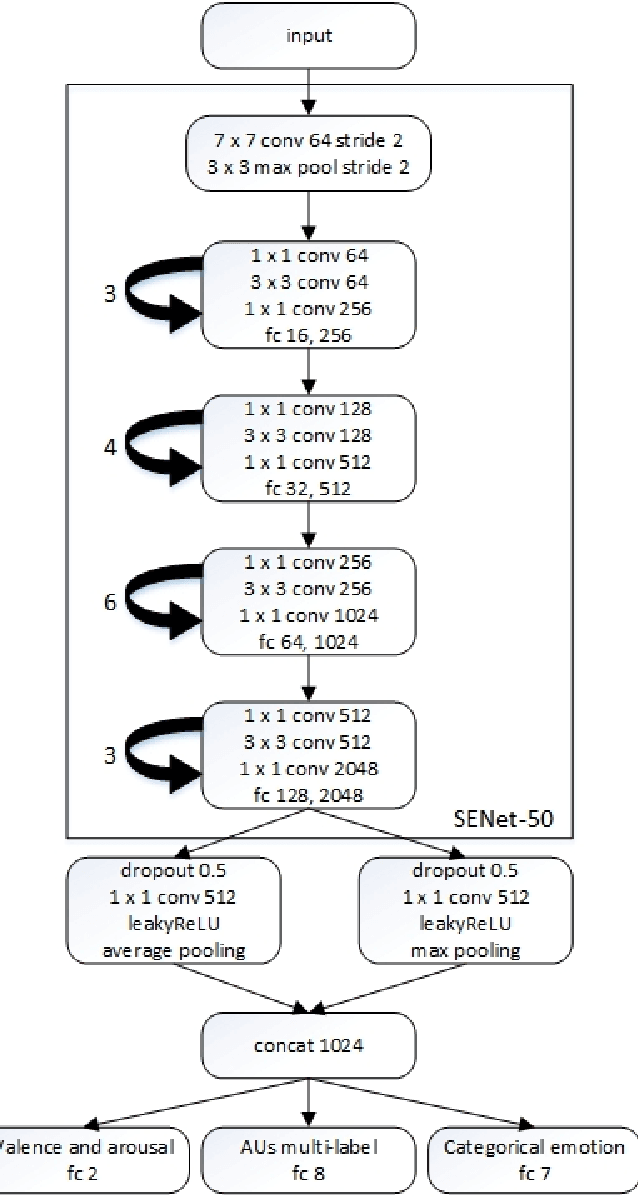
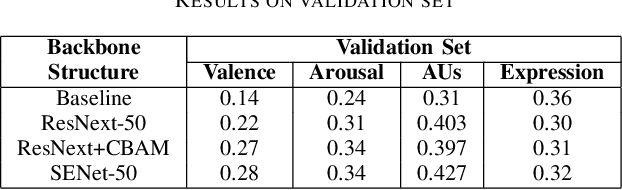
This paper presents a neural network based method Multi-Task Affect Net(MTANet) submitted to the Affective Behavior Analysis in-the-Wild Challenge in FG2020. This method is a multi-task network and based on SE-ResNet modules. By utilizing multi-task learning, this network can estimate and recognize three quantified affective models: valence and arousal, action units, and seven basic emotions simultaneously. MTANet achieve Concordance Correlation Coefficient(CCC) rates of 0.28 and 0.34 for valence and arousal, F1-score of 0.427 and 0.32 for AUs detection and categorical emotion classification.