 Add to Chrome
 Add to Firefox
 Add to Edge
Think at 5 Hz, Act at 20 Hz: Asynchronous Fast-Slow Vision-Language-Action Inference for Closed-Loop Driving
Jul 17, 2026
Large language models bring instruction following and scene reasoning to end-to-end driving, but their inference latency collides with the control rate a vehicle requires. Existing closed-loop agents hide this gap by invoking the model on alternate simulation ticks and replaying the previous command in between, so half of all control outputs ignore the newest observations. We present a fast-slow architecture that removes this compromise. A frozen 7B vision-language backbone acts as the slow system, digesting navigation instructions and visual history at low frequency while exposing its per-layer key-value cache as a standing representation of the scene. A lightweight action expert acts as the fast system, attending to this cache and to the current camera frame at every simulation tick to regress waypoints in a single forward pass. Since the cache lags behind the world at deployment, we train the expert under randomized staleness, aligning training with asynchronous execution. On LangAuto-Short routes in CARLA, our system produces fresh control at every 50 ms simulation tick and lifts route completion from 37.0 to 94.0 over the frame-skipping baseline. A frame-skip ablation with the same expert separates the two factors at work: the expert raises the driving score on its own, while per-tick freshness raises completion from 82.1 to 94.0 and cuts red-light violations by a third. Trained on a single town, the expert transfers zero-shot to two unseen towns, holding 84-94% route completion where the baseline reaches 31-41%. It reduces open-loop waypoint error by nearly a factor of four compared to the backbone's own action head, at a per-tick model cost of 32 ms that is independent of history length on a single consumer GPU.

Instance-Level Post Hoc Uncertainty Quantification in Object Detection
Jun 03, 2026Object detection is a safety-critical component of autonomous driving. It is essential to quantify the uncertainty in bounding-box predictions for safety assurance. Post hoc uncertainty quantification without retraining aligns with real-world deployment requirements; therefore, we employ the Laplace approximation. Because instance-level uncertainty is needed, linearized inference methods that require multiple backpropagations are not time-efficient, and sampling-based methods are not fully post hoc. We propose Monte-Carlo generalized linearized model (MC-GLM), which provides instance-level and approximately post hoc uncertainty quantification. The number of samples required in the Monte Carlo step is constant and independent of the number of output instances, so it can be parallelized. Experiments on the nuScenes dataset with the CenterPoint detector validate the effectiveness of our method, and the resulting uncertainties exhibit good quality.
World Models: The Safety Perspective
Nov 12, 2024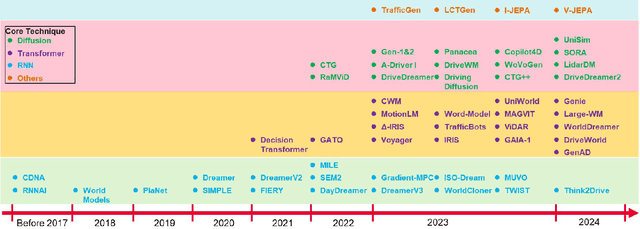
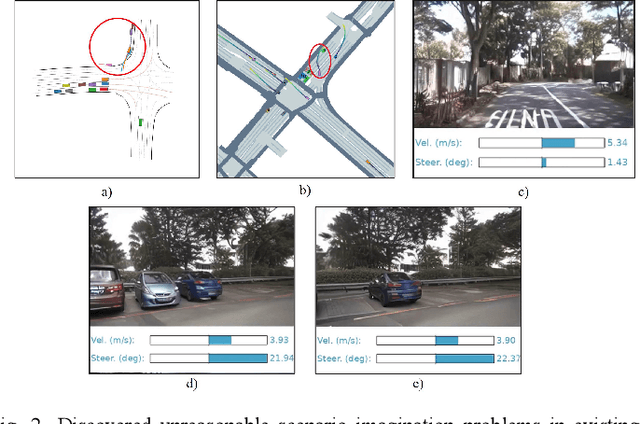
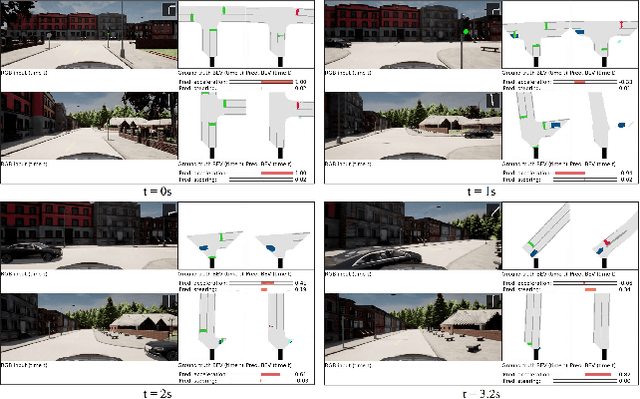
With the proliferation of the Large Language Model (LLM), the concept of World Models (WM) has recently attracted a great deal of attention in the AI research community, especially in the context of AI agents. It is arguably evolving into an essential foundation for building AI agent systems. A WM is intended to help the agent predict the future evolution of environmental states or help the agent fill in missing information so that it can plan its actions and behave safely. The safety property of WM plays a key role in their effective use in critical applications. In this work, we review and analyze the impacts of the current state-of-the-art in WM technology from the point of view of trustworthiness and safety based on a comprehensive survey and the fields of application envisaged. We provide an in-depth analysis of state-of-the-art WMs and derive technical research challenges and their impact in order to call on the research community to collaborate on improving the safety and trustworthiness of WM.