 Add to Chrome
 Add to Firefox
 Add to Edge
StemVLA:An Open-Source Vision-Language-Action Model with Future 3D Spatial Geometry Knowledge and 4D Historical Representation
Feb 27, 2026
Vision-language-action (VLA) models integrate visual observations and language instructions to predict robot actions, demonstrating promising generalization in manipulation tasks. However, most existing approaches primarily rely on direct mappings from 2D visual inputs to action sequences, without explicitly modeling the underlying 3D spatial structure or temporal world dynamics. Such representations may limit spatial reasoning and long-horizon decision-making in dynamic environments. To address this limitation, we propose StemVLA, a novel framework that explicitly incorporates both future-oriented 3D spatial knowledge and historical 4D spatiotemporal representations into action prediction. First, instead of relying solely on observed images, StemVLA forecasts structured 3D future spatial-geometric world knowledge, enabling the model to anticipate upcoming scene geometry and object configurations. Second, to capture temporal consistency and motion dynamics, we feed historical image frames into a pretrained video-geometry transformer backbone to extract implicit 3D world representations, and further aggregate them across time using a temporal attention module, termed VideoFormer [20], forming a unified 4D historical spatiotemporal representation. By jointly modeling 2D observations, predicted 3D future structure, and aggregated 4D temporal dynamics, StemVLA enables more comprehensive world understanding for robot manipulation. Extensive experiments in simulation demonstrate that StemVLA significantly improves long-horizon task success and achieves state-of-the-art performance on the CALVIN ABC-D benchmark [46], achieving an average sequence length of XXX.

UI Layout Generation with LLMs Guided by UI Grammar
Oct 24, 2023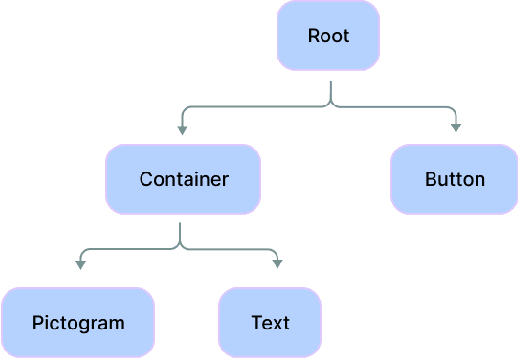
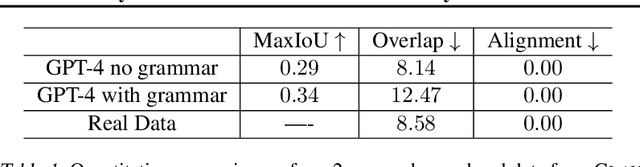
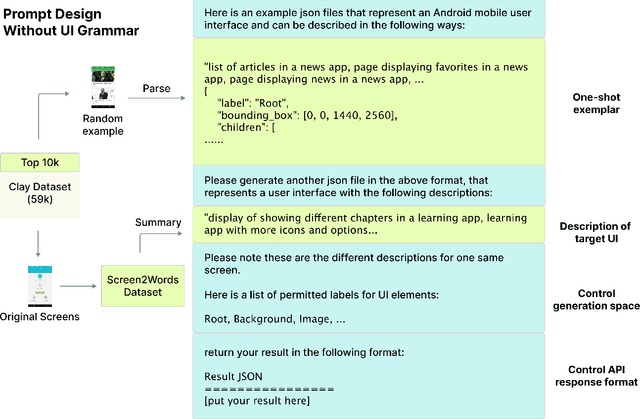
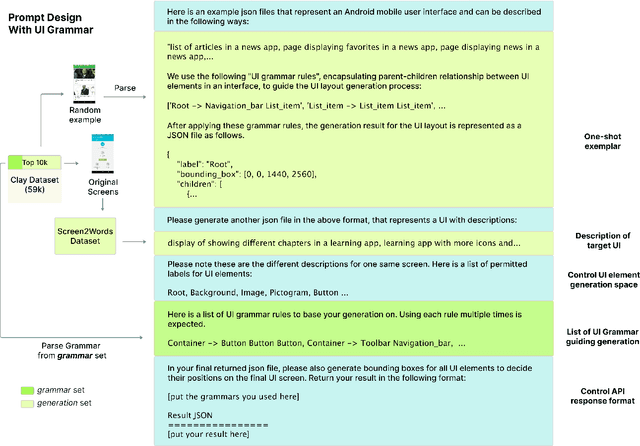
The recent advances in Large Language Models (LLMs) have stimulated interest among researchers and industry professionals, particularly in their application to tasks concerning mobile user interfaces (UIs). This position paper investigates the use of LLMs for UI layout generation. Central to our exploration is the introduction of UI grammar -- a novel approach we proposed to represent the hierarchical structure inherent in UI screens. The aim of this approach is to guide the generative capacities of LLMs more effectively and improve the explainability and controllability of the process. Initial experiments conducted with GPT-4 showed the promising capability of LLMs to produce high-quality user interfaces via in-context learning. Furthermore, our preliminary comparative study suggested the potential of the grammar-based approach in improving the quality of generative results in specific aspects.