 Add to Chrome
 Add to Firefox
 Add to Edge
BASeg: Boundary-Aware Remote Sensing Segmentation with Structural Penalties
Aug 16, 2026
Semantic segmentation is a core computer vision task in the remote sensing field, accelerating advancements in ur- ban development, agriculture, ecology, water resources, and environmental monitoring. However, recent methods usually struggle to capture fine-grained object features and bound- ary details. Besides, current widely used datasets often lack city morphology diversity and segmentation on generative im- ages remains largely unexplored. To address these issues, we propose a Mahalanobis-Angle Boundary Loss (MABL) that explicitly enhances boundary and shape consistency. MABL jointly models structural importance and boundary orientation through Mahalanobis distance-based weighting and angle- aware penalty. It can be readily integrated into diverse seg- mentation architectures and consistently improves their accu- racy. Built upon MABL, we introduce BASeg, a boundary- aware remote sensing segmentation framework with Struc- tural Penalties. BASeg integrates a Global Visual State Space module (GSM) with a Cross-Feature Fusion module (CFM) to capture both long-range contextual dependencies and fine- grained local details. Additionally, we establish a global 10- city benchmark dataset (GCD-25k) to facilitate accurate build- ing and road segmentation. Extensive experiments on four remote-sensing benchmarks demonstrate that BASeg consis- tently outperforms existing methods, achieving up to a 2.8% improvement in mIoU while producing more accurate object boundary segmentation across diverse scenes. Moreover, integrating MABL into multiple existing segmentation archi- tectures consistently improves performance across datasets, demonstrating its robustness and broad applicability.

TAPS: Target-Aware Prefix Tree Selection for Diffusion-Drafted Speculative Decoding
May 30, 2026Using a diffusion model for parallel drafting is a promising approach for speculative decoding. By predicting tokens at multiple future positions in a single forward pass, diffusion drafters substantially reduce drafting latency. However, this shifts the bottleneck to verification: verifying a single sequence limits acceptance length, while verifying large draft trees incurs excessive target-model latency. We identify a key mismatch in existing draft-tree methods: existing diffusion-tree methods rank nodes by the marginal probability, ignoring that verification is prefix-conditioned. As a result, they may verify unreachable descendants of rejected prefixes, increasing latency with limited acceptance gains. To address this, we propose TAPS, a target-aware prefix selection method that turns diffusion marginals into path-conditioned acceptance estimates. TAPS then selects a compact prefix-closed subtree under a fixed verification budget, improving the acceptance-cost tradeoff rather than simply expanding the draft tree. Experiments across diverse datasets and model families demonstrate that TAPS achieves up to 7.9x lossless end-to-end speedup over vanilla autoregressive decoding, outperforming state-of-the-art DFlash and DDTree by 1.36x and 1.74x respectively. Our work is available at https://anonymous.4open.science/r/TAPS-EMNLP2026-53DD
Rules or Weights? Comparing User Understanding of Explainable AI Techniques with the Cognitive XAI-Adaptive Model
Feb 23, 2026Rules and Weights are popular XAI techniques for explaining AI decisions. Yet, it remains unclear how to choose between them, lacking a cognitive framework to compare their interpretability. In an elicitation user study on forward and counterfactual decision tasks, we identified 7 reasoning strategies of interpreting three XAI Schemas - weights, rules, and their hybrid. To analyze their capabilities, we propose CoXAM, a Cognitive XAI-Adaptive Model with shared memory representation to encode instance attributes, linear weights, and decision rules. CoXAM employs computational rationality to choose among reasoning processes based on the trade-off in utility and reasoning time, separately for forward or counterfactual decision tasks. In a validation study, CoXAM demonstrated a stronger alignment with human decision-making compared to baseline machine learning proxy models. The model successfully replicated and explained several key empirical findings, including that counterfactual tasks are inherently harder than forward tasks, decision tree rules are harder to recall and apply than linear weights, and the helpfulness of XAI depends on the application data context, alongside identifying which underlying reasoning strategies were most effective. With CoXAM, we contribute a cognitive basis to accelerate debugging and benchmarking disparate XAI techniques.
Step-GUI Technical Report
Dec 19, 2025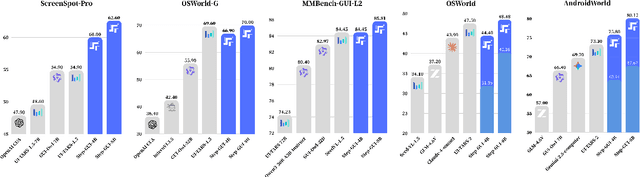
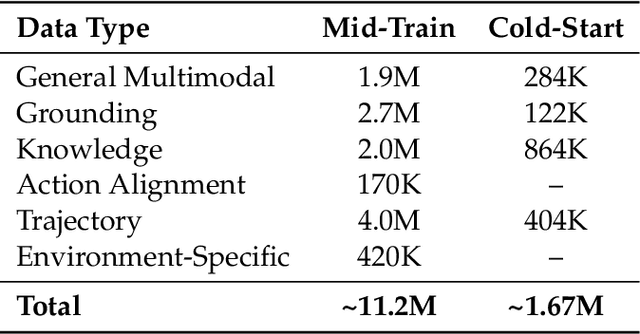
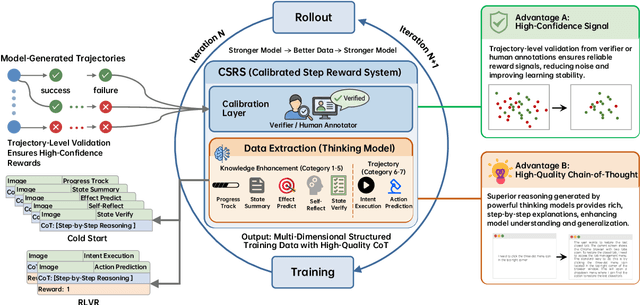
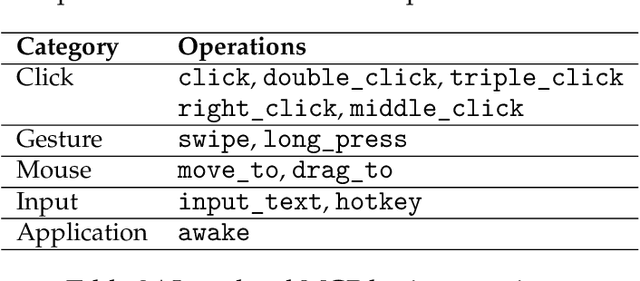
Recent advances in multimodal large language models unlock unprecedented opportunities for GUI automation. However, a fundamental challenge remains: how to efficiently acquire high-quality training data while maintaining annotation reliability? We introduce a self-evolving training pipeline powered by the Calibrated Step Reward System, which converts model-generated trajectories into reliable training signals through trajectory-level calibration, achieving >90% annotation accuracy with 10-100x lower cost. Leveraging this pipeline, we introduce Step-GUI, a family of models (4B/8B) that achieves state-of-the-art GUI performance (8B: 80.2% AndroidWorld, 48.5% OSWorld, 62.6% ScreenShot-Pro) while maintaining robust general capabilities. As GUI agent capabilities improve, practical deployment demands standardized interfaces across heterogeneous devices while protecting user privacy. To this end, we propose GUI-MCP, the first Model Context Protocol for GUI automation with hierarchical architecture that combines low-level atomic operations and high-level task delegation to local specialist models, enabling high-privacy execution where sensitive data stays on-device. Finally, to assess whether agents can handle authentic everyday usage, we introduce AndroidDaily, a benchmark grounded in real-world mobile usage patterns with 3146 static actions and 235 end-to-end tasks across high-frequency daily scenarios (8B: static 89.91%, end-to-end 52.50%). Our work advances the development of practical GUI agents and demonstrates strong potential for real-world deployment in everyday digital interactions.