 Add to Chrome
 Add to Firefox
 Add to Edge
Rules or Weights? Comparing User Understanding of Explainable AI Techniques with the Cognitive XAI-Adaptive Model
Feb 23, 2026
Rules and Weights are popular XAI techniques for explaining AI decisions. Yet, it remains unclear how to choose between them, lacking a cognitive framework to compare their interpretability. In an elicitation user study on forward and counterfactual decision tasks, we identified 7 reasoning strategies of interpreting three XAI Schemas - weights, rules, and their hybrid. To analyze their capabilities, we propose CoXAM, a Cognitive XAI-Adaptive Model with shared memory representation to encode instance attributes, linear weights, and decision rules. CoXAM employs computational rationality to choose among reasoning processes based on the trade-off in utility and reasoning time, separately for forward or counterfactual decision tasks. In a validation study, CoXAM demonstrated a stronger alignment with human decision-making compared to baseline machine learning proxy models. The model successfully replicated and explained several key empirical findings, including that counterfactual tasks are inherently harder than forward tasks, decision tree rules are harder to recall and apply than linear weights, and the helpfulness of XAI depends on the application data context, alongside identifying which underlying reasoning strategies were most effective. With CoXAM, we contribute a cognitive basis to accelerate debugging and benchmarking disparate XAI techniques.

Comparables XAI: Faithful Example-based AI Explanations with Counterfactual Trace Adjustments
Feb 14, 2026Explaining with examples is an intuitive way to justify AI decisions. However, it is challenging to understand how a decision value should change relative to the examples with many features differing by large amounts. We draw from real estate valuation that uses Comparables-examples with known values for comparison. Estimates are made more accurate by hypothetically adjusting the attributes of each Comparable and correspondingly changing the value based on factors. We propose Comparables XAI for relatable example-based explanations of AI with Trace adjustments that trace counterfactual changes from each Comparable to the Subject, one attribute at a time, monotonically along the AI feature space. In modelling and user studies, Trace-adjusted Comparables achieved the highest XAI faithfulness and precision, user accuracy, and narrowest uncertainty bounds compared to linear regression, linearly adjusted Comparables, or unadjusted Comparables. This work contributes a new analytical basis for using example-based explanations to improve user understanding of AI decisions.
SalienTrack: providing salient information for semi-automated self-tracking feedback with model explanations
Sep 21, 2021
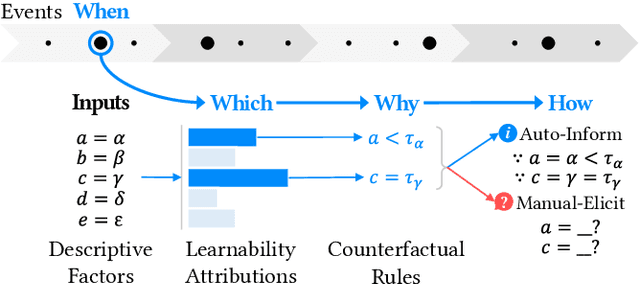

Self-tracking can improve people's awareness of their unhealthy behaviors to provide insights towards behavior change. Prior work has explored how self-trackers reflect on their logged data, but it remains unclear how much they learn from the tracking feedback, and which information is more useful. Indeed, the feedback can still be overwhelming, and making it concise can improve learning by increasing focus and reducing interpretation burden. We conducted a field study of mobile food logging with two feedback modes (manual journaling and automatic annotation of food images) and identified learning differences regarding nutrition, assessment, behavioral, and contextual information. We propose a Self-Tracking Feedback Saliency Framework to define when to provide feedback, on which specific information, why those details, and how to present them (as manual inquiry or automatic feedback). We propose SalienTrack to implement these requirements. Using the data collected from the user study, we trained a machine learning model to predict whether a user would learn from each tracked event. Using explainable AI (XAI) techniques, we identified the most salient features per instance and why they lead to positive learning outcomes. We discuss implications for learnability in self-tracking, and how adding model explainability expands opportunities for improving feedback experience.