 Add to Chrome
 Add to Firefox
 Add to Edge
PL-NBA: A Possession-level Universal Basketball Video Dataset Supporting Multiple Visual Understanding Tasks
Aug 20, 2026
Visual understanding in sports has emerged as a hot topic in computer vision in recent years. Most existing basketball video datasets adopt single action or activity as sample, which can neither preserve the temporal continuity of game events nor support complex tasks such as action anticipation. To address this issue, this paper constructs the first possession-level basketball video dataset (PL-NBA), in which each sample is composed of a complete NBA offensive possession. Collected from 60 NBA games, PL-NBA contains 11,000 valid offensive possession clips and 31,567 annotated events with player names, captions, event types and timestamps. Each video clip includes multiple events and preserves the continuity of events, which is helpful for analysis of tactic. Experiment is conducted on multiple visual understanding tasks, including event recognition, video captioning, temporal action localization and action anticipation. Experimental results show that existing methods achieve limited performance on above four tasks, demonstrating that PL-NBA is a challenging benchmark for sports video understanding.

Knowledge Augmented Relation Inference for Group Activity Recognition
Mar 01, 2023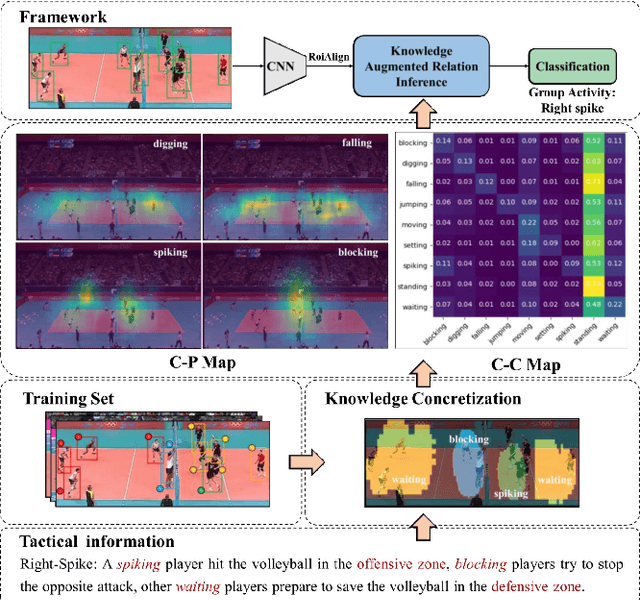
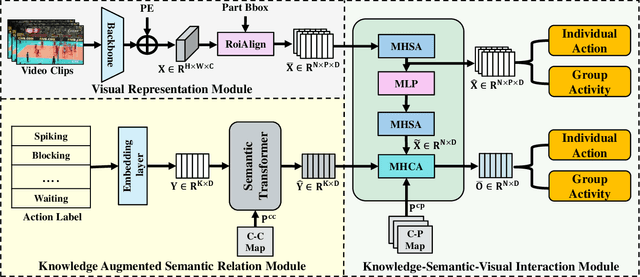
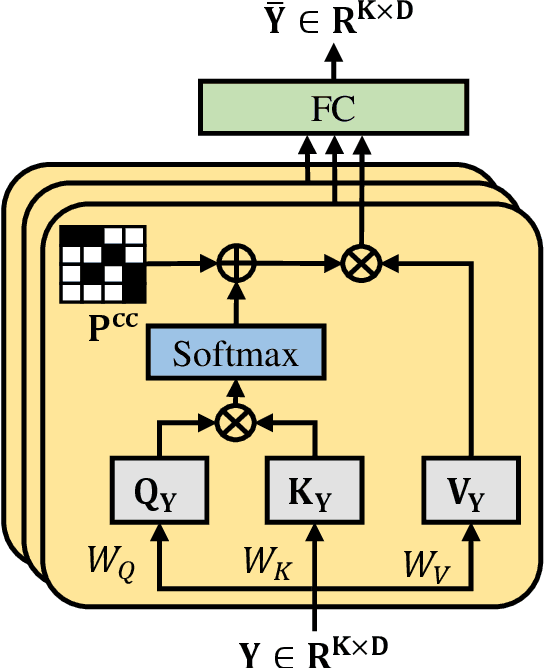
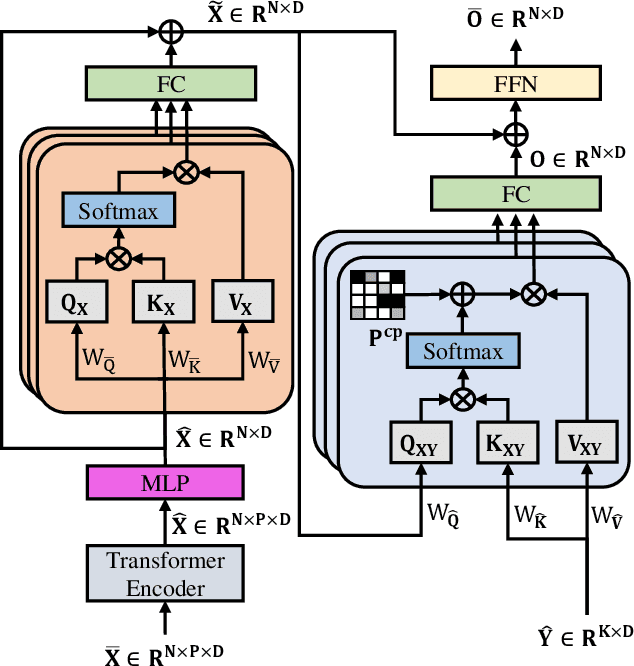
Most existing group activity recognition methods construct spatial-temporal relations merely based on visual representation. Some methods introduce extra knowledge, such as action labels, to build semantic relations and use them to refine the visual presentation. However, the knowledge they explored just stay at the semantic-level, which is insufficient for pursing notable accuracy. In this paper, we propose to exploit knowledge concretization for the group activity recognition, and develop a novel Knowledge Augmented Relation Inference framework that can effectively use the concretized knowledge to improve the individual representations. Specifically, the framework consists of a Visual Representation Module to extract individual appearance features, a Knowledge Augmented Semantic Relation Module explore semantic representations of individual actions, and a Knowledge-Semantic-Visual Interaction Module aims to integrate visual and semantic information by the knowledge. Benefiting from these modules, the proposed framework can utilize knowledge to enhance the relation inference process and the individual representations, thus improving the performance of group activity recognition. Experimental results on two public datasets show that the proposed framework achieves competitive performance compared with state-of-the-art methods.