 Add to Chrome
 Add to Firefox
 Add to Edge
FinanceHarness: Autonomous Financial Deep Research Framework
Jul 30, 2026
Powered by advances in LLMs and autonomous agents, deep research has become one of the most widely adopted agentic products. However, most deep research systems write general-purpose reports, which are inadequate for financial deep research. Financial research demands specialized knowledge to analyze historical patterns and forecast upcoming events. Automating financial deep research therefore requires both a layered harness to drive the research agent and a verifiable, point-in-time benchmark that prevents leakage of future information. We present FinanceHarness, a harness that runs finance-oriented tools and practitioner-guided workflows, automating financial deep research end to end: environment and data construction, the agent execution loop, and reward modeling. We further propose FinanceGym, comprising thesis-driven research questions and rubrics that combine pre-cutoff and post-cutoff criteria. Professional expert validation yields an 82% pass rate. Even leading LLMs and agents score below 40% on the rubrics, showing that FinanceGym is challenging and leaves substantial headroom. With the same open-weight backbone, FinanceHarness improves the overall rubric score from 25.3% to 32.4%. FinanceHarness is available at https://github.com/Yijia-Xiao/FinanceHarness.

Hierarchical end-to-end autonomous navigation through few-shot waypoint detection
Sep 23, 2024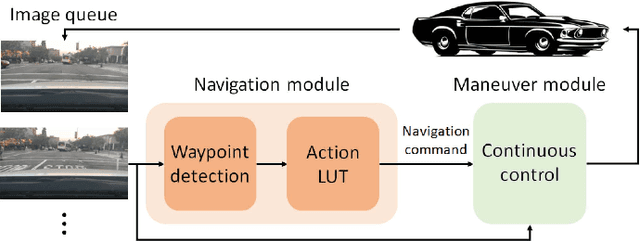
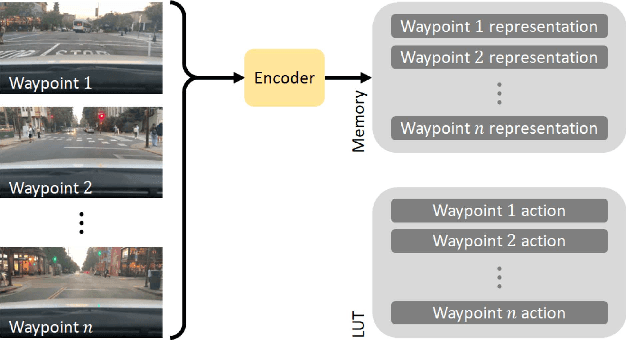

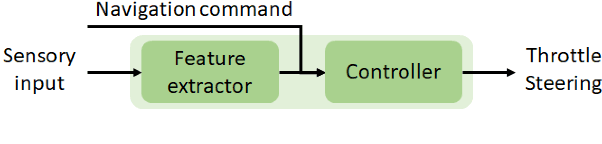
Human navigation is facilitated through the association of actions with landmarks, tapping into our ability to recognize salient features in our environment. Consequently, navigational instructions for humans can be extremely concise, such as short verbal descriptions, indicating a small memory requirement and no reliance on complex and overly accurate navigation tools. Conversely, current autonomous navigation schemes rely on accurate positioning devices and algorithms as well as extensive streams of sensory data collected from the environment. Inspired by this human capability and motivated by the associated technological gap, in this work we propose a hierarchical end-to-end meta-learning scheme that enables a mobile robot to navigate in a previously unknown environment upon presentation of only a few sample images of a set of landmarks along with their corresponding high-level navigation actions. This dramatically simplifies the wayfinding process and enables easy adoption to new environments. For few-shot waypoint detection, we implement a metric-based few-shot learning technique through distribution embedding. Waypoint detection triggers the multi-task low-level maneuver controller module to execute the corresponding high-level navigation action. We demonstrate the effectiveness of the scheme using a small-scale autonomous vehicle on novel indoor navigation tasks in several previously unseen environments.
* Appeared at the 40th Anniversary of the IEEE International Conference on Robotics and Automation (ICRA@40), 23-26 September, 2024, Rotterdam, The Netherlands. 9 pages, 5 figures
One-Shot Learning of Visual Path Navigation for Autonomous Vehicles
Jun 15, 2023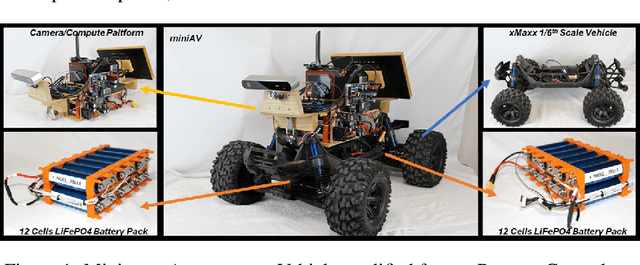
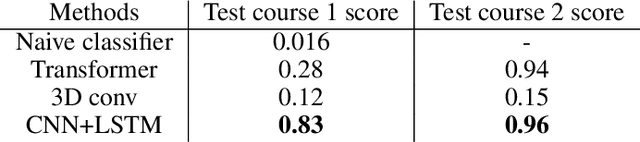
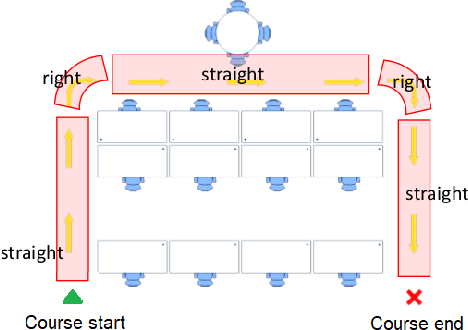
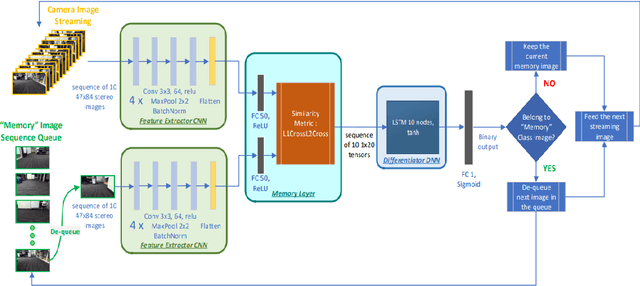
Autonomous driving presents many challenges due to the large number of scenarios the autonomous vehicle (AV) may encounter. End-to-end deep learning models are comparatively simplistic models that can handle a broad set of scenarios. However, end-to-end models require large amounts of diverse data to perform well. This paper presents a novel deep neural network that performs image-to-steering path navigation that helps with the data problem by adding one-shot learning to the system. Presented with a previously unseen path, the vehicle can drive the path autonomously after being shown the path once and without model retraining. In fact, the full path is not needed and images of the road junctions is sufficient. In-vehicle testing and offline testing are used to verify the performance of the proposed navigation and to compare different candidate architectures.