 Add to Chrome
 Add to Firefox
 Add to Edge
CoCo-IR: Contextual Composed Image Retrieval
Aug 05, 2026
Current instruction-based image retrieval systems are powerful but limited to single-turn interactions, failing to capture the iterative nature of complex, real-world visual searches. To overcome this limitation, we introduce Contextual Composed Image Retrieval (CoCo-IR), a novel task that enables users to progressively refine search results through interactions. We address this new task by proposing a new model based on a Large Multimodal Model (LMM) that functions as a context-aware reasoner for CoCo-IR. Our model interprets the entire interaction history to generate Transformable Image Embeddings (TIE) that evolve across turns. To fuel the model training without expensive human annotations, we develop a fully autonomous, scalable data engine that leverages LMMs to generate high-quality contextual retrieval data, and uses model-guided verification to mine challenging hard negatives. Extensive experiments demonstrate that our approach establishes new state-of-the-art performance: We achieve 39.4 mAP@5 on the challenging single-turn benchmark CIRCO; furthermore, on our new CoCo-IR benchmark, our model maintains robust performance with 44.1 R@1 on 4-turn dialogues, dramatically outperforming existing methods (28.2 4-turn R@1) that fail to handle multi-turn context. Project page: https://CoCo-IR.github.io.

Gemini Embedding 2: A Native Multimodal Embedding Model from Gemini
May 26, 2026We introduce Gemini Embedding 2, a native multimodal embedding model that allows embedding video, audio, image, and text modalities in a unified representation space. We leverage the multimodal capabilities of Gemini to produce embeddings for arbitrary combinations of interleaved inputs across all these modalities that generalize well across a wide variety of tasks. Applying large-scale contrastive learning in a multi-task multi-stage training setup, we achieve state-of-the-art performance on key embedding benchmarks including unimodal, cross-modal, and multimodal retrieval spanning a diverse set of tasks. We show that our embedding model demonstrates strong performance (with a score of 62.9 R@1 on MSCOCO, 68.8 NDCG@10 on Vatex, 69.9 on MTEB multilingual and 84.0 on MTEB Code) across a variety of tasks surpassing the performance of specialized models. These unified capabilities make Gemini Embedding 2 a promising candidate for downstream use cases such as RAG, recommendation and search. Furthermore, its robust zero-shot performance across distinct fields - from astronomy and bioscience to fine arts and the culinary arts - establishes it as a highly reliable, out-of-the-box representation even for specialized domains.
Modifying Bayesian Networks by Probability Constraints
Jul 04, 2012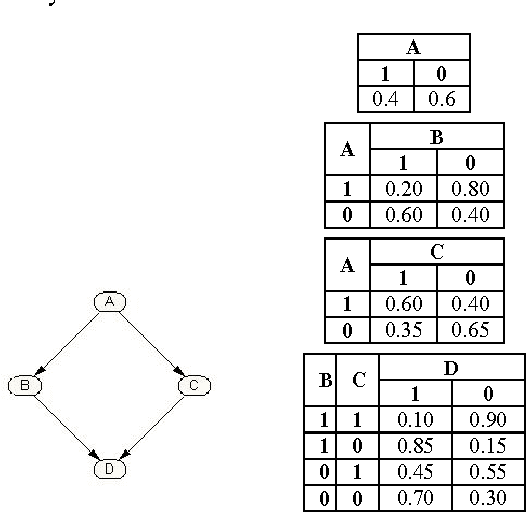
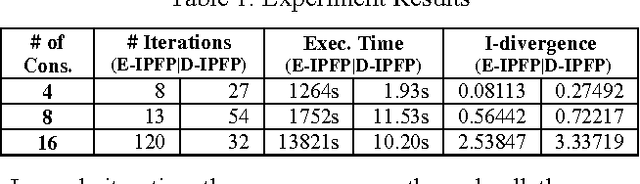
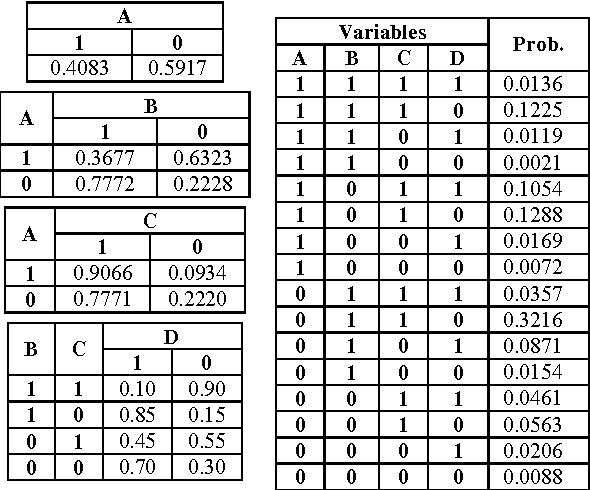
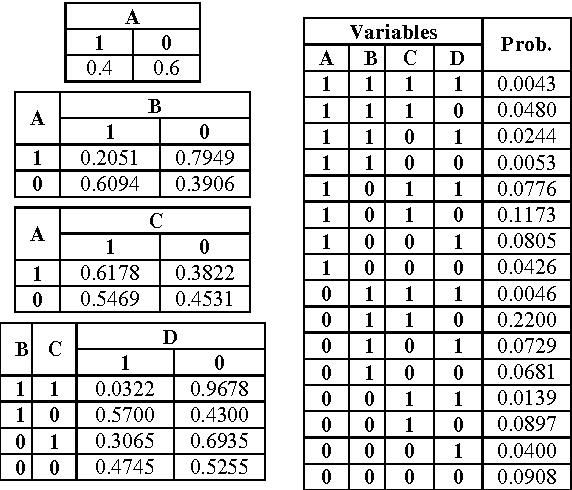
This paper deals with the following problem: modify a Bayesian network to satisfy a given set of probability constraints by only change its conditional probability tables, and the probability distribution of the resulting network should be as close as possible to that of the original network. We propose to solve this problem by extending IPFP (iterative proportional fitting procedure) to probability distributions represented by Bayesian networks. The resulting algorithm E-IPFP is further developed to D-IPFP, which reduces the computational cost by decomposing a global EIPFP into a set of smaller local E-IPFP problems. Limited analysis is provided, including the convergence proofs of the two algorithms. Computer experiments were conducted to validate the algorithms. The results are consistent with the theoretical analysis.