 Add to Chrome
 Add to Firefox
 Add to Edge
Transferable Tool-Tissue Contact Detection from Stereo Depth in Robot-Assisted Surgery
Aug 18, 2026
Reliable tool--tissue contact detection can support interaction-aware control and downstream force estimation in robot-assisted surgery. Most existing methods learn a contact classifier from RGB appearance, which is hard to generalize. In this work, we use the depth image generated from a stereo pair to give more information about tool--tissue contact. For each depth frame, we localize a spatially supported minimum-distance patch around the tool boundary and reduce it to a single scalar, $-\log_{10}|d|$; this signal rises and falls in step with ground-truth contact. We formalize this observation with a fully supervised two-state hidden Markov model. We fit this model as a six-fold leave-one-session-out (LOSO) ensemble on six palpation sessions against a single silicone cup-like phantom, with the decision threshold selected from the pooled out-of-fold predictions. It is evaluated on four held-out sessions of three categories: 1. same task on same phantom; 2. same task on different phantom; 3. different task on different phantom. This model reaches held-out macro F1 $0.927$ and AUPRC $0.980$. We further compare against a reproduction of an RGB-based contact classifier from prior work. This RGB-based model achieves high performance on the first category (F1 $0.965$), but substantially lower performance on the other two, resulting in macro F1 $0.320$ across all four sessions. These results indicate that the tool--tissue distance is a strong, transferable cue for contact detection in robot-assisted surgery.

Scalable Deep Compressive Sensing
Jan 22, 2021
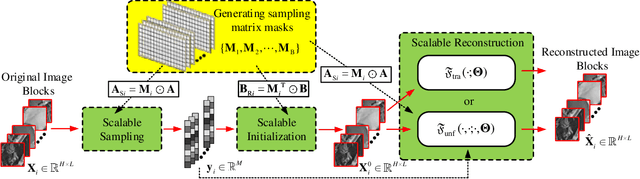
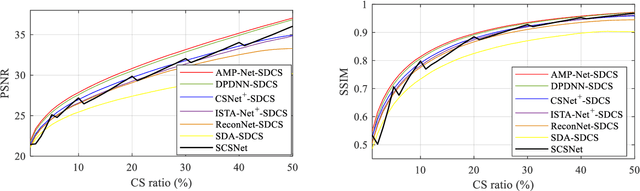
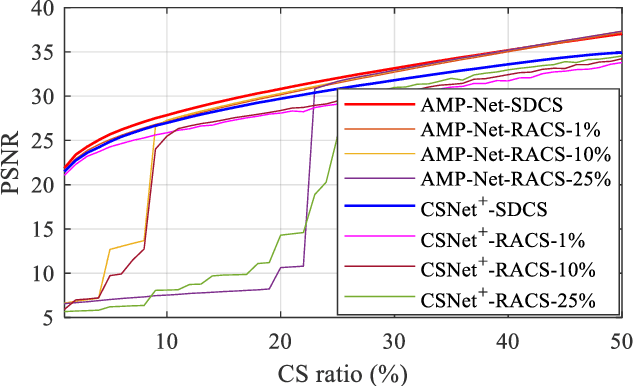
Deep learning has been used to image compressive sensing (CS) for enhanced reconstruction performance. However, most existing deep learning methods train different models for different subsampling ratios, which brings additional hardware burden. In this paper, we develop a general framework named scalable deep compressive sensing (SDCS) for the scalable sampling and reconstruction (SSR) of all existing end-to-end-trained models. In the proposed way, images are measured and initialized linearly. Two sampling masks are introduced to flexibly control the subsampling ratios used in sampling and reconstruction, respectively. To make the reconstruction model adapt to any subsampling ratio, a training strategy dubbed scalable training is developed. In scalable training, the model is trained with the sampling matrix and the initialization matrix at various subsampling ratios by integrating different sampling matrix masks. Experimental results show that models with SDCS can achieve SSR without changing their structure while maintaining good performance, and SDCS outperforms other SSR methods.
AMP-Net: Denoising based Deep Unfolding for Compressive Image Sensing
Apr 21, 2020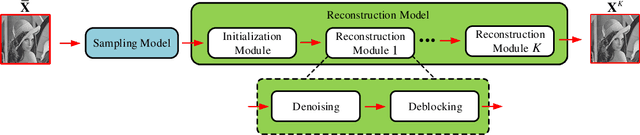
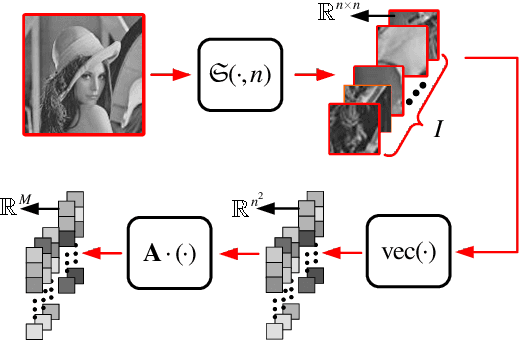
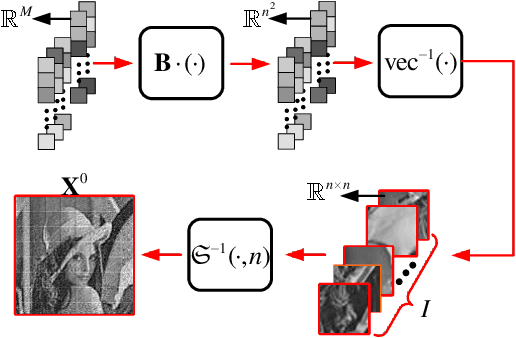
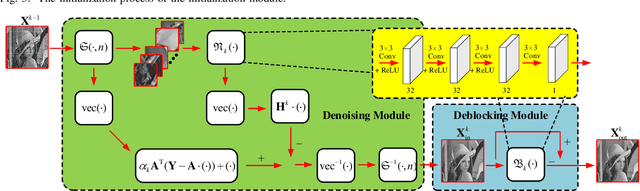
Most compressive sensing (CS) reconstruction methods can be divided into two categories, i.e. model based methods and classical deep network methods. By unfolding the iterative optimization algorithm for model based methods into networks, deep unfolding method has the good interpretation of model based methods and the high speed of classical deep network methods. In this paper, to solve the visual image CS problem, we propose a deep unfolding model dubbed AMP-Net. Rather than learning regularization terms, it is established by unfolding the iterative denoising process of the well-known approximate message passing algorithm. Furthermore, AMP-Net integrates deblocking modules in order to eliminate the blocking artifact that usually appears in CS of visual image. In addition, the sampling matrix is jointly trained with other network parameters to enhance the reconstruction performance. Experimental results show that the proposed AMP-Net has better reconstruction accuracy than other state-of-the-art methods with high reconstruction speed and a small number of network parameters.