 Add to Chrome
 Add to Firefox
 Add to Edge
Experience-Calibrated Contrastive Decoding for Mitigating Hallucinations in LM-Based Text-to-Speech
Aug 01, 2026
Language model-based text-to-speech (LM-based TTS) remains vulnerable to speech hallucinations that deviate from the target text. Existing mitigation mainly relies on architectural changes or additional training, while decoding-time control remains underexplored. We present a conditional information view that distinguishes text-derived alignment information from experience information supplied by acoustic context and learned speech regularities. We hypothesize that an important class of hallucinations begins when alignment support is insufficiently reflected in the selected token at a vulnerable transition. Using predictions from the same speech LM with and without text conditions, we propose Experience-Calibrated Contrastive Decoding (ECCD), a training-free method that strengthens alignment support while preserving useful experience information. ECCD preserves the original expert distribution, applies only positive alignment enhancement, and calibrates its strength using set-level experience compatibility. Across four models, ECCD reduces WER/CER by up to 55.6% in all SeedTTS-Eval settings and 24 of 25 multilingual CV3-Eval settings. A listening test yields a CMOS gain of $+0.644$ while retaining strong speaker similarity. Further analysis shows that alignment influence and decision-level gain vary within linguistic units and are lower at first-error boundaries than at matched correct boundaries. Overall, these extensive experiments and analyses identify conditional information control as a promising decoding-time direction for mitigating speech hallucination.

Attacking Voice Anonymization Systems with Augmented Feature and Speaker Identity Difference
Dec 26, 2024
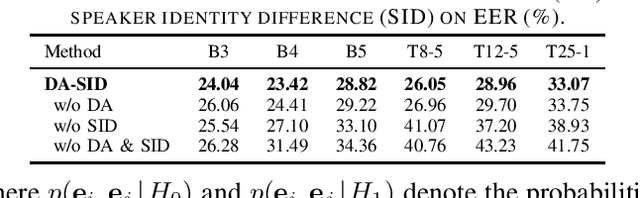
This study focuses on the First VoicePrivacy Attacker Challenge within the ICASSP 2025 Signal Processing Grand Challenge, which aims to develop speaker verification systems capable of determining whether two anonymized speech signals are from the same speaker. However, differences between feature distributions of original and anonymized speech complicate this task. To address this challenge, we propose an attacker system that combines Data Augmentation enhanced feature representation and Speaker Identity Difference enhanced classifier to improve verification performance, termed DA-SID. Specifically, data augmentation strategies (i.e., data fusion and SpecAugment) are utilized to mitigate feature distribution gaps, while probabilistic linear discriminant analysis (PLDA) is employed to further enhance speaker identity difference. Our system significantly outperforms the baseline, demonstrating exceptional effectiveness and robustness against various voice anonymization systems, ultimately securing a top-5 ranking in the challenge.