 Add to Chrome
 Add to Firefox
 Add to Edge
Consistency-guided semi-supervised outlier detection in heterogeneous data using fuzzy rough sets
Dec 22, 2025
Outlier detection aims to find samples that behave differently from the majority of the data. Semi-supervised detection methods can utilize the supervision of partial labels, thus reducing false positive rates. However, most of the current semi-supervised methods focus on numerical data and neglect the heterogeneity of data information. In this paper, we propose a consistency-guided outlier detection algorithm (COD) for heterogeneous data with the fuzzy rough set theory in a semi-supervised manner. First, a few labeled outliers are leveraged to construct label-informed fuzzy similarity relations. Next, the consistency of the fuzzy decision system is introduced to evaluate attributes' contributions to knowledge classification. Subsequently, we define the outlier factor based on the fuzzy similarity class and predict outliers by integrating the classification consistency and the outlier factor. The proposed algorithm is extensively evaluated on 15 freshly proposed datasets. Experimental results demonstrate that COD is better than or comparable with the leading outlier detectors. This manuscript is the accepted author version of a paper published by Elsevier. The final published version is available at https://doi.org/10.1016/j.asoc.2024.112070
* Author's Accepted Manuscript

Outlier detection in mixed-attribute data: a semi-supervised approach with fuzzy approximations and relative entropy
Dec 22, 2025Outlier detection is a critical task in data mining, aimed at identifying objects that significantly deviate from the norm. Semi-supervised methods improve detection performance by leveraging partially labeled data but typically overlook the uncertainty and heterogeneity of real-world mixed-attribute data. This paper introduces a semi-supervised outlier detection method, namely fuzzy rough sets-based outlier detection (FROD), to effectively handle these challenges. Specifically, we first utilize a small subset of labeled data to construct fuzzy decision systems, through which we introduce the attribute classification accuracy based on fuzzy approximations to evaluate the contribution of attribute sets in outlier detection. Unlabeled data is then used to compute fuzzy relative entropy, which provides a characterization of outliers from the perspective of uncertainty. Finally, we develop the detection algorithm by combining attribute classification accuracy with fuzzy relative entropy. Experimental results on 16 public datasets show that FROD is comparable with or better than leading detection algorithms. All datasets and source codes are accessible at https://github.com/ChenBaiyang/FROD. This manuscript is the accepted author version of a paper published by Elsevier. The final published version is available at https://doi.org/10.1016/j.ijar.2025.109373
* Author's accepted manuscript
Label-Informed Outlier Detection Based on Granule Density
Dec 21, 2025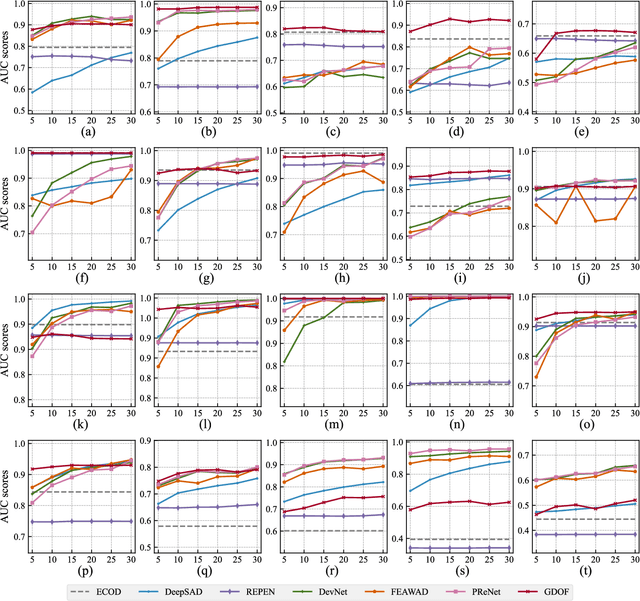
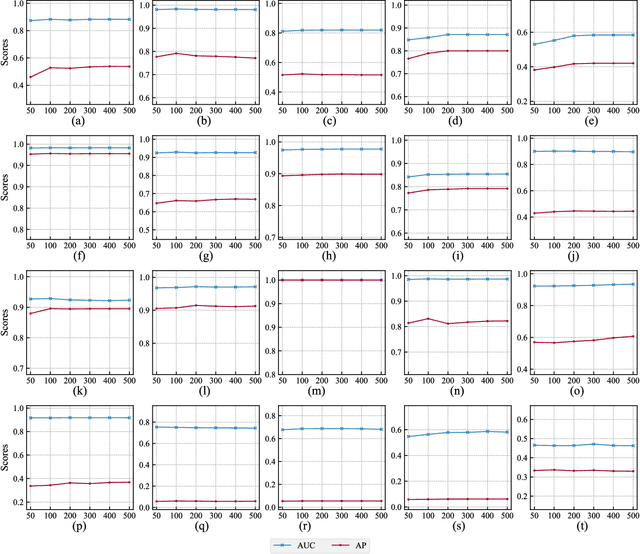
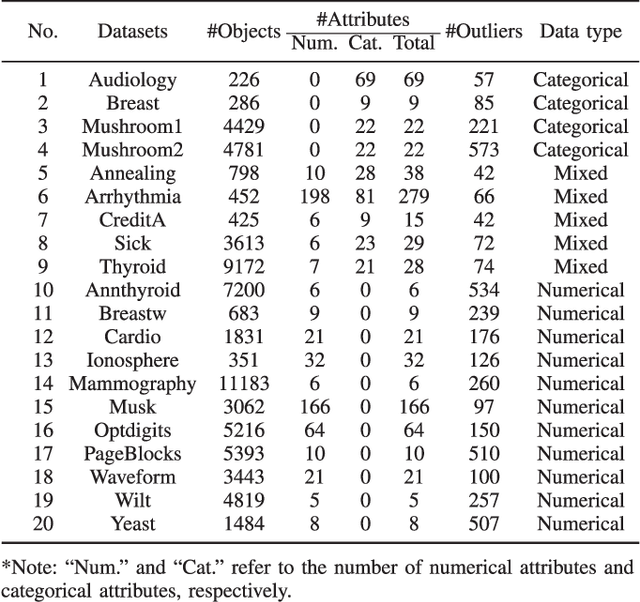
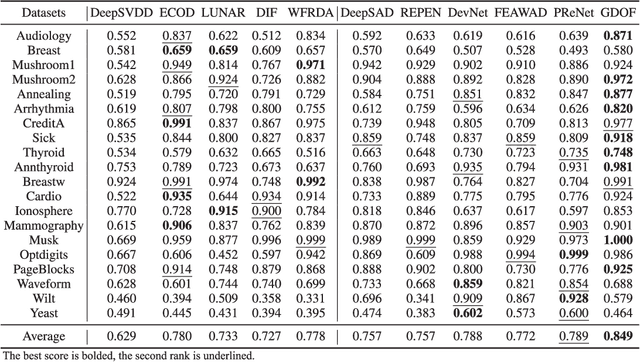
Outlier detection, crucial for identifying unusual patterns with significant implications across numerous applications, has drawn considerable research interest. Existing semi-supervised methods typically treat data as purely numerical and} in a deterministic manner, thereby neglecting the heterogeneity and uncertainty inherent in complex, real-world datasets. This paper introduces a label-informed outlier detection method for heterogeneous data based on Granular Computing and Fuzzy Sets, namely Granule Density-based Outlier Factor (GDOF). Specifically, GDOF first employs label-informed fuzzy granulation to effectively represent various data types and develops granule density for precise density estimation. Subsequently, granule densities from individual attributes are integrated for outlier scoring by assessing attribute relevance with a limited number of labeled outliers. Experimental results on various real-world datasets show that GDOF stands out in detecting outliers in heterogeneous data with a minimal number of labeled outliers. The integration of Fuzzy Sets and Granular Computing in GDOF offers a practical framework for outlier detection in complex and diverse data types. All relevant datasets and source codes are publicly available for further research. This is the author's accepted manuscript of a paper published in IEEE Transactions on Fuzzy Systems. The final version is available at https://doi.org/10.1109/TFUZZ.2024.3514853
* Author's Accepted Manuscript