 Add to Chrome
 Add to Firefox
 Add to Edge
Forward Consistency Learning with Gated Context Aggregation for Video Anomaly Detection
Jan 26, 2026
As a crucial element of public security, video anomaly detection (VAD) aims to measure deviations from normal patterns for various events in real-time surveillance systems. However, most existing VAD methods rely on large-scale models to pursue extreme accuracy, limiting their feasibility on resource-limited edge devices. Moreover, mainstream prediction-based VAD detects anomalies using only single-frame future prediction errors, overlooking the richer constraints from longer-term temporal forward information. In this paper, we introduce FoGA, a lightweight VAD model that performs Forward consistency learning with Gated context Aggregation, containing about 2M parameters and tailored for potential edge devices. Specifically, we propose a Unet-based method that performs feature extraction on consecutive frames to generate both immediate and forward predictions. Then, we introduce a gated context aggregation module into the skip connections to dynamically fuse encoder and decoder features at the same spatial scale. Finally, the model is jointly optimized with a novel forward consistency loss, and a hybrid anomaly measurement strategy is adopted to integrate errors from both immediate and forward frames for more accurate detection. Extensive experiments demonstrate the effectiveness of the proposed method, which substantially outperforms state-of-the-art competing methods, running up to 155 FPS. Hence, our FoGA achieves an excellent trade-off between performance and the efficiency metric.

Appearance Blur-driven AutoEncoder and Motion-guided Memory Module for Video Anomaly Detection
Sep 26, 2024Video anomaly detection (VAD) often learns the distribution of normal samples and detects the anomaly through measuring significant deviations, but the undesired generalization may reconstruct a few anomalies thus suppressing the deviations. Meanwhile, most VADs cannot cope with cross-dataset validation for new target domains, and few-shot methods must laboriously rely on model-tuning from the target domain to complete domain adaptation. To address these problems, we propose a novel VAD method with a motion-guided memory module to achieve cross-dataset validation with zero-shot. First, we add Gaussian blur to the raw appearance images, thereby constructing the global pseudo-anomaly, which serves as the input to the network. Then, we propose multi-scale residual channel attention to deblur the pseudo-anomaly in normal samples. Next, memory items are obtained by recording the motion features in the training phase, which are used to retrieve the motion features from the raw information in the testing phase. Lastly, our method can ignore the blurred real anomaly through attention and rely on motion memory items to increase the normality gap between normal and abnormal motion. Extensive experiments on three benchmark datasets demonstrate the effectiveness of the proposed method. Compared with cross-domain methods, our method achieves competitive performance without adaptation during testing.
Lightweight Structure-aware Transformer Network for VHR Remote Sensing Image Change Detection
Jun 03, 2023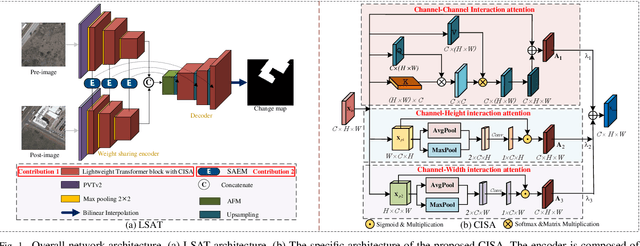
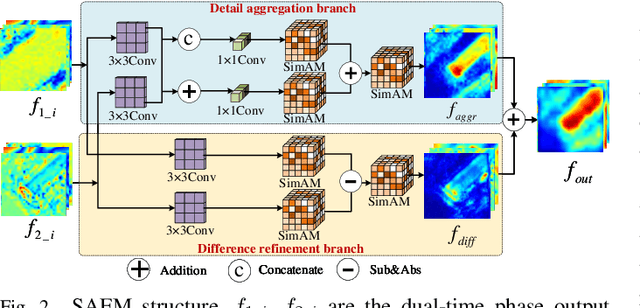
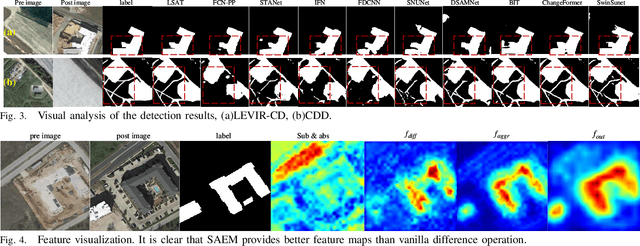
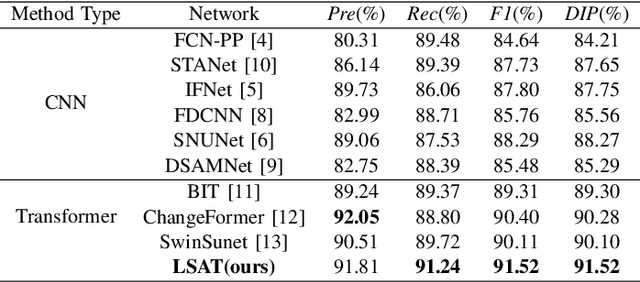
Popular Transformer networks have been successfully applied to remote sensing (RS) image change detection (CD) identifications and achieve better results than most convolutional neural networks (CNNs), but they still suffer from two main problems. First, the computational complexity of the Transformer grows quadratically with the increase of image spatial resolution, which is unfavorable to very high-resolution (VHR) RS images. Second, these popular Transformer networks tend to ignore the importance of fine-grained features, which results in poor edge integrity and internal tightness for largely changed objects and leads to the loss of small changed objects. To address the above issues, this Letter proposes a Lightweight Structure-aware Transformer (LSAT) network for RS image CD. The proposed LSAT has two advantages. First, a Cross-dimension Interactive Self-attention (CISA) module with linear complexity is designed to replace the vanilla self-attention in visual Transformer, which effectively reduces the computational complexity while improving the feature representation ability of the proposed LSAT. Second, a Structure-aware Enhancement Module (SAEM) is designed to enhance difference features and edge detail information, which can achieve double enhancement by difference refinement and detail aggregation so as to obtain fine-grained features of bi-temporal RS images. Experimental results show that the proposed LSAT achieves significant improvement in detection accuracy and offers a better tradeoff between accuracy and computational costs than most state-of-the-art CD methods for VHR RS images.