 Add to Chrome
 Add to Firefox
 Add to Edge
Resource-Constrained Robotic Planning in the face of Mixed Uncertainty
May 07, 2026
Robots operate under significant uncertainty, from quantifiable noise to unquantifiable unknowns, and must account for strict operational constraints, such as limited resources. In this paper, we consider the problem of synthesizing robust strategies to guide a robot's actions in fulfilling a given task, while ensuring the system never exhausts its resources. To solve this problem, we first model the robotic system as a Consumption Markov Decision Process with Set-valued Transitions(CMDPST), a unified framework modelling nondeterministic actions, quantifiable and unquantifiable uncertainty, and resource consumption. Then, we combine the CMDPST with the task specification, expressed as a Linear Temporal Logic over finite traces (LTLf ) formula. Lastly, we address the resource constrained optimal robust strategy synthesis problem, which aims to synthesize a strategy that maximizes the probability of satisfying the LTLf objective without resource exhaustion. Our solution involves two techniques: a direct unrolling-based method and a more efficient, optimized approach that leverages state-space pruning for better performance. Experiments on a warehouse transportation network show the effectiveness of the proposed solutions.

ADVREPAIR:Provable Repair of Adversarial Attack
Apr 02, 2024
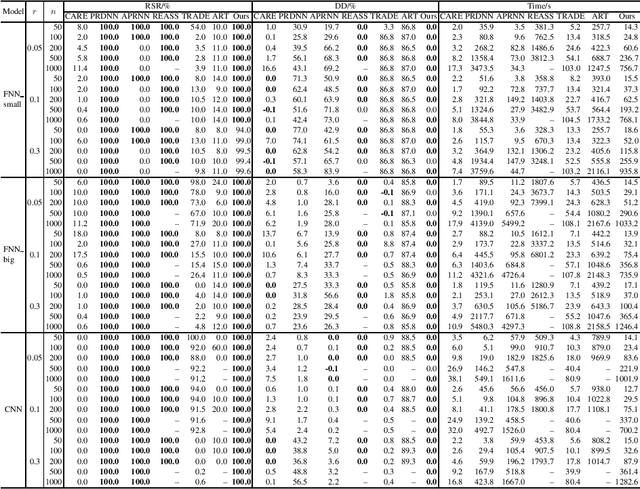
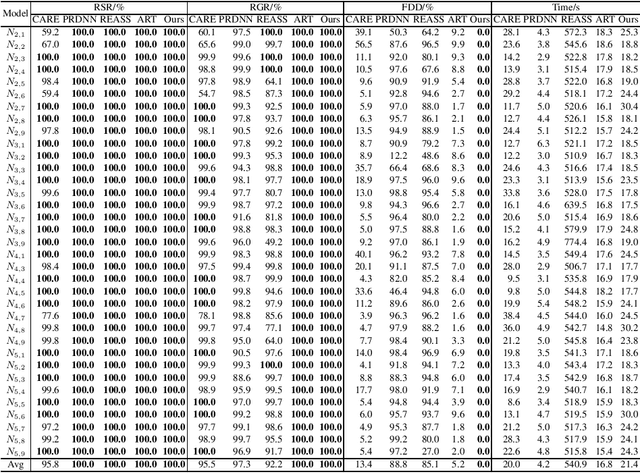
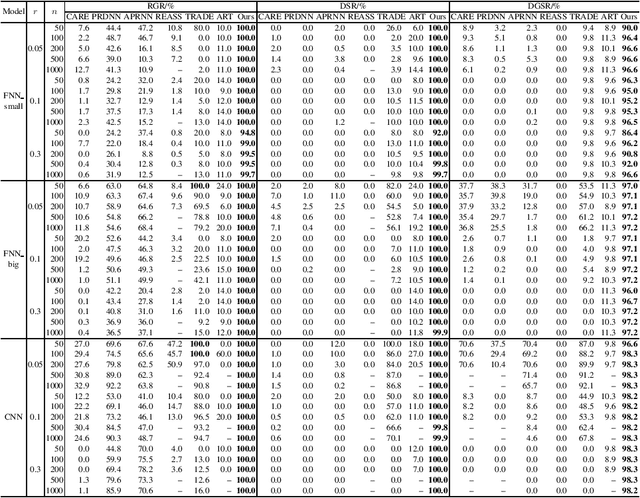
Deep neural networks (DNNs) are increasingly deployed in safety-critical domains, but their vulnerability to adversarial attacks poses serious safety risks. Existing neuron-level methods using limited data lack efficacy in fixing adversaries due to the inherent complexity of adversarial attack mechanisms, while adversarial training, leveraging a large number of adversarial samples to enhance robustness, lacks provability. In this paper, we propose ADVREPAIR, a novel approach for provable repair of adversarial attacks using limited data. By utilizing formal verification, ADVREPAIR constructs patch modules that, when integrated with the original network, deliver provable and specialized repairs within the robustness neighborhood. Additionally, our approach incorporates a heuristic mechanism for assigning patch modules, allowing this defense against adversarial attacks to generalize to other inputs. ADVREPAIR demonstrates superior efficiency, scalability and repair success rate. Different from existing DNN repair methods, our repair can generalize to general inputs, thereby improving the robustness of the neural network globally, which indicates a significant breakthrough in the generalization capability of ADVREPAIR.
Incremental Satisfiability Modulo Theory for Verification of Deep Neural Networks
Feb 10, 2023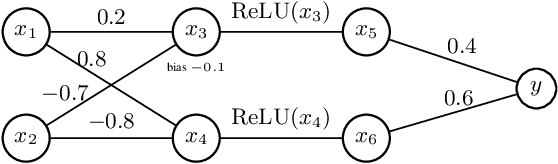
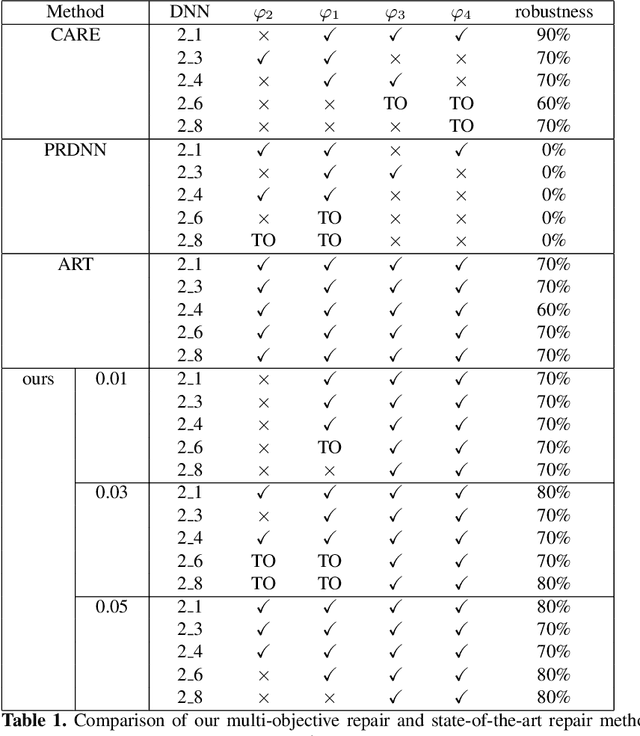
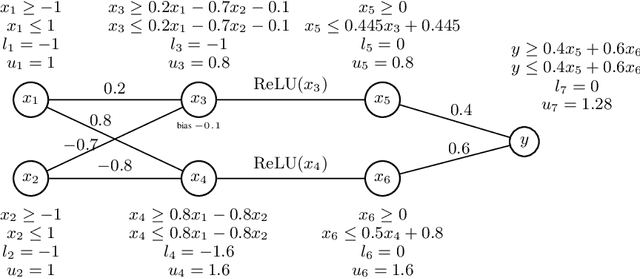
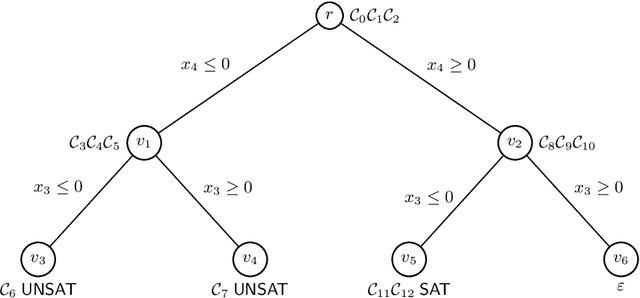
Constraint solving is an elementary way for verification of deep neural networks (DNN). In the domain of AI safety, a DNN might be modified in its structure and parameters for its repair or attack. For such situations, we propose the incremental DNN verification problem, which asks whether a safety property still holds after the DNN is modified. To solve the problem, we present an incremental satisfiability modulo theory (SMT) algorithm based on the Reluplex framework. We simulate the most important features of the configurations that infers the verification result of the searching branches in the old solving procedure (with respect to the original network), and heuristically check whether the proofs are still valid for the modified DNN. We implement our algorithm as an incremental solver called DeepInc, and exerimental results show that DeepInc is more efficient in most cases. For the cases that the property holds both before and after modification, the acceleration can be faster by several orders of magnitude, showing that DeepInc is outstanding in incrementally searching for counterexamples. Moreover, based on the framework, we propose the multi-objective DNN repair problem and give an algorithm based on our incremental SMT solving algorithm. Our repair method preserves more potential safety properties on the repaired DNNs compared with state-of-the-art.