 Add to Chrome
 Add to Firefox
 Add to Edge
LLMs Are Not Good Strategists, Yet Memory-Enhanced Agency Boosts Reasoning
Aug 12, 2026
Strategic reasoning in Large Language Models (LLMs) within long-horizon environments is often limited by inconsistent subgoals. In these settings, finite attention resources prevent the model from maintaining strategic coherence over thousands of steps. This limitation leads to strategic drift, where localized decisions fail to sustain a coherent trajectory across reasoning. To address this, we introduce EpicStar, a framework that enables agents to learn memory as policy to tackle long-horizon reasoning. Specifically, the agent maintains a bank of successful past episodes as a heuristic alongside a working memory to track short-term environmental changes. During inference, a dynamic gating mechanism determines whether to execute a retrieved action directly or to perform new reasoning through a contextual fusion of the retrieved episodes and current working memory. Utilizing StarCraft II as the testbed, we evaluated EpicStar against diverse opponent styles. It significantly outperforms baseline methods, achieving higher win rates while consuming an order of magnitude fewer tokens, and it maintains this advantage consistently across difficulty levels and opponent strategies. Our findings provide compelling evidence that structured cross-episode memory is essential for enabling LLM agents to perform robust, long-term strategic execution in dynamic, autonomous settings.

Failures and Successes to Learn a Core Conceptual Distinction from the Statistics of Language
Jul 05, 2026Generic statements like "tigers are striped" and "cars have radios" communicate information that is, in general, true. However, while the first statement is true in principle, the second is true only statistically. People are exquisitely sensitive to this principled-vs-statistical distinction. It has been argued that this ability to distinguish between something being true by virtue of it being a category member versus being true because of mere statistical regularity, is a general property of people's conceptual machinery and cannot itself be learned. We investigate whether the distinction between principled and statistical properties can be learned from language itself. If so, it raises the possibility that language experience can bootstrap core conceptual distinctions and that it is possible to learn sophisticated causal models directly from language. We find that language models are all sensitive to statistical prevalence, but struggle with representing the principled-vs-statistical distinction controlling for prevalence. Until GPT-4, which succeeds.
Language Models Represent and Transform Concepts with Shared Geometry
Jul 05, 2026How concepts are represented in neural networks is a fundamental question in machine learning. The dominant view treats concept representations as stationary geometric objects. Yet concepts appear in context, and context transforms them. Drawing from neural population geometry, we formalize concept representations as point-cloud manifolds and contextual transformations as vector fields, and instantiate this framework in large language models. Across six model families of varying scales, we find that context moves each concept differently. The variance in these displacements is semantically organized, correlating with lexical concreteness and density. Importantly, both the concepts being transformed and this variance structure are shared across models: displacement structure transported from one model predicts held-out displacements in others significantly above chance. Together, these findings show that models share a common geometry not only in how concepts are represented, but more importantly in how context transforms them, a structure with richer organization than prior work has recognized.
Are More Tokens Rational? Inference-Time Scaling in Language Models as Adaptive Resource Rationality
Feb 10, 2026Human reasoning is shaped by resource rationality -- optimizing performance under constraints. Recently, inference-time scaling has emerged as a powerful paradigm to improve the reasoning performance of Large Language Models by expanding test-time computation. Specifically, instruction-tuned (IT) models explicitly generate long reasoning steps during inference, whereas Large Reasoning Models (LRMs) are trained by reinforcement learning to discover reasoning paths that maximize accuracy. However, it remains unclear whether resource-rationality can emerge from such scaling without explicit reward related to computational costs. We introduce a Variable Attribution Task in which models infer which variables determine outcomes given candidate variables, input-output trials, and predefined logical functions. By varying the number of candidate variables and trials, we systematically manipulate task complexity. Both models exhibit a transition from brute-force to analytic strategies as complexity increases. IT models degrade on XOR and XNOR functions, whereas LRMs remain robust. These findings suggest that models can adjust their reasoning behavior in response to task complexity, even without explicit cost-based reward. It provides compelling evidence that resource rationality is an emergent property of inference-time scaling itself.
The Representational Geometry of Number
Feb 06, 2026A central question in cognitive science is whether conceptual representations converge onto a shared manifold to support generalization, or diverge into orthogonal subspaces to minimize task interference. While prior work has discovered evidence for both, a mechanistic account of how these properties coexist and transform across tasks remains elusive. We propose that representational sharing lies not in the concepts themselves, but in the geometric relations between them. Using number concepts as a testbed and language models as high-dimensional computational substrates, we show that number representations preserve a stable relational structure across tasks. Task-specific representations are embedded in distinct subspaces, with low-level features like magnitude and parity encoded along separable linear directions. Crucially, we find that these subspaces are largely transformable into one another via linear mappings, indicating that representations share relational structure despite being located in distinct subspaces. Together, these results provide a mechanistic lens of how language models balance the shared structure of number representation with functional flexibility. It suggests that understanding arises when task-specific transformations are applied to a shared underlying relational structure of conceptual representations.
Sleep Staging Based on Multi Scale Dual Attention Network
Aug 14, 2021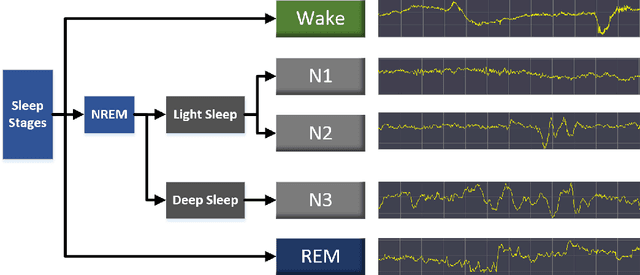

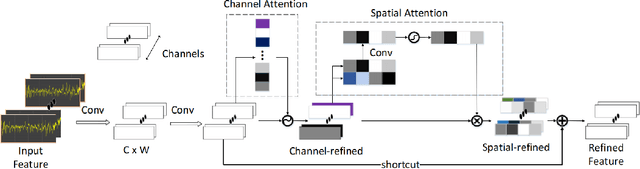

Sleep staging plays an important role on the diagnosis of sleep disorders. In general, experts classify sleep stages manually based on polysomnography (PSG), which is quite time-consuming. Meanwhile, the acquisition process of multiple signals is much complex, which can affect the subject's sleep. Therefore, the use of single-channel electroencephalogram (EEG) for automatic sleep staging has become a popular research topic. In the literature, a large number of sleep staging methods based on single-channel EEG have been proposed with promising results and achieve the preliminary automation of sleep staging. However, the performance for most of these methods in the N1 stage do not satisfy the needs of the diagnosis. In this paper, we propose a deep learning model multi scale dual attention network(MSDAN) based on raw EEG, which utilizes multi-scale convolution to extract features in different waveforms contained in the EEG signal, connects channel attention and spatial attention mechanisms in series to filter and highlight key information, and uses soft thresholding to remove redundant information. Experiments were conducted using two datasets with 5-fold cross-validation and hold-out validation method. The final average accuracy, overall accuracy, macro F1 score and Cohen's Kappa coefficient of the model reach 96.70%, 91.74%, 0.8231 and 0.8723 on the Sleep-EDF dataset, 96.14%, 90.35%, 0.7945 and 0.8284 on the Sleep-EDFx dataset. Significantly, our model performed superiorly in the N1 stage, with F1 scores of 54.41% and 52.79% on the two datasets respectively. The results show the superiority of our network over the existing methods, reaching a new state-of-the-art. In particular, the proposed method achieves excellent results in the N1 sleep stage compared to other methods.