 Add to Chrome
 Add to Firefox
 Add to Edge
Cross-View Urban Sensing: Mapping Subjective Streetscape Perception via AlphaEarth Embeddings and Urban Context
Aug 17, 2026
Residents' perception of the urban streetscape is an important factor in public health, active mobility, and social wellbeing. Street view imagery (SVI) has emerged as a widely used data source for assessing these perceptual qualities, yet its uneven coverage and irregular updating limit large-scale measurement. Here, we present CVLNet, a Cross-View Learning Network that predicts street-level perception from AlphaEarth embeddings and multi-source urban contextual data without requiring SVI at inference. CVLNet applies per-task adaptive gating to jointly model five perceptual dimensions, using labels from the pretrained SVI-Percept model as ground truth. The proposed method is evaluated across four Southeast Asian cities: Singapore, Kuala Lumpur, Jakarta, and Manila. CVLNet achieves a median road-segment-level Adjusted $R^{2}$ of 0.76 and consistently outperforms the baseline models, with gains ranging from 5.9--11.3% across the five perceptual dimensions. Ablation experiments show that AlphaEarth features and urban contextual features contribute complementary information. We further produce citywide road-level streetscape perception maps for five subjective perceptual dimensions across all four cities, extending perception estimation from the 13--31% of the road network directly covered by available SVI to the complete road network of each city. Integrating these maps with WorldPop gridded population data, we quantify exposure inequality across population-density, demographic, and land-use groups using the Deficit Palma Ratio. These results demonstrate that remote sensing can serve as a scalable alternative to SVI for citywide streetscape perception mapping, enabling a more comprehensive assessment of urban environmental inequality.

Periodically Exchange Teacher-Student for Source-Free Object Detection
Nov 23, 2023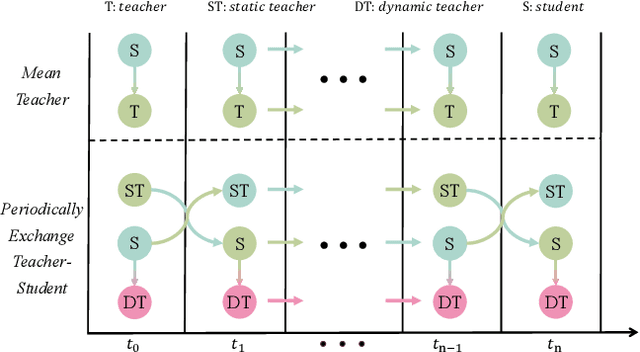
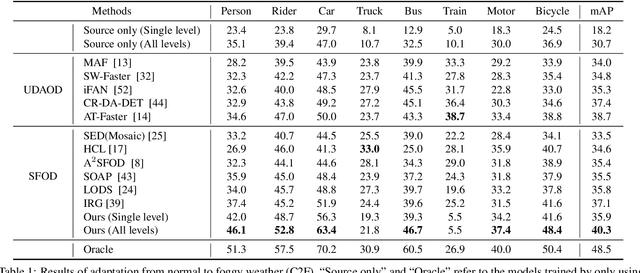
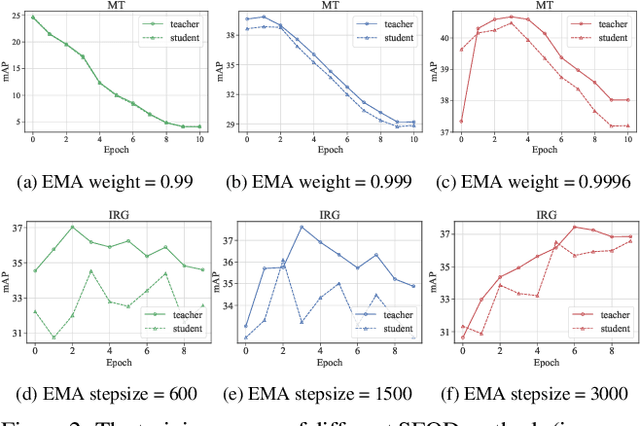
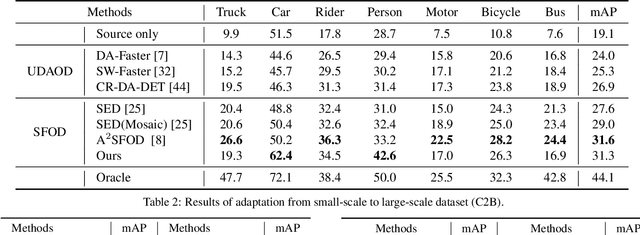
Source-free object detection (SFOD) aims to adapt the source detector to unlabeled target domain data in the absence of source domain data. Most SFOD methods follow the same self-training paradigm using mean-teacher (MT) framework where the student model is guided by only one single teacher model. However, such paradigm can easily fall into a training instability problem that when the teacher model collapses uncontrollably due to the domain shift, the student model also suffers drastic performance degradation. To address this issue, we propose the Periodically Exchange Teacher-Student (PETS) method, a simple yet novel approach that introduces a multiple-teacher framework consisting of a static teacher, a dynamic teacher, and a student model. During the training phase, we periodically exchange the weights between the static teacher and the student model. Then, we update the dynamic teacher using the moving average of the student model that has already been exchanged by the static teacher. In this way, the dynamic teacher can integrate knowledge from past periods, effectively reducing error accumulation and enabling a more stable training process within the MT-based framework. Further, we develop a consensus mechanism to merge the predictions of two teacher models to provide higher-quality pseudo labels for student model. Extensive experiments on multiple SFOD benchmarks show that the proposed method achieves state-of-the-art performance compared with other related methods, demonstrating the effectiveness and superiority of our method on SFOD task.
Dynamic Domain Generalization
May 27, 2022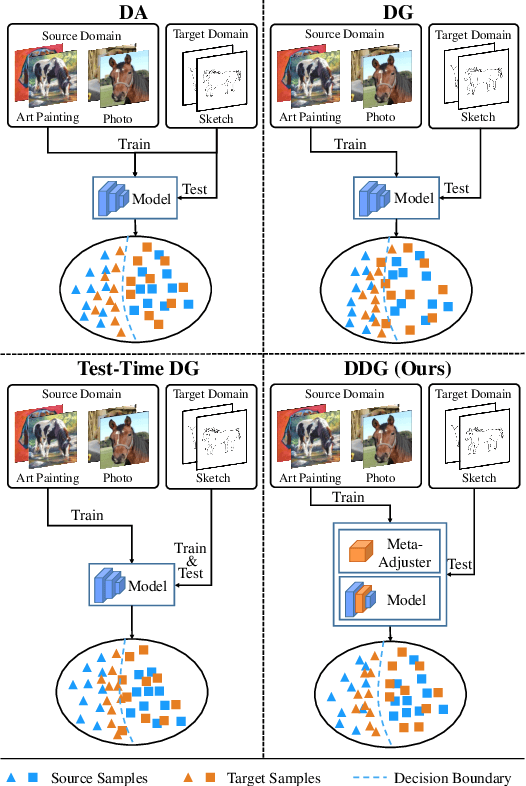
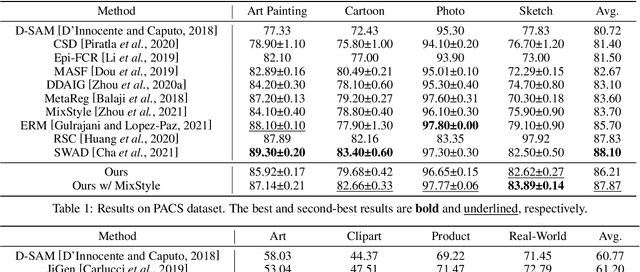
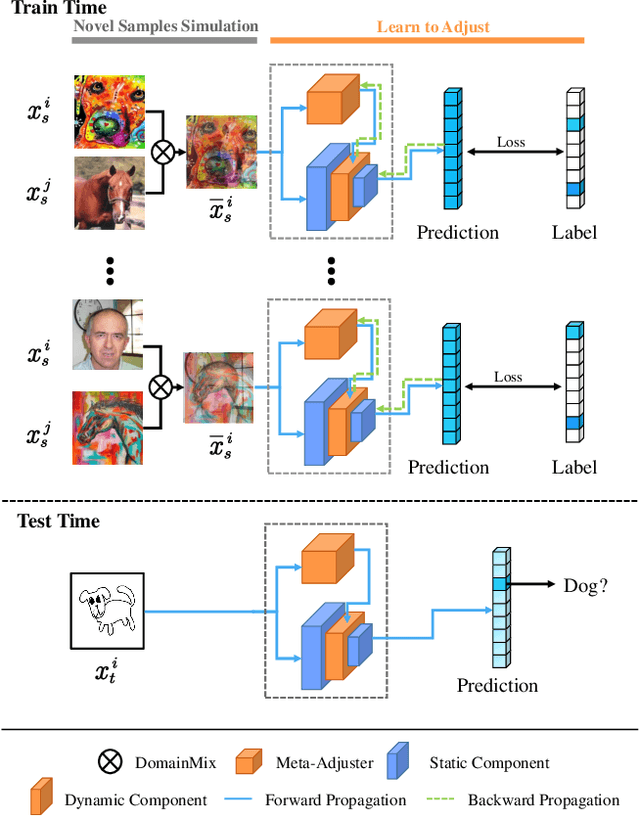
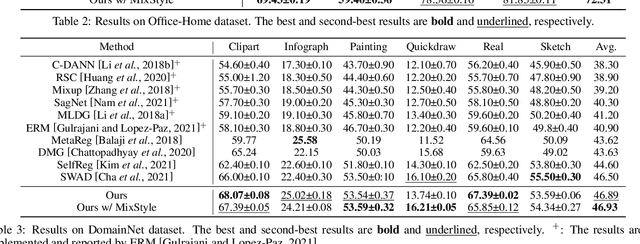
Domain generalization (DG) is a fundamental yet very challenging research topic in machine learning. The existing arts mainly focus on learning domain-invariant features with limited source domains in a static model. Unfortunately, there is a lack of training-free mechanism to adjust the model when generalized to the agnostic target domains. To tackle this problem, we develop a brand-new DG variant, namely Dynamic Domain Generalization (DDG), in which the model learns to twist the network parameters to adapt the data from different domains. Specifically, we leverage a meta-adjuster to twist the network parameters based on the static model with respect to different data from different domains. In this way, the static model is optimized to learn domain-shared features, while the meta-adjuster is designed to learn domain-specific features. To enable this process, DomainMix is exploited to simulate data from diverse domains during teaching the meta-adjuster to adapt to the upcoming agnostic target domains. This learning mechanism urges the model to generalize to different agnostic target domains via adjusting the model without training. Extensive experiments demonstrate the effectiveness of our proposed method. Code is available at: https://github.com/MetaVisionLab/DDG
Semi-Supervised Domain Generalization in Real World:New Benchmark and Strong Baseline
Nov 19, 2021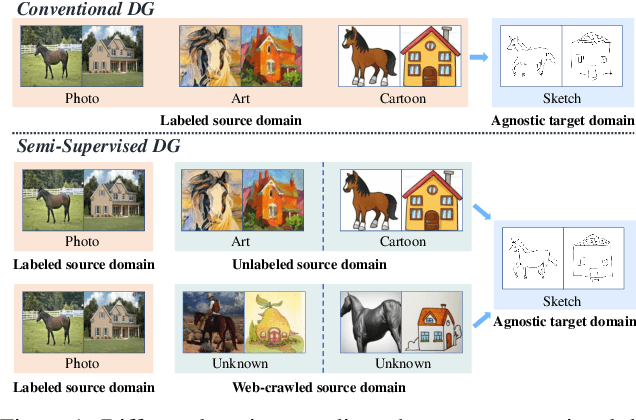
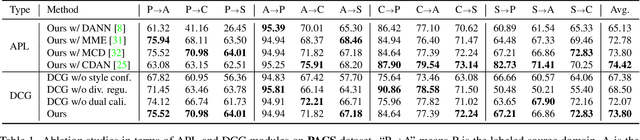
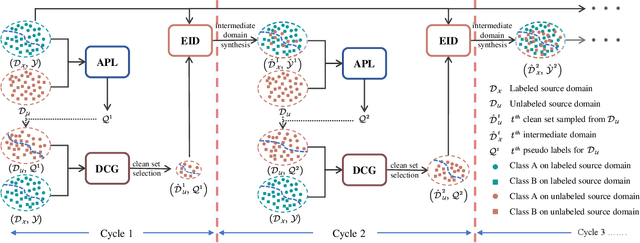
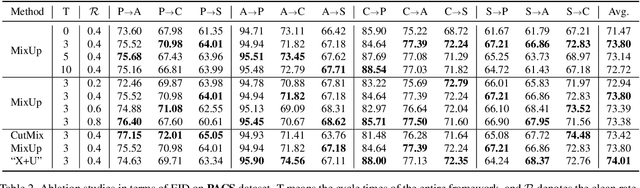
Conventional domain generalization aims to learn domain invariant representation from multiple domains, which requires accurate annotations. In realistic application scenarios, however, it is too cumbersome or even infeasible to collect and annotate the large mass of data. Yet, web data provides a free lunch to access a huge amount of unlabeled data with rich style information that can be harnessed to augment domain generalization ability. In this paper, we introduce a novel task, termed as semi-supervised domain generalization, to study how to interact the labeled and unlabeled domains, and establish two benchmarks including a web-crawled dataset, which poses a novel yet realistic challenge to push the limits of existing technologies. To tackle this task, a straightforward solution is to propagate the class information from the labeled to the unlabeled domains via pseudo labeling in conjunction with domain confusion training. Considering narrowing domain gap can improve the quality of pseudo labels and further advance domain invariant feature learning for generalization, we propose a cycle learning framework to encourage the positive feedback between label propagation and domain generalization, in favor of an evolving intermediate domain bridging the labeled and unlabeled domains in a curriculum learning manner. Experiments are conducted to validate the effectiveness of our framework. It is worth highlighting that web-crawled data benefits domain generalization as demonstrated in our results. Our code will be available later.