 Add to Chrome
 Add to Firefox
 Add to Edge
Ontology Memory-Augmented ASR Correction for Long Text-Speech Interleaved Conversations
Jun 11, 2026
Automatic speech recognition (ASR) correction has traditionally focused on isolated utterances or short local contexts. However, as text and speech become increasingly interleaved in long interactions, ASR correction requires conversation-level contextual evidence. Existing ASR correction methods often rely on the current hypothesis or concatenate raw dialogue history. In such contexts, sparse correction evidence can be difficult to locate amid redundancy and noise. Addressing these challenges, we propose an ontology memory-augmented ASR correction framework for long text-speech interleaved conversations. The framework organizes preceding interaction history into a dynamically updatable ontology memory, where entities, terminology, surface variants, potential ASR confusions, and semantic relations are stored as retrievable nodes for context-grounded correction. To evaluate this setting, we construct RAMC-Corr, a dataset derived from MAGIC-RAMC for long-range ASR correction with grounded context. Experiments on RAMC-Corr show that our method improves over direct correction in 9 out of 10 paired backbone-setting combinations and encourages more selective and evidence-grounded corrections for context-dependent ASR errors.

SEAL: Structure and Element Aware Learning to Improve Long Structured Document Retrieval
Aug 28, 2025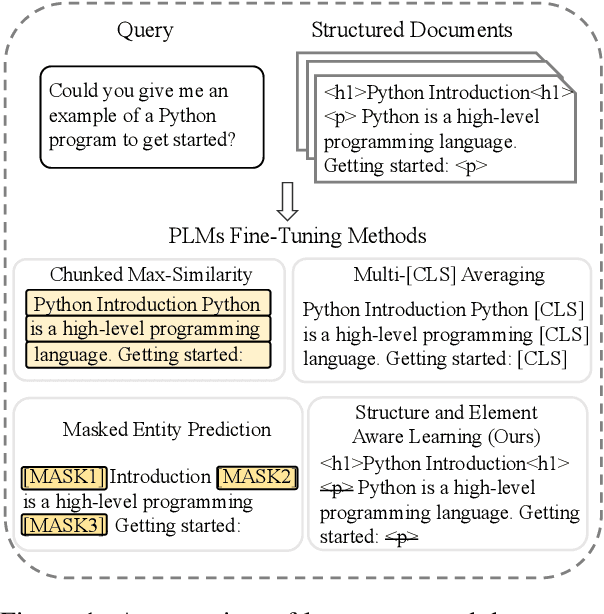
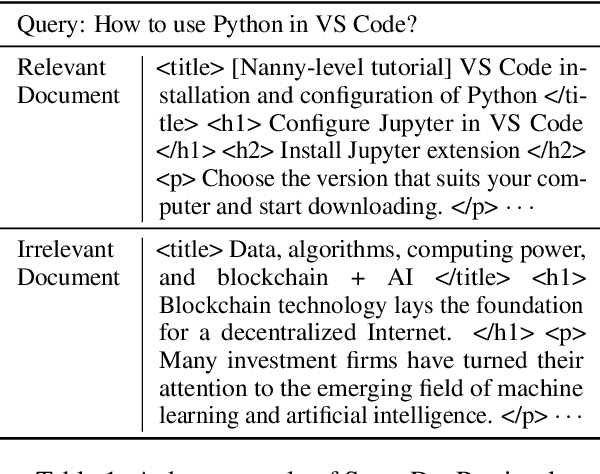
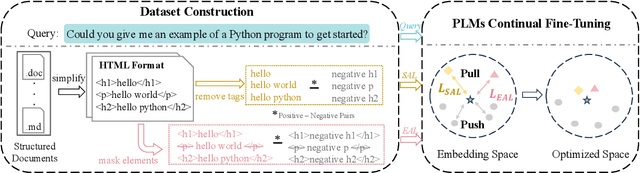
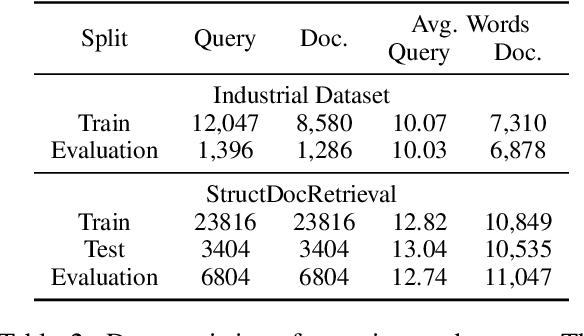
In long structured document retrieval, existing methods typically fine-tune pre-trained language models (PLMs) using contrastive learning on datasets lacking explicit structural information. This practice suffers from two critical issues: 1) current methods fail to leverage structural features and element-level semantics effectively, and 2) the lack of datasets containing structural metadata. To bridge these gaps, we propose \our, a novel contrastive learning framework. It leverages structure-aware learning to preserve semantic hierarchies and masked element alignment for fine-grained semantic discrimination. Furthermore, we release \dataset, a long structured document retrieval dataset with rich structural annotations. Extensive experiments on both released and industrial datasets across various modern PLMs, along with online A/B testing, demonstrate consistent performance improvements, boosting NDCG@10 from 73.96\% to 77.84\% on BGE-M3. The resources are available at https://github.com/xinhaoH/SEAL.
Improving Tropical Cyclone Forecasting With Video Diffusion Models
Jan 27, 2025



Tropical cyclone (TC) forecasting is crucial for disaster preparedness and mitigation. While recent deep learning approaches have shown promise, existing methods often treat TC evolution as a series of independent frame-to-frame predictions, limiting their ability to capture long-term dynamics. We present a novel application of video diffusion models for TC forecasting that explicitly models temporal dependencies through additional temporal layers. Our approach enables the model to generate multiple frames simultaneously, better capturing cyclone evolution patterns. We introduce a two-stage training strategy that significantly improves individual-frame quality and performance in low-data regimes. Experimental results show our method outperforms the previous approach of Nath et al. by 19.3% in MAE, 16.2% in PSNR, and 36.1% in SSIM. Most notably, we extend the reliable forecasting horizon from 36 to 50 hours. Through comprehensive evaluation using both traditional metrics and Fr\'echet Video Distance (FVD), we demonstrate that our approach produces more temporally coherent forecasts while maintaining competitive single-frame quality. Code accessible at https://github.com/Ren-creater/forecast-video-diffmodels.