 Add to Chrome
 Add to Firefox
 Add to Edge
LawGPT: Knowledge-Guided Data Generation and Its Application to Legal LLM
Feb 10, 2025

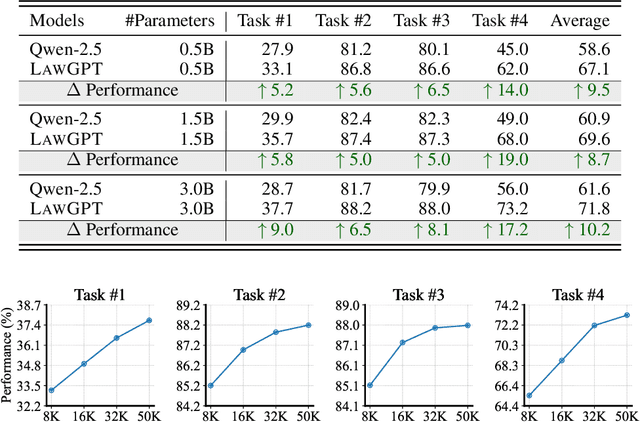
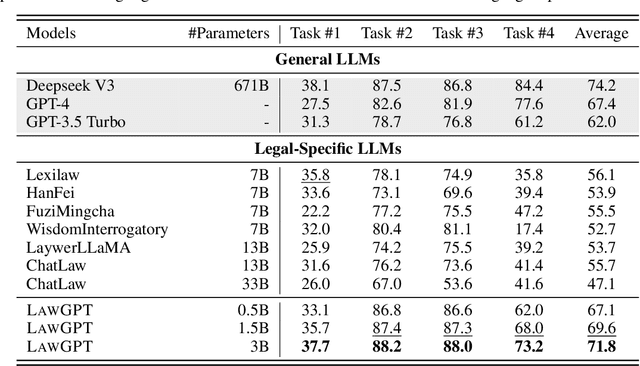
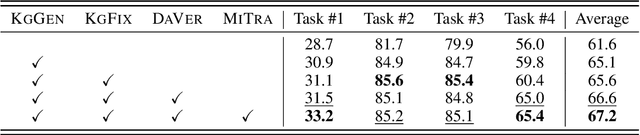
Large language models (LLMs), both proprietary and open-source, have demonstrated remarkable capabilities across various natural language processing tasks. However, they face significant limitations in legal reasoning tasks. Proprietary models introduce data privacy risks and high inference costs, while open-source models underperform due to insufficient legal domain training data. To address these limitations, we study data generation for legal reasoning to improve the legal reasoning performance of open-source LLMs with the help of proprietary LLMs. This is challenging due to the lack of legal knowledge in proprietary LLMs and the difficulty in verifying the generated data. We propose KgDG, a knowledge-guided data generation framework for legal reasoning. Our framework enables leveraging legal knowledge to enhance generation diversity and introduces a refinement and verification process to ensure the quality of generated data. Moreover, we expand the generated dataset to further enhance the LLM reasoning capabilities. Using KgDG, we create a synthetic legal reasoning dataset containing 50K high-quality examples. Our trained model LawGPT outperforms existing legal-specific LLMs and achieves performance comparable to proprietary LLMs, demonstrating the effectiveness of KgDG and LawGPT. Our code and resources is publicly available at https://anonymous.4open.science/r/KgDG-45F5 .

Online Location Planning for AI-Defined Vehicles: Optimizing Joint Tasks of Order Serving and Spatio-Temporal Heterogeneous Model Fine-Tuning
Feb 06, 2025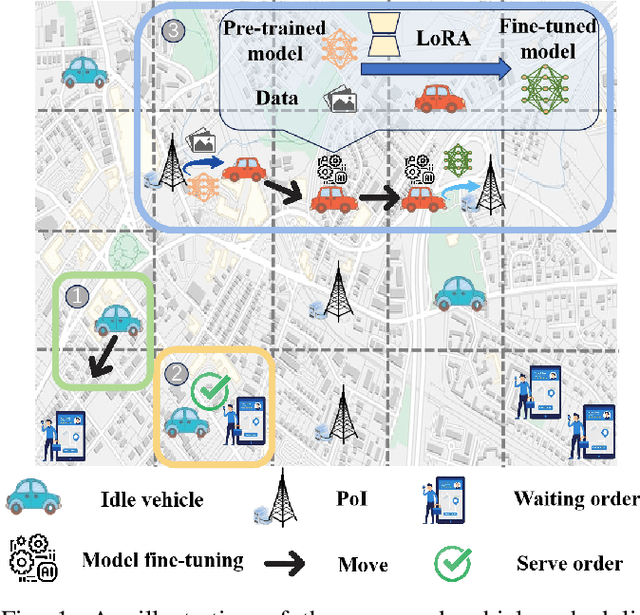
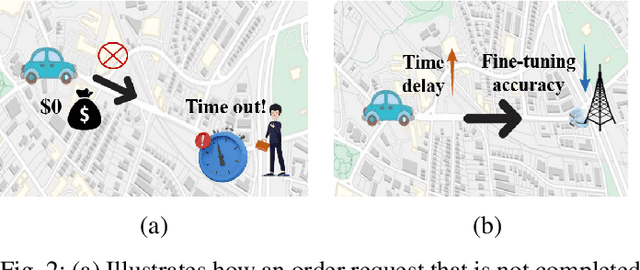
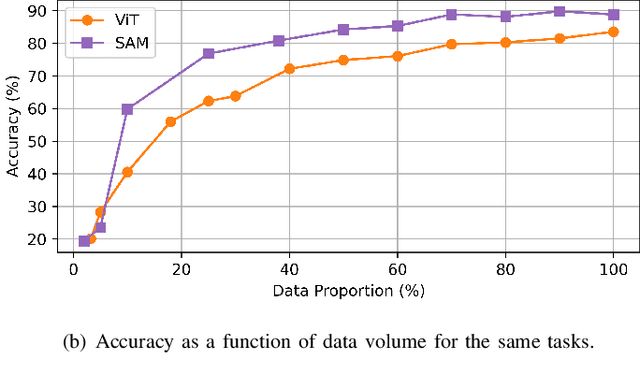
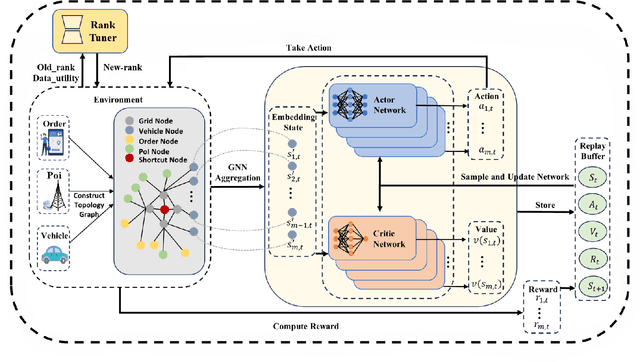
Advances in artificial intelligence (AI) including foundation models (FMs), are increasingly transforming human society, with smart city driving the evolution of urban living.Meanwhile, vehicle crowdsensing (VCS) has emerged as a key enabler, leveraging vehicles' mobility and sensor-equipped capabilities. In particular, ride-hailing vehicles can effectively facilitate flexible data collection and contribute towards urban intelligence, despite resource limitations. Therefore, this work explores a promising scenario, where edge-assisted vehicles perform joint tasks of order serving and the emerging foundation model fine-tuning using various urban data. However, integrating the VCS AI task with the conventional order serving task is challenging, due to their inconsistent spatio-temporal characteristics: (i) The distributions of ride orders and data point-of-interests (PoIs) may not coincide in geography, both following a priori unknown patterns; (ii) they have distinct forms of temporal effects, i.e., prolonged waiting makes orders become instantly invalid while data with increased staleness gradually reduces its utility for model fine-tuning.To overcome these obstacles, we propose an online framework based on multi-agent reinforcement learning (MARL) with careful augmentation. A new quality-of-service (QoS) metric is designed to characterize and balance the utility of the two joint tasks, under the effects of varying data volumes and staleness. We also integrate graph neural networks (GNNs) with MARL to enhance state representations, capturing graph-structured, time-varying dependencies among vehicles and across locations. Extensive experiments on our testbed simulator, utilizing various real-world foundation model fine-tuning tasks and the New York City Taxi ride order dataset, demonstrate the advantage of our proposed method.
Step Back to Leap Forward: Self-Backtracking for Boosting Reasoning of Language Models
Feb 06, 2025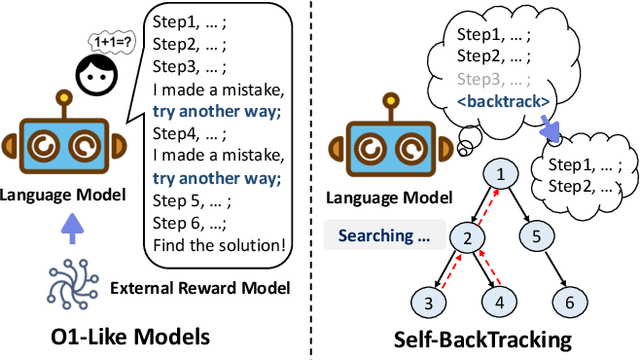
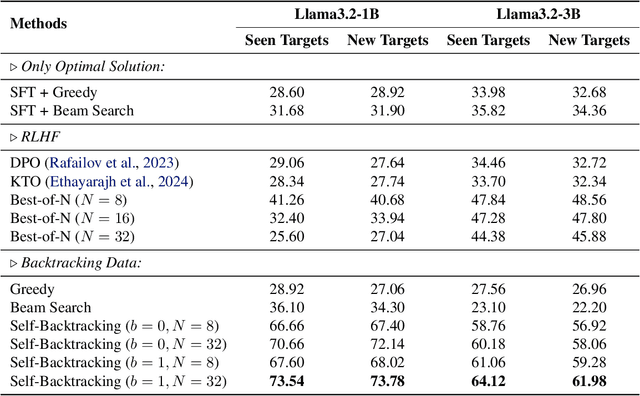
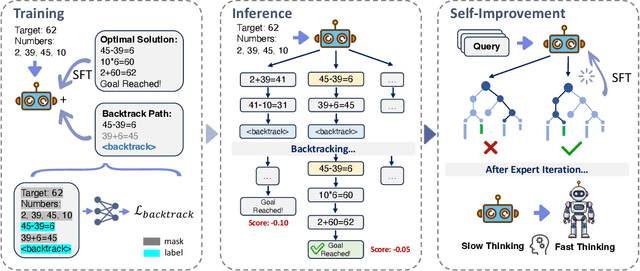
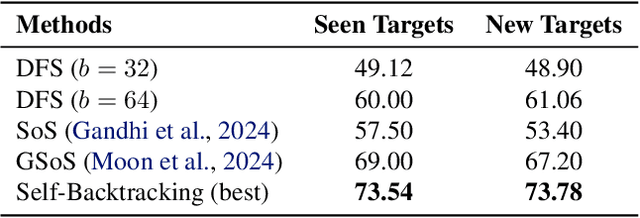
The integration of slow-thinking mechanisms into large language models (LLMs) offers a promising way toward achieving Level 2 AGI Reasoners, as exemplified by systems like OpenAI's o1. However, several significant challenges remain, including inefficient overthinking and an overreliance on auxiliary reward models. We point out that these limitations stem from LLMs' inability to internalize the search process, a key component of effective reasoning. A critical step toward addressing this issue is enabling LLMs to autonomously determine when and where to backtrack, a fundamental operation in traditional search algorithms. To this end, we propose a self-backtracking mechanism that equips LLMs with the ability to backtrack during both training and inference. This mechanism not only enhances reasoning ability but also efficiency by transforming slow-thinking processes into fast-thinking through self-improvement. Empirical evaluations demonstrate that our proposal significantly enhances the reasoning capabilities of LLMs, achieving a performance gain of over 40 percent compared to the optimal-path supervised fine-tuning method. We believe this study introduces a novel and promising pathway for developing more advanced and robust Reasoners.
TabFSBench: Tabular Benchmark for Feature Shifts in Open Environment
Jan 31, 2025Tabular data is widely utilized in various machine learning tasks. Current tabular learning research predominantly focuses on closed environments, while in real-world applications, open environments are often encountered, where distribution and feature shifts occur, leading to significant degradation in model performance. Previous research has primarily concentrated on mitigating distribution shifts, whereas feature shifts, a distinctive and unexplored challenge of tabular data, have garnered limited attention. To this end, this paper conducts the first comprehensive study on feature shifts in tabular data and introduces the first tabular feature-shift benchmark (TabFSBench). TabFSBench evaluates impacts of four distinct feature-shift scenarios on four tabular model categories across various datasets and assesses the performance of large language models (LLMs) and tabular LLMs in the tabular benchmark for the first time. Our study demonstrates three main observations: (1) most tabular models have the limited applicability in feature-shift scenarios; (2) the shifted feature set importance has a linear relationship with model performance degradation; (3) model performance in closed environments correlates with feature-shift performance. Future research direction is also explored for each observation. TabFSBench is released for public access by using a few lines of Python codes at https://github.com/LAMDASZ-ML/TabFSBench.
Contrast-Aware Calibration for Fine-Tuned CLIP: Leveraging Image-Text Alignment
Jan 31, 2025

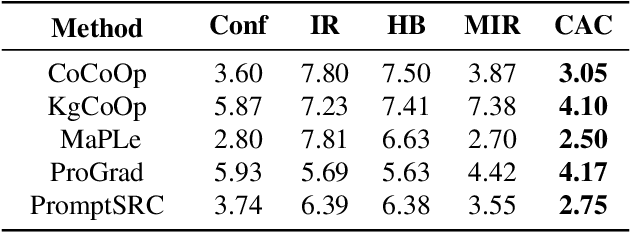
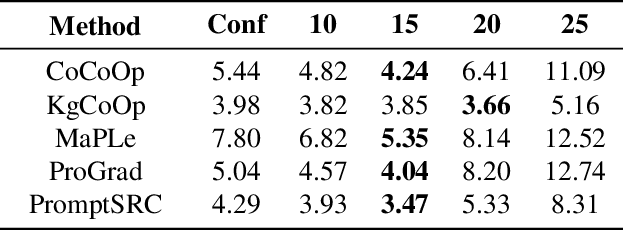
Vision-language models (VLMs), such as CLIP, have demonstrated exceptional generalization capabilities and can quickly adapt to downstream tasks through prompt fine-tuning. Unfortunately, in classification tasks involving non-training classes, known as open-vocabulary setting, fine-tuned VLMs often overfit to train classes, resulting in a misalignment between confidence scores and actual accuracy on unseen classes, which significantly undermines their reliability in real-world deployments. Existing confidence calibration methods typically require training parameters or analyzing features from the training dataset, restricting their ability to generalize unseen classes without corresponding train data. Moreover, VLM-specific calibration methods rely solely on text features from train classes as calibration indicators, which inherently limits their ability to calibrate train classes. To address these challenges, we propose an effective multimodal calibration method Contrast-Aware Calibration (CAC). Building on the original CLIP's zero-shot adaptability and the conclusion from empirical analysis that poor intra-class and inter-class discriminative ability on unseen classes is the root cause, we calculate calibration weights based on the contrastive difference between the original and fine-tuned CLIP. This method not only adapts to calibrating unseen classes but also overcomes the limitations of previous VLM calibration methods that could not calibrate train classes. In experiments involving 11 datasets with 5 fine-tuning methods, CAC consistently achieved the best calibration effect on both train and unseen classes without sacrificing accuracy and inference speed.
Project-and-Fuse: Improving RGB-D Semantic Segmentation via Graph Convolution Networks
Jan 31, 2025

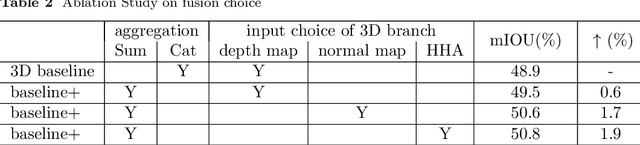
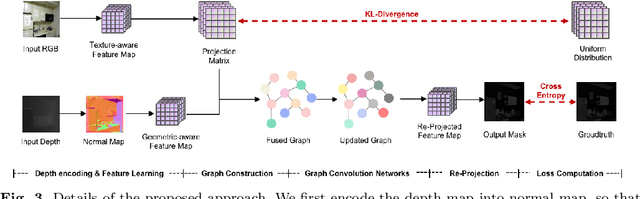
Most existing RGB-D semantic segmentation methods focus on the feature level fusion, including complex cross-modality and cross-scale fusion modules. However, these methods may cause misalignment problem in the feature fusion process and counter-intuitive patches in the segmentation results. Inspired by the popular pixel-node-pixel pipeline, we propose to 1) fuse features from two modalities in a late fusion style, during which the geometric feature injection is guided by texture feature prior; 2) employ Graph Neural Networks (GNNs) on the fused feature to alleviate the emergence of irregular patches by inferring patch relationship. At the 3D feature extraction stage, we argue that traditional CNNs are not efficient enough for depth maps. So, we encode depth map into normal map, after which CNNs can easily extract object surface tendencies.At projection matrix generation stage, we find the existence of Biased-Assignment and Ambiguous-Locality issues in the original pipeline. Therefore, we propose to 1) adopt the Kullback-Leibler Loss to ensure no missing important pixel features, which can be viewed as hard pixel mining process; 2) connect regions that are close to each other in the Euclidean space as well as in the semantic space with larger edge weights so that location informations can been considered. Extensive experiments on two public datasets, NYU-DepthV2 and SUN RGB-D, have shown that our approach can consistently boost the performance of RGB-D semantic segmentation task.
Pre-Trained Vision-Language Model Selection and Reuse for Downstream Tasks
Jan 30, 2025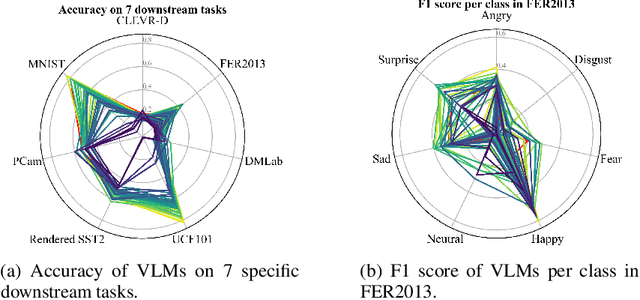
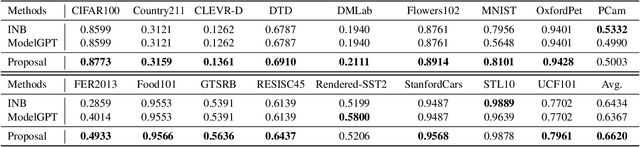
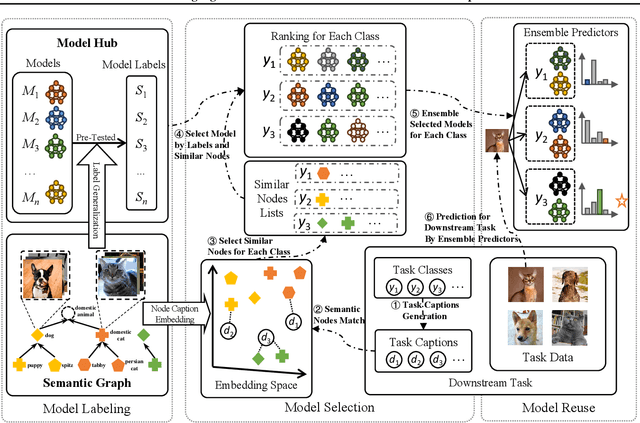
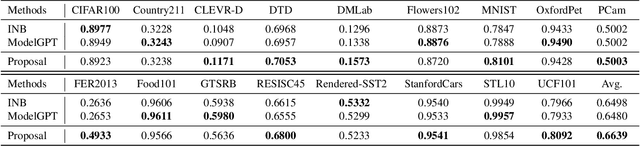
Pre-trained Vision-Language Models (VLMs) are becoming increasingly popular across various visual tasks, and several open-sourced VLM variants have been released. However, selecting the best-performing pre-trained VLM for a specific downstream task is challenging since no single VLM can achieve promising performance on all downstream tasks, and evaluating all available VLMs is impossible due to time and data limitations. To address this problem, this paper proposes a novel paradigm to select and reuse VLM for downstream tasks, called Model Label Learning (MLL). The proposal contains three key modules: \emph{model labeling}, which assigns labels to each VLM to describe their specialty and utility; \emph{model selection}, which matches the requirements of the target task with model labels; and \emph{model reuse}, which applies selected VLMs to the target task in an ensemble manner. The proposal is highly computationally efficient and growable since the model labeling process is completed target task independent and the ability could grow with the number of candidate VLMs. We also introduce a new benchmark for evaluating VLM selection methods, including 49 VLMs and 17 target task datasets. Experimental results clearly demonstrate the effectiveness of the proposed method for selecting and reusing VLMs.
BMIP: Bi-directional Modality Interaction Prompt Learning for VLM
Jan 14, 2025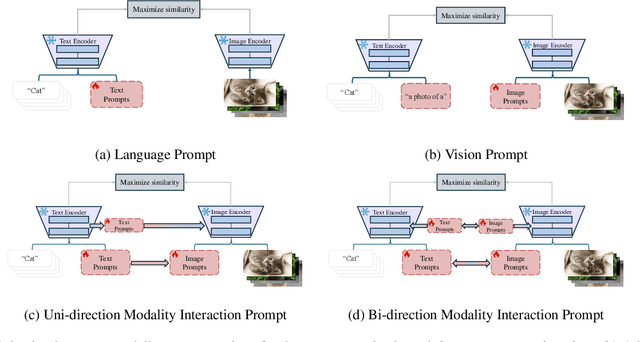


Vision-language models (VLMs) have exhibited remarkable generalization capabilities, and prompt learning for VLMs has attracted great attention for the ability to adapt pre-trained VLMs to specific downstream tasks. However, existing studies mainly focus on single-modal prompts or uni-directional modality interaction, overlooking the powerful alignment effects resulting from the interaction between the vision and language modalities. To this end, we propose a novel prompt learning method called $\underline{\textbf{B}}i-directional \underline{\textbf{M}}odality \underline{\textbf{I}}nteraction \underline{\textbf{P}}rompt (BMIP)$, which dynamically weights bi-modal information through learning the information of the attention layer, enhancing trainability and inter-modal consistency compared to simple information aggregation methods. To evaluate the effectiveness of prompt learning methods, we propose a more realistic evaluation paradigm called open-world generalization complementing the widely adopted cross-dataset transfer and domain generalization tasks. Comprehensive experiments on various datasets reveal that BMIP not only outperforms current state-of-the-art methods across all three evaluation paradigms but is also flexible enough to be combined with other prompt-based methods for consistent performance enhancement.
You Only Submit One Image to Find the Most Suitable Generative Model
Dec 16, 2024
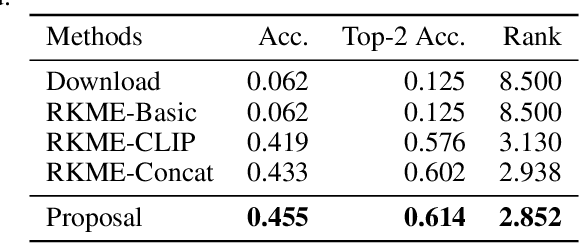


Deep generative models have achieved promising results in image generation, and various generative model hubs, e.g., Hugging Face and Civitai, have been developed that enable model developers to upload models and users to download models. However, these model hubs lack advanced model management and identification mechanisms, resulting in users only searching for models through text matching, download sorting, etc., making it difficult to efficiently find the model that best meets user requirements. In this paper, we propose a novel setting called Generative Model Identification (GMI), which aims to enable the user to identify the most appropriate generative model(s) for the user's requirements from a large number of candidate models efficiently. To our best knowledge, it has not been studied yet. In this paper, we introduce a comprehensive solution consisting of three pivotal modules: a weighted Reduced Kernel Mean Embedding (RKME) framework for capturing the generated image distribution and the relationship between images and prompts, a pre-trained vision-language model aimed at addressing dimensionality challenges, and an image interrogator designed to tackle cross-modality issues. Extensive empirical results demonstrate the proposal is both efficient and effective. For example, users only need to submit a single example image to describe their requirements, and the model platform can achieve an average top-4 identification accuracy of more than 80%.
Fully Test-time Adaptation for Tabular Data
Dec 14, 2024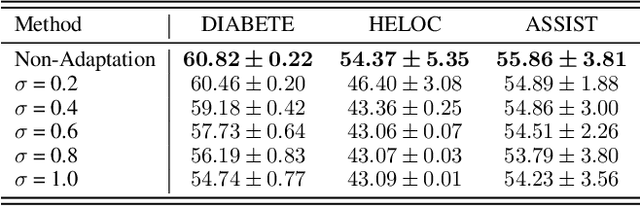
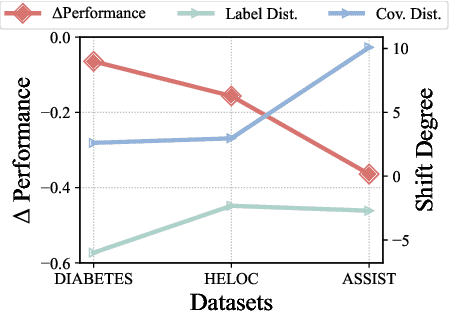
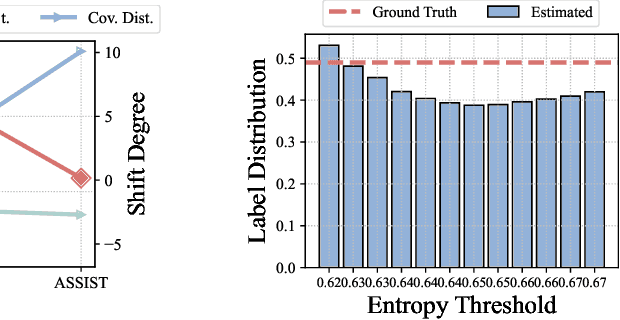
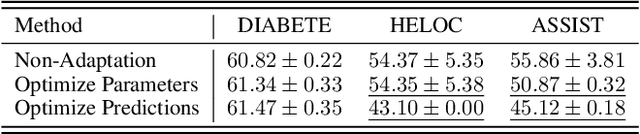
Tabular data plays a vital role in various real-world scenarios and finds extensive applications. Although recent deep tabular models have shown remarkable success, they still struggle to handle data distribution shifts, leading to performance degradation when testing distributions change. To remedy this, a robust tabular model must adapt to generalize to unknown distributions during testing. In this paper, we investigate the problem of fully test-time adaptation (FTTA) for tabular data, where the model is adapted using only the testing data. We identify three key challenges: the existence of label and covariate distribution shifts, the lack of effective data augmentation, and the sensitivity of adaptation, which render existing FTTA methods ineffective for tabular data. To this end, we propose the Fully Test-time Adaptation for Tabular data, namely FTAT, which enables FTTA methods to robustly optimize the label distribution of predictions, adapt to shifted covariate distributions, and suit a variety of tasks and models effectively. We conduct comprehensive experiments on six benchmark datasets, which are evaluated using three metrics. The experimental results demonstrate that FTAT outperforms state-of-the-art methods by a margin.