 Add to Chrome
 Add to Firefox
 Add to Edge
Self-Evolving Neuro-Symbolic Skills for Tool-Augmented Spatial Reasoning
Aug 08, 2026
Large vision-language models have achieved strong performance in multimodal reasoning, but they remain unreliable on fine-grained spatial tasks that demand both precise spatial perception and fine-grained geometric computation beyond end-to-end generation. Tool augmentation offers a natural solution, while existing methods either plan tool calls from scratch without explicit dependency constraints or rely on fixed pipelines that are redundant and generalize poorly across spatial tasks. An effective spatial reasoning agent should instead accumulate reusable experience and adaptively compose it for new problems. To this end, we propose NeSy-Spatial, a neuro-symbolic framework for self-evolving spatial skills. NeSy-Spatial abstracts tool interactions and geometric operations into typed executable atomic instructions and composes them into two complementary skill types: Tool-Use Skills for organizing tool execution and Geometry Skills for structured geometric reasoning. During inference, NeSy-Spatial retrieves and executes relevant skills in a closed-loop process. During evolution, it analyzes buffered successful and failed trajectories to refine skill structures and prune unreliable or inactive entries. Experiments on three spatial reasoning benchmarks show that NeSy-Spatial consistently improves reasoning accuracy with more precise tool utilization.

Step Back to Leap Forward: Self-Backtracking for Boosting Reasoning of Language Models
Feb 06, 2025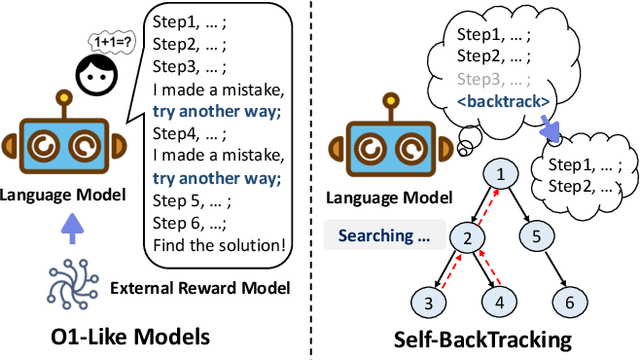
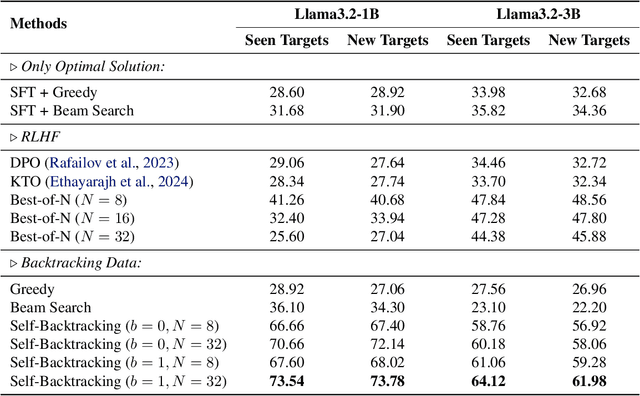
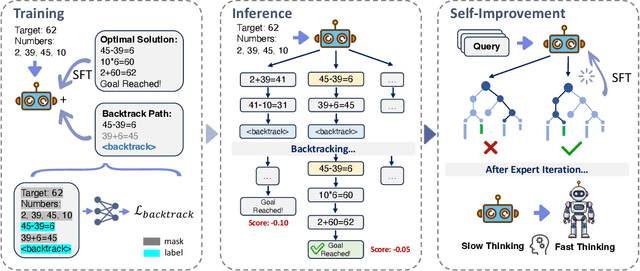
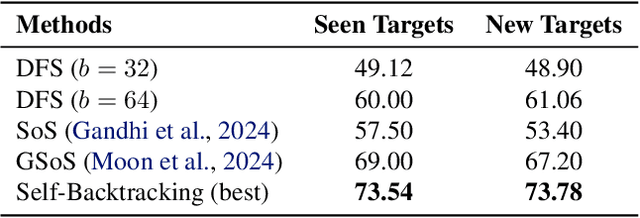
The integration of slow-thinking mechanisms into large language models (LLMs) offers a promising way toward achieving Level 2 AGI Reasoners, as exemplified by systems like OpenAI's o1. However, several significant challenges remain, including inefficient overthinking and an overreliance on auxiliary reward models. We point out that these limitations stem from LLMs' inability to internalize the search process, a key component of effective reasoning. A critical step toward addressing this issue is enabling LLMs to autonomously determine when and where to backtrack, a fundamental operation in traditional search algorithms. To this end, we propose a self-backtracking mechanism that equips LLMs with the ability to backtrack during both training and inference. This mechanism not only enhances reasoning ability but also efficiency by transforming slow-thinking processes into fast-thinking through self-improvement. Empirical evaluations demonstrate that our proposal significantly enhances the reasoning capabilities of LLMs, achieving a performance gain of over 40 percent compared to the optimal-path supervised fine-tuning method. We believe this study introduces a novel and promising pathway for developing more advanced and robust Reasoners.