 Add to Chrome
 Add to Firefox
 Add to Edge
UniTac: A Unified Multimodal Model for Cross-Sensor Tactile Understanding and Generation
Jun 30, 2026
Unified multimodal models (UMMs) have shown great promise in integrating understanding and generation across diverse modalities. However, existing research rarely extends this paradigm to the tactile domain, where both object-level semantics and sensor-level configurations jointly determine the meaning of touch. To address this gap, we propose UniTac, the first UMM designed for tactile understanding and generation. UniTac models the tactile process as a transition from non-contact to contact, capturing the physical interaction between sensors and objects through a dual-level representation that encodes both sensor and object attributes. For tactile understanding, UniTac introduces two tasks, object property description and sensor identification, to enhance reasoning over physical and cross-sensor information. For tactile generation, we design a two-stage training paradigm consisting of reconstruction and alignment, together with a sensor-prior-based sampling strategy that simulates realistic tactile contact. Trained on large-scale multi-sensor datasets, UniTac achieves state-of-the-art performance in tactile understanding and generates realistic tactile signals across sensors.

Bi-KVIL: Keypoints-based Visual Imitation Learning of Bimanual Manipulation Tasks
Mar 05, 2024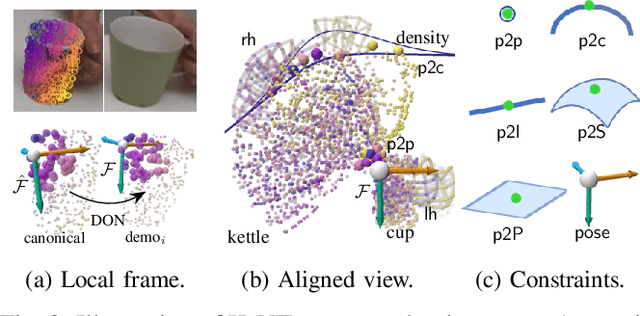

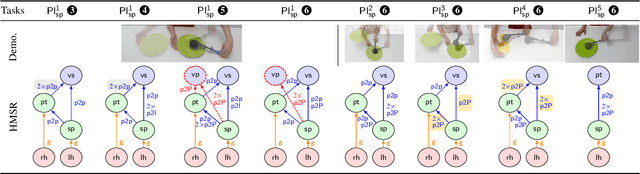
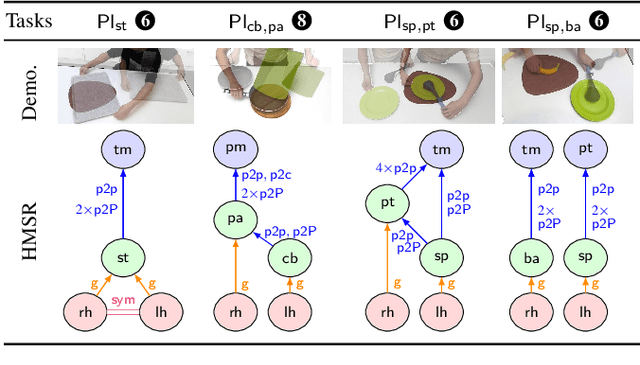
Visual imitation learning has achieved impressive progress in learning unimanual manipulation tasks from a small set of visual observations, thanks to the latest advances in computer vision. However, learning bimanual coordination strategies and complex object relations from bimanual visual demonstrations, as well as generalizing them to categorical objects in novel cluttered scenes remain unsolved challenges. In this paper, we extend our previous work on keypoints-based visual imitation learning (\mbox{K-VIL})~\cite{gao_kvil_2023} to bimanual manipulation tasks. The proposed Bi-KVIL jointly extracts so-called \emph{Hybrid Master-Slave Relationships} (HMSR) among objects and hands, bimanual coordination strategies, and sub-symbolic task representations. Our bimanual task representation is object-centric, embodiment-independent, and viewpoint-invariant, thus generalizing well to categorical objects in novel scenes. We evaluate our approach in various real-world applications, showcasing its ability to learn fine-grained bimanual manipulation tasks from a small number of human demonstration videos. Videos and source code are available at https://sites.google.com/view/bi-kvil.
K-VIL: Keypoints-based Visual Imitation Learning
Sep 07, 2022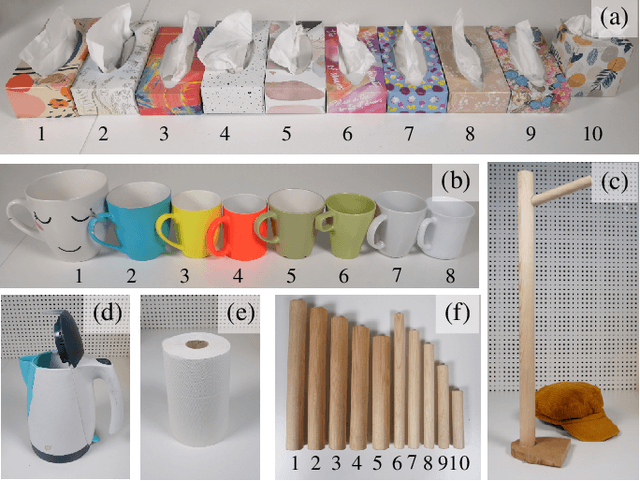
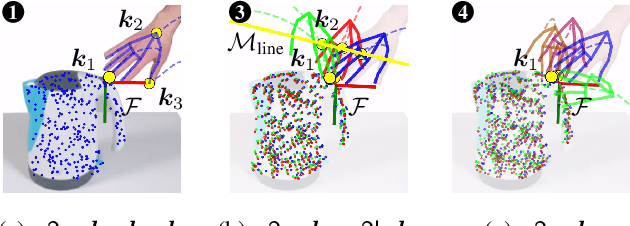
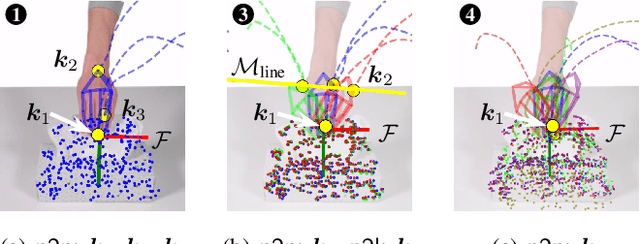
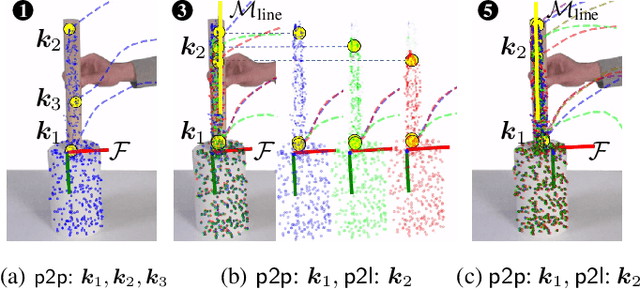
Visual imitation learning provides efficient and intuitive solutions for robotic systems to acquire novel manipulation skills. However, simultaneously learning geometric task constraints and control policies from visual inputs alone remains a challenging problem. In this paper, we propose an approach for keypoint-based visual imitation (K-VIL) that automatically extracts sparse, object-centric, and embodiment-independent task representations from a small number of human demonstration videos. The task representation is composed of keypoint-based geometric constraints on principal manifolds, their associated local frames, and the movement primitives that are then needed for the task execution. Our approach is capable of extracting such task representations from a single demonstration video, and of incrementally updating them when new demonstrations become available. To reproduce manipulation skills using the learned set of prioritized geometric constraints in novel scenes, we introduce a novel keypoint-based admittance controller. We evaluate our approach in several real-world applications, showcasing its ability to deal with cluttered scenes, new instances of categorical objects, and large object pose and shape variations, as well as its efficiency and robustness in both one-shot and few-shot imitation learning settings. Videos and source code are available at https://sites.google.com/view/k-vil.