 Add to Chrome
 Add to Firefox
 Add to Edge
Splaxel: Efficient Distributed Training of 3D Gaussian Splatting for Large-scale Scene Reconstruction via Pixel-level Communication
Jun 17, 2026
3D Gaussian Splatting (3DGS) enables high-fidelity and real-time 3D scene reconstruction, but scaling training to large-scale scenes requires optimizing hundreds of millions of Gaussians across multiple GPUs. Existing distributed approaches either partition scenes into isolated regions, causing global inconsistency, or rely on global Gaussian-level exchanges, which lead to substantial growth in inter-GPU communication and quickly dominate iteration time. We propose Splaxel, a communication-efficient distributed 3DGS training framework based on pixel-level local rendering and global composition. Instead of synchronizing Gaussians, each GPU renders its local subset and exchanges only partial pixel values, maintaining mathematical consistency while keeping communication cost stable as the scene size increases. Splaxel further reduces pixel-level redundancy through geometric and transmittance visibility prediction and improves GPU utilization via conflict-free camera-view consolidation. Evaluated on large-scale datasets with up to 120M Gaussians, Splaxel achieves up to 7.6$\times$ speedup over the state-of-the-art distributed 3DGS framework while preserving high reconstruction quality.

NeurLZ: On Enhancing Lossy Compression Performance based on Error-Controlled Neural Learning for Scientific Data
Sep 10, 2024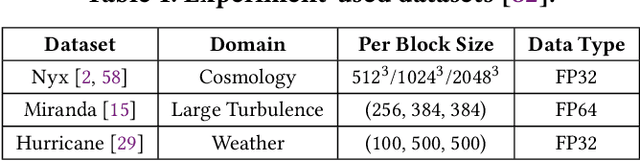
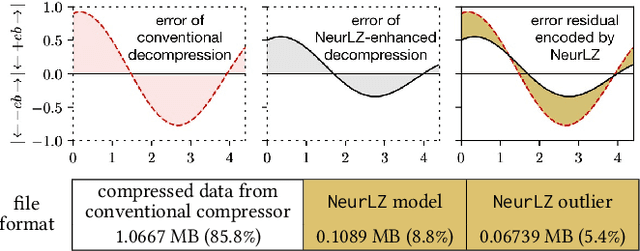

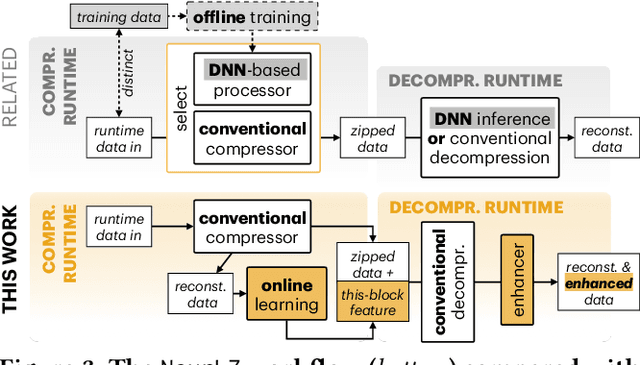
Large-scale scientific simulations generate massive datasets that pose significant challenges for storage and I/O. While traditional lossy compression techniques can improve performance, balancing compression ratio, data quality, and throughput remains difficult. To address this, we propose NeurLZ, a novel cross-field learning-based and error-controlled compression framework for scientific data. By integrating skipping DNN models, cross-field learning, and error control, our framework aims to substantially enhance lossy compression performance. Our contributions are three-fold: (1) We design a lightweight skipping model to provide high-fidelity detail retention, further improving prediction accuracy. (2) We adopt a cross-field learning approach to significantly improve data prediction accuracy, resulting in a substantially improved compression ratio. (3) We develop an error control approach to provide strict error bounds according to user requirements. We evaluated NeurLZ on several real-world HPC application datasets, including Nyx (cosmological simulation), Miranda (large turbulence simulation), and Hurricane (weather simulation). Experiments demonstrate that our framework achieves up to a 90% relative reduction in bit rate under the same data distortion, compared to the best existing approach.