 Add to Chrome
 Add to Firefox
 Add to Edge
SCORE: Subject Coordinate Recovery for Label-Free Cross-Subject EEG-to-Image Retrieval
Aug 19, 2026
Accurate visual decoding can reveal how the brain represents visual information and recover perceived content from neural signals such as electroencephalography (EEG), with potential for neural communication. However, current EEG-to-image retrieval methods perform far below their within-subject counterparts for new users without labeled calibration, limiting real-world deployment. To understand this gap, we analyze EEG features across subjects and find that different subjects preserve similar relationships among concepts but express them along different coordinate directions. We therefore propose Subject Coordinate Recovery (SCORE), a target label-free framework combining recovery-aware source training with coordinate alignment at deployment. During training, SCORE aligns source subject EEG with a common image space and simulates unseen-subject recovery through source-only episodes. At deployment, with both encoders frozen, SCORE selects reliable EEG-image landmarks through hubness-corrected matching and estimates an orthogonal transformation to recover target EEG coordinates without source data or target labels. In 200-way retrieval on two public benchmarks, SCORE outperforms the unadapted baseline for every target subject and achieves the best overall accuracy. It reaches 53.23%/83.55% and 12.01%/32.16% Top-1/Top-5 on THINGS-EEG2 and Alljoined-1.6M, respectively, surpassing the strongest baselines by 17.45/15.70 and 3.08/4.62 percentage points. Without target labels or encoder updates, SCORE brings brain-based visual decoding closer to robust, practical, low-latency deployment across users.

Beyond Trial Averaging: Anchoring Neural and Visual Representations for Few-Repetition Brain-to-Image Retrieval
Aug 19, 2026Decoding visual information from brain signals probes neural representations and enables neuro-rehabilitation and dream decoding. Recent brain-to-image retrieval approaches have achieved promising performance, typically by averaging many (up to 80) neural trials per image, requiring repeated stimulus presentation that increases latency, cost, and user burden. When only one or a few repetitions are available, the retrieval accuracy drops sharply. This drop is commonly attributed to query noise because averaging suppresses noise and increases signal stability. However, we find a non-transitive alignment pattern: the low-repetition query signal and the image representation each align with the high-repetition center, but not directly with each other. This pattern shows that query noise is only part of the problem and that gallery placement also affects retrieval. We therefore propose a neural-anchor-based retrieval (NEAR) framework that treats the high-repetition center as an anchor and approaches it from both sides: a denoiser pulls the noisy query toward the true anchor, and a small network predicts each candidate's pseudo anchor from its image and pulls the image toward it. Across four datasets spanning EEG, MEG and fMRI, NEAR consistently improved retrieval in the few-repetition regime. On THINGS-EEG2, it improved 200-way Top-1 accuracy by 5.7 and 9.3 percentage points respectively, when averaging one and four repetitions. By anchoring neural and visual representations, NEAR reduces reliance on repeated acquisition and brings neural retrieval closer to real-world deployment.
EEG Foundation Models: Progresses, Benchmarking, and Open Problems
Jan 25, 2026Electroencephalography (EEG) foundation models have recently emerged as a promising paradigm for brain-computer interfaces (BCIs), aiming to learn transferable neural representations from large-scale heterogeneous recordings. Despite rapid progresses, there lacks fair and comprehensive comparisons of existing EEG foundation models, due to inconsistent pre-training objectives, preprocessing choices, and downstream evaluation protocols. This paper fills this gap. We first review 50 representative models and organize their design choices into a unified taxonomic framework including data standardization, model architectures, and self-supervised pre-training strategies. We then evaluate 12 open-source foundation models and competitive specialist baselines across 13 EEG datasets spanning nine BCI paradigms. Emphasizing real-world deployments, we consider both cross-subject generalization under a leave-one-subject-out protocol and rapid calibration under a within-subject few-shot setting. We further compare full-parameter fine-tuning with linear probing to assess the transferability of pre-trained representations, and examine the relationship between model scale and downstream performance. Our results indicate that: 1) linear probing is frequently insufficient; 2) specialist models trained from scratch remain competitive across many tasks; and, 3) larger foundation models do not necessarily yield better generalization performance under current data regimes and training practices.
Backpropagation-Free Test-Time Adaptation for Lightweight EEG-Based Brain-Computer Interfaces
Jan 12, 2026Electroencephalogram (EEG)-based brain-computer interfaces (BCIs) face significant deployment challenges due to inter-subject variability, signal non-stationarity, and computational constraints. While test-time adaptation (TTA) mitigates distribution shifts under online data streams without per-use calibration sessions, existing TTA approaches heavily rely on explicitly defined loss objectives that require backpropagation for updating model parameters, which incurs computational overhead, privacy risks, and sensitivity to noisy data streams. This paper proposes Backpropagation-Free Transformations (BFT), a TTA approach for EEG decoding that eliminates such issues. BFT applies multiple sample-wise transformations of knowledge-guided augmentations or approximate Bayesian inference to each test trial, generating multiple prediction scores for a single test sample. A learning-to-rank module enhances the weighting of these predictions, enabling robust aggregation for uncertainty suppression during inference under theoretical justifications. Extensive experiments on five EEG datasets of motor imagery classification and driver drowsiness regression tasks demonstrate the effectiveness, versatility, robustness, and efficiency of BFT. This research enables lightweight plug-and-play BCIs on resource-constrained devices, broadening the real-world deployment of decoding algorithms for EEG-based BCI.
CMCRD: Cross-Modal Contrastive Representation Distillation for Emotion Recognition
Apr 12, 2025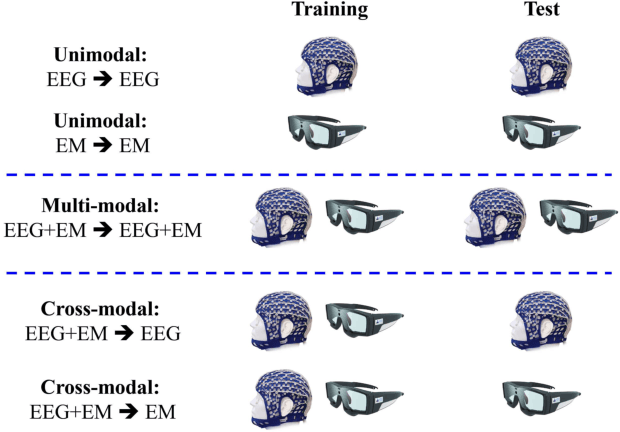
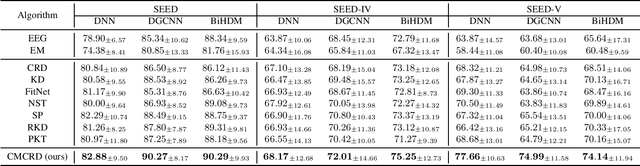
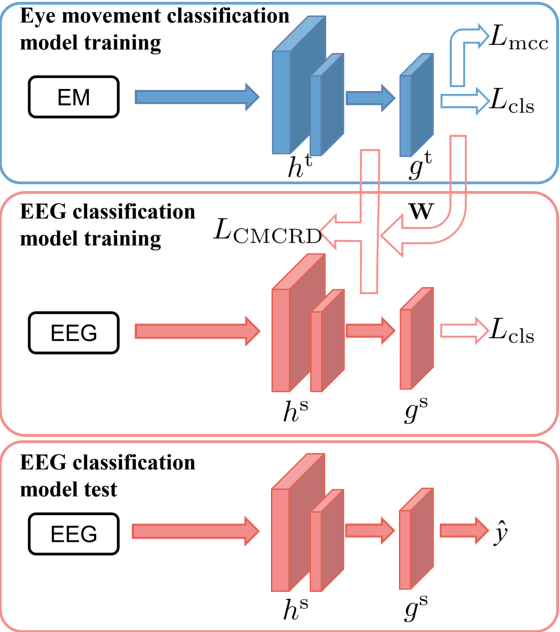
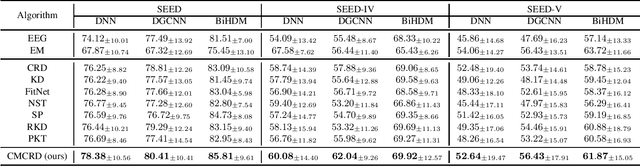
Emotion recognition is an important component of affective computing, and also human-machine interaction. Unimodal emotion recognition is convenient, but the accuracy may not be high enough; on the contrary, multi-modal emotion recognition may be more accurate, but it also increases the complexity and cost of the data collection system. This paper considers cross-modal emotion recognition, i.e., using both electroencephalography (EEG) and eye movement in training, but only EEG or eye movement in test. We propose cross-modal contrastive representation distillation (CMCRD), which uses a pre-trained eye movement classification model to assist the training of an EEG classification model, improving feature extraction from EEG signals, or vice versa. During test, only EEG signals (or eye movement signals) are acquired, eliminating the need for multi-modal data. CMCRD not only improves the emotion recognition accuracy, but also makes the system more simplified and practical. Experiments using three different neural network architectures on three multi-modal emotion recognition datasets demonstrated the effectiveness of CMCRD. Compared with the EEG-only model, it improved the average classification accuracy by about 6.2%.