 Add to Chrome
 Add to Firefox
 Add to Edge
FedADB: Class Anchor-Driven Dual-Branch Federated Learning for Mitigating Forgetting
Aug 15, 2026
Multimodal data collected by heterogeneous devices are used for collaborative training, where federated learning (FL) serves as a key paradigm for effective distributed modeling with data privacy preservation. However, local training suffers from the forgetting of previously learned global knowledge under cross-client data heterogeneity, which leads to significant declines in both performance and convergence speed. Most previous studies rely on global alignment strategies to retain global knowledge, which hinder local optimization and lead to inadequate supervision of missing classes. Some studies introduce proxy datasets to supplement supervision for missing classes. However, it remains a challenge to balance class-wise global consistency and local optimization objectives without proxy datasets. In this work, we propose FedADB, a Class Anchor-Driven Dual-Branch FL framework. Specifically, the server generates class anchors optimized in a differentiable input space, which are shared across clients. These class anchors serve as global references that provide supervision for missing classes during local training. A dual-branch collaborative training mechanism is designed for clients. In this mechanism, the anchor-based global branch focuses on learning with global consistency, achieving global knowledge alignment by class-anchor balanced sampling. The local calibration branch focuses on learning discriminative local features, mitigating the degradation of local representations caused by excessive global alignment. Extensive experiments across multiple medical and natural datasets demonstrate that FedADB achieves significant improvements in both accuracy and convergence speed.

Classifier Clustering and Feature Alignment for Federated Learning under Distributed Concept Drift
Oct 24, 2024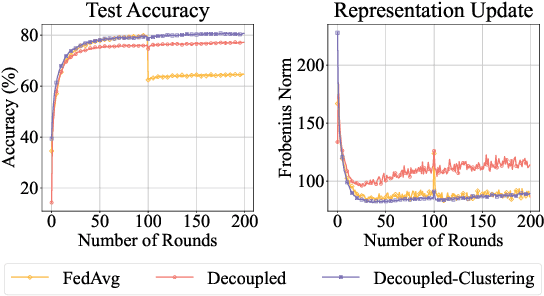
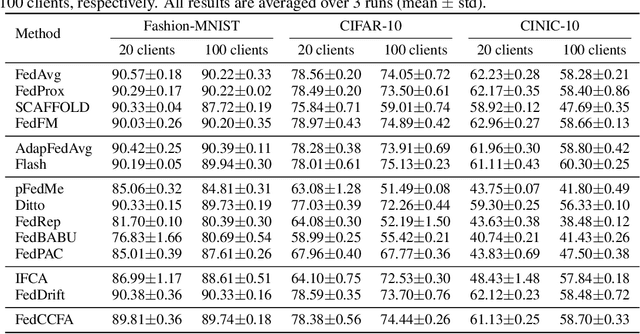
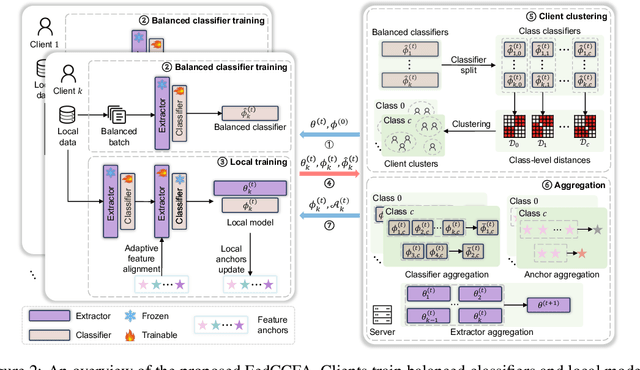
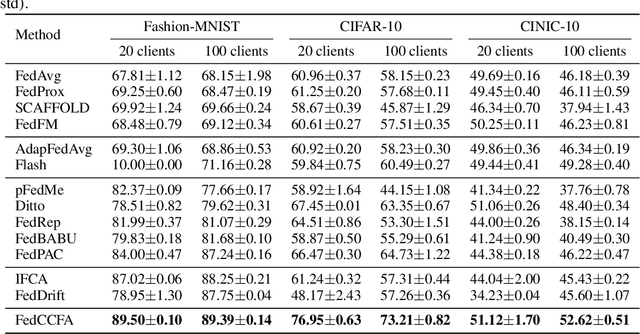
Data heterogeneity is one of the key challenges in federated learning, and many efforts have been devoted to tackling this problem. However, distributed concept drift with data heterogeneity, where clients may additionally experience different concept drifts, is a largely unexplored area. In this work, we focus on real drift, where the conditional distribution $P(Y|X)$ changes. We first study how distributed concept drift affects the model training and find that local classifier plays a critical role in drift adaptation. Moreover, to address data heterogeneity, we study the feature alignment under distributed concept drift, and find two factors that are crucial for feature alignment: the conditional distribution $P(Y|X)$ and the degree of data heterogeneity. Motivated by the above findings, we propose FedCCFA, a federated learning framework with classifier clustering and feature alignment. To enhance collaboration under distributed concept drift, FedCCFA clusters local classifiers at class-level and generates clustered feature anchors according to the clustering results. Assisted by these anchors, FedCCFA adaptively aligns clients' feature spaces based on the entropy of label distribution $P(Y)$, alleviating the inconsistency in feature space. Our results demonstrate that FedCCFA significantly outperforms existing methods under various concept drift settings. Code is available at https://github.com/Chen-Junbao/FedCCFA.