 Add to Chrome
 Add to Firefox
 Add to Edge
Keyframe-Anchored Identity Preservation for Sequential-Action Video Generation
Jul 20, 2026
Identity-preserving text-to-video generation aims to synthesize a video that accurately follows a textual description while maintaining the recognizability of a user-specified subject throughout. The IPVG26 challenge extends this framework from a single holistic prompt to a temporally structured specification. The model additionally receives a sequence of timestamped action captions and must render the subject performing these actions in the specified order. This temporal structure presents a challenge not encountered in previous identity-preserving generation tasks, as the subject must continuously perform a scripted sequence of distinct actions while maintaining a consistent identity. However, end-to-end video generators are prone to appearance drift as motion accumulates and the depicted actions change. We address this challenge with a training-free, three-stage pipeline framework. An action-aware prompt polishment stage first rewrites the inputs into image-generation prompts that specify the terminal state of each action. An identity-preserving generation stage then produces the keyframe sequence by conditioning each frame jointly on the reference identity and its predecessor, thereby decoupling time-invariant appearance from time-varying pose. Finally, an identity-aware inference enhancement stage synthesizes the intermediate segments using multi-reference guidance and identity-driven noise searching, both of which reinforce identity fidelity during sampling. Our method ranked third on the official Track 2 leaderboard, demonstrating competitive performance and strong generality.

Latent-Space Contrastive Reinforcement Learning for Stable and Efficient LLM Reasoning
Jan 24, 2026While Large Language Models (LLMs) demonstrate exceptional performance in surface-level text generation, their nature in handling complex multi-step reasoning tasks often remains one of ``statistical fitting'' rather than systematic logical deduction. Traditional Reinforcement Learning (RL) attempts to mitigate this by introducing a ``think-before-speak'' paradigm. However, applying RL directly in high-dimensional, discrete token spaces faces three inherent challenges: sample-inefficient rollouts, high gradient estimation variance, and the risk of catastrophic forgetting. To fundamentally address these structural bottlenecks, we propose \textbf{DeepLatent Reasoning (DLR)}, a latent-space bidirectional contrastive reinforcement learning framework. This framework shifts the trial-and-error cost from expensive token-level full sequence generation to the continuous latent manifold. Specifically, we introduce a lightweight assistant model to efficiently sample $K$ reasoning chain encodings within the latent space. These encodings are filtered via a dual reward mechanism based on correctness and formatting; only high-value latent trajectories are fed into a \textbf{frozen main model} for single-pass decoding. To maximize reasoning diversity while maintaining coherence, we design a contrastive learning objective to enable directed exploration within the latent space. Since the main model parameters remain frozen during optimization, this method mathematically eliminates catastrophic forgetting. Experiments demonstrate that under comparable GPU computational budgets, DLR achieves more stable training convergence, supports longer-horizon reasoning chains, and facilitates the sustainable accumulation of reasoning capabilities, providing a viable path toward reliable and scalable reinforcement learning for LLMs.
ConsistTalk: Intensity Controllable Temporally Consistent Talking Head Generation with Diffusion Noise Search
Nov 10, 2025Recent advancements in video diffusion models have significantly enhanced audio-driven portrait animation. However, current methods still suffer from flickering, identity drift, and poor audio-visual synchronization. These issues primarily stem from entangled appearance-motion representations and unstable inference strategies. In this paper, we introduce \textbf{ConsistTalk}, a novel intensity-controllable and temporally consistent talking head generation framework with diffusion noise search inference. First, we propose \textbf{an optical flow-guided temporal module (OFT)} that decouples motion features from static appearance by leveraging facial optical flow, thereby reducing visual flicker and improving temporal consistency. Second, we present an \textbf{Audio-to-Intensity (A2I) model} obtained through multimodal teacher-student knowledge distillation. By transforming audio and facial velocity features into a frame-wise intensity sequence, the A2I model enables joint modeling of audio and visual motion, resulting in more natural dynamics. This further enables fine-grained, frame-wise control of motion dynamics while maintaining tight audio-visual synchronization. Third, we introduce a \textbf{diffusion noise initialization strategy (IC-Init)}. By enforcing explicit constraints on background coherence and motion continuity during inference-time noise search, we achieve better identity preservation and refine motion dynamics compared to the current autoregressive strategy. Extensive experiments demonstrate that ConsistTalk significantly outperforms prior methods in reducing flicker, preserving identity, and delivering temporally stable, high-fidelity talking head videos.
Supplementary Material: Implementation and Experiments for GAU-based Model
May 18, 2022
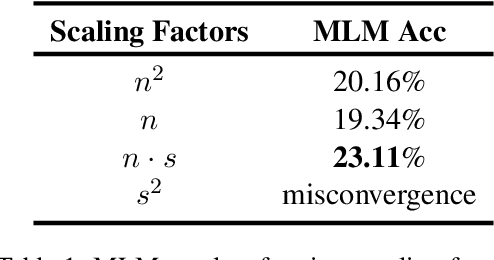


In February this year Google proposed a new Transformer variant called FLASH, which has a faster speed, lower VRAM footprint and better performance. This is achieved by designing a performant layer named GAU (Gated Attention Unit), which combines the Attention layer and FFN. In this paper, some implementation details are re-analyzed both theoretically and practically. We then propose a novel GAU-based model and pre-train it on a Chinese corpus. Results of the CLUE benchmark show that our model achieves a dev average score of 75.02, 1% higher than RoFormerV1 and being 45% faster, which is also competitive with RoFormerV2.