 Add to Chrome
 Add to Firefox
 Add to Edge
IFPV: An Integrated Multi-Agent Framework for Generative Operational Planning and High-Fidelity Plan Verification
May 14, 2026
Operational plan generation and verification are critical for modern complex and rapidly changing battlefield environments, yet traditional generation and verification methods still respectively face the challenges of generation infeasibility and verification insufficiency. To alleviate these limitations, we propose an Integrated Multi-Agent Framework for Generative Operational Planning and High-Fidelity Plan Verification (IFPV). IFPV consists of two tightly coupled modules: Multi-Perspective Hierarchical Agents (MPHA) for generative operational planning and an Adversarial Cognitive Simulation Engine (ACSE) for high-fidelity adversarial plan verification. MPHA decomposes commander intent into executable multi-platform tactical action sequences through the collaboration of Pathfinder, Analyst, and Planner agents. ACSE introduces an opponent equipped with a customized world model, which predicts the future evolution of mission-critical platforms and conducts dynamic counteractions against candidate plans. Simulation experiments in the Asymmetric Combat Tactic Simulator (ACTS) show that IFPV improves mission success by 19.4% and reduces operational cost by 41.7% compared with a single-step large language model (LLM) planning baseline. Compared with a traditional rule-based validator, ACSE increases the average suppression rate by 31.8%, indicating that the proposed verification environment is stricter and more discriminative in revealing the latent vulnerabilities of candidate plans. The code for IFPV can be found at https://github.com/zhigao3ks/IFPV.

MAFIG: Multi-agent Driven Formal Instruction Generation Framework
Apr 13, 2026Emergency situations in scheduling systems often trigger local functional failures that undermine system stability and even cause system collapse. Existing methods primarily rely on robust scheduling or reactive scheduling, handling emergencies through predefined rules or rescheduling strategies. However, the diversity and unpredictability of real-world emergencies make them difficult to anticipate, which limits the adaptability of these methods in complex scenarios. Recent studies have shown that Large Language Models (LLMs) possess strong potential for complex scheduling tasks because of their extensive prior knowledge and strong reasoning capabilities. Nevertheless, the high inference latency of LLMs and the lengthy contextual information of scheduling systems significantly hinder their application for emergency handling. To mitigate these issues, we propose the Multi-agent Driven Formal Instruction Generation Framework (MAFIG). The framework constrains the decision scope to local functional modules affected by emergency situations and repairs scheduling logic rapidly by generating formal instructions. MAFIG contains a Perception Agent and an Emergency Decision Agent, which mitigates the adverse impact of lengthy system contexts on emergency decision-making. We further introduce span-focused loss-driven local distillation mechanism (SFL) to transfer the decision-making capability of powerful Cloud Large Language Models (C-LLMs) to lightweight local models, reducing inference latency while preserving decision-making effectiveness. Experiments in the Port, Warehousing, and Deck scheduling datasets show success rates of 98.49\%, 94.97\%, and 97.50\%, with average processing times of 0.33 s, 0.23 s, and 0.19 s. These results demonstrate that MAFIG effectively mitigates the impact of emergencies and improves the robustness and adaptability of scheduling systems.
Easy Adaptation: An Efficient Task-Specific Knowledge Injection Method for Large Models in Resource-Constrained Environments
Dec 19, 2025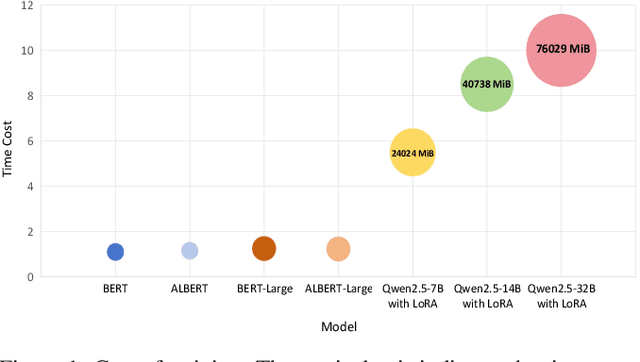
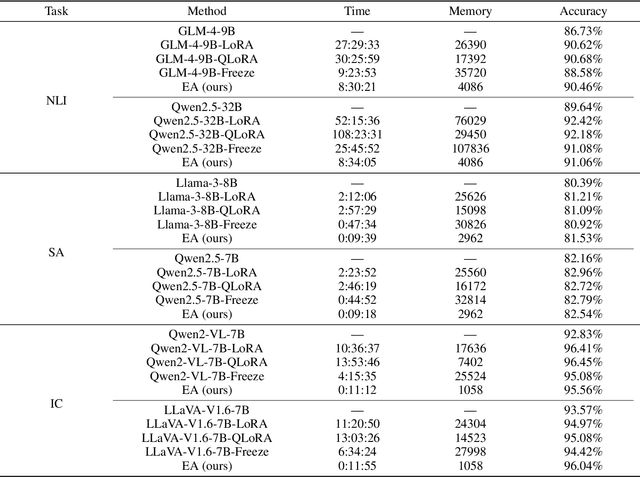
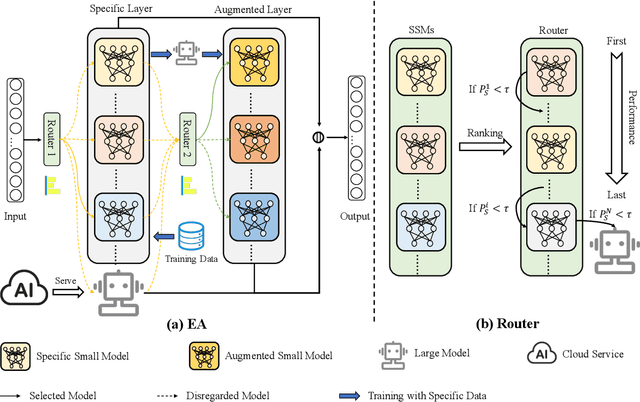
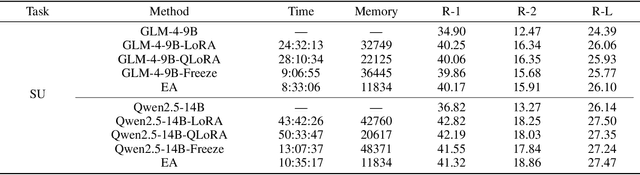
While the enormous parameter scale endows Large Models (LMs) with unparalleled performance, it also limits their adaptability across specific tasks. Parameter-Efficient Fine-Tuning (PEFT) has emerged as a critical approach for effectively adapting LMs to a diverse range of downstream tasks. However, existing PEFT methods face two primary challenges: (1) High resource cost. Although PEFT methods significantly reduce resource demands compared to full fine-tuning, it still requires substantial time and memory, making it impractical in resource-constrained environments. (2) Parameter dependency. PEFT methods heavily rely on updating a subset of parameters associated with LMs to incorporate task-specific knowledge. Yet, due to increasing competition in the LMs landscape, many companies have adopted closed-source policies for their leading models, offering access only via Application Programming Interface (APIs). Whereas, the expense is often cost-prohibitive and difficult to sustain, as the fine-tuning process of LMs is extremely slow. Even if small models perform far worse than LMs in general, they can achieve superior results on particular distributions while requiring only minimal resources. Motivated by this insight, we propose Easy Adaptation (EA), which designs Specific Small Models (SSMs) to complement the underfitted data distribution for LMs. Extensive experiments show that EA matches the performance of PEFT on diverse tasks without accessing LM parameters, and requires only minimal resources.