 Add to Chrome
 Add to Firefox
 Add to Edge
Modeling Behavioral Intensity and Transitions for Generative Recommendation
Apr 27, 2026
Multi-behavior recommendation aims to predict user conversions by modeling various interaction types that carry distinct intent signals. Recently, generative sequence modeling methods have emerged as an important paradigm for multi-behavior recommendation by achieving flexible sequence generation. However, existing generative methods typically treat behaviors as auxiliary token features and feed them into unified attention mechanisms. These models implicitly assume uniform activation of dependencies among historical behaviors, thereby failing to discern differences in intensity or capture transition patterns. To address these limitations, we propose BITRec, a novel generative multi-behavior recommendation framework that introduces structured behavioral modeling through selective dependency activation. BITRec incorporates (i) Hierarchical Behavior Aggregation (HBA), which explicitly models behavioral intensity differences through separated exploration and commitment pathways, and (ii) Transition Relation Encoding (TRE), which encodes transition structures through explicit learnable relation matrices. Experiments on four large-scale datasets (RetailRocket, Taobao, Tmall, Insurance Dataset) with millions of interactions achieve consistent improvements of 15-23% across multiple metrics, with peak gains of 22.79% MRR on Tmall and 17.83% HR@10, 17.55% NDCG@10 on Taobao.

LLM-Powered Ensemble Learning for Paper Source Tracing: A GPU-Free Approach
Sep 17, 2024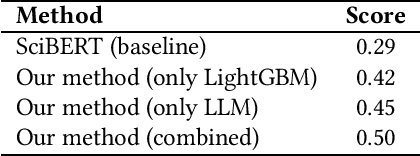
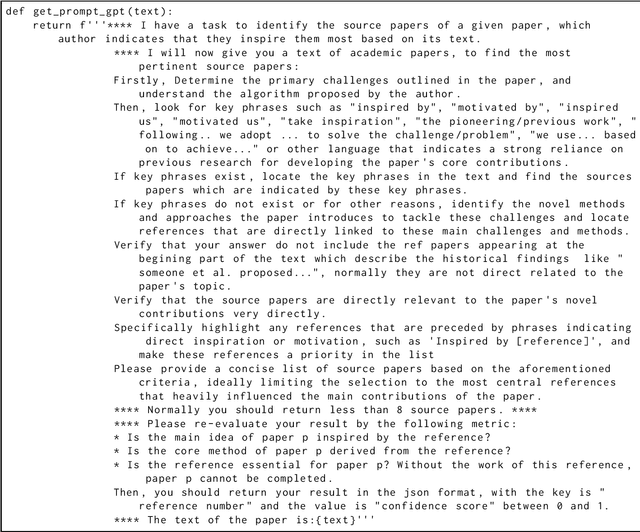
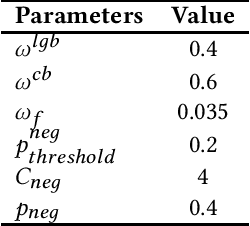
We participated in the KDD CUP 2024 paper source tracing competition and achieved the 3rd place. This competition tasked participants with identifying the reference sources (i.e., ref-sources, as referred to by the organizers of the competition) of given academic papers. Unlike most teams that addressed this challenge by fine-tuning pre-trained neural language models such as BERT or ChatGLM, our primary approach utilized closed-source large language models (LLMs). With recent advancements in LLM technology, closed-source LLMs have demonstrated the capability to tackle complex reasoning tasks in zero-shot or few-shot scenarios. Consequently, in the absence of GPUs, we employed closed-source LLMs to directly generate predicted reference sources from the provided papers. We further refined these predictions through ensemble learning. Notably, our method was the only one among the award-winning approaches that did not require the use of GPUs for model training. Code available at https://github.com/Cklwanfifa/KDDCUP2024-PST.