 Add to Chrome
 Add to Firefox
 Add to Edge
ExtractBench: A Benchmark for Schema-Guided Enterprise Document Extraction
Jul 31, 2026
Enterprise workflows increasingly rely on agents for \emph{schema-guided extraction}: given a document and a user-defined schema, the agent faithfully follows the schema to produce the correct output with source evidence as grounding metadata. We present ExtractBench, a benchmark for schema-guided extraction and, to our knowledge, the first to score value accuracy, record completeness at scale, grounding, and measured cost together. The evaluation system contains 4,869 pages across 370 enterprise documents, 8 business domains, and 67 document types, with clear tags differentiating their challenge scenarios. The scalable schema and ground-truth curation pipeline combines independent-system agreement for real documents, known values for synthetic lists, and human verification for forms. We report order-insensitive value F1 for value accuracy, plus two grounding metrics for source traceability: word- and page-level F1. Commercial VLMs perform well on short documents but often truncate record lists on long ones, while coding agents retain higher accuracy at much higher cost. LlamaExtract Agentic Plus ranks first on all three metrics, with accuracy comparable to coding agents at a fraction of the cost. Dataset and evaluation code are available on \href{https://huggingface.co/datasets/llamaindex/ExtractBench}{HuggingFace} and \href{https://github.com/run-llama/ExtractBench}{GitHub}.

A Statistical Test for the Benefits of Personalizing Interventions
Jul 09, 2026From medicine to marketing to social sciences, the promise of tailoring interventions to individuals is undeniable. However, practical applications force weighing personalization's potential benefits with its possible increased cost and fragility. We introduce a statistical hypothesis test that evaluates, given historical data, evidence that a personalized intervention policy's performance will surpass deploying the best single intervention. The test maintains strict type-I error control while achieving asymptotic normality with the minimal possible variance under specified conditions. Results on diverse datasets from job training, depression treatment, education and recommendation systems demonstrate the test's versatility and its superior performance over alternatives. This test can support decision-makers throughout the intervention sciences by providing a simple and powerful quantification of the potential benefits of personalization.
Active Learning for Stochastic Contextual Linear Bandits
May 24, 2026A key goal in stochastic contextual linear bandits is to efficiently learn a near-optimal policy. Prior algorithms for this problem learn a policy by strategically sampling actions but naively (passively) sampling contexts from the underlying context distribution. However, in many practical scenarios -- including online content recommendation, survey research, and clinical trials -- practitioners can actively sample or recruit contexts based on prior knowledge of the context distribution. Despite this potential for active learning, the role of strategic context sampling in stochastic contextual linear bandits is underexplored. We propose an algorithm that learns a near-optimal policy by strategically sampling rewards of context-action pairs. We prove instance-dependent theoretical guarantees demonstrating that our active context sampling strategy can improve over the minimax rate by up to a factor of $\sqrt{d}$, where $d$ is the linear dimension. We show empirically that our algorithm reduces the number of samples needed to learn a near-optimal policy, in tasks such as warfarin dose prediction and joke recommendation.
Optimal Exploration is no harder than Thompson Sampling
Oct 24, 2023
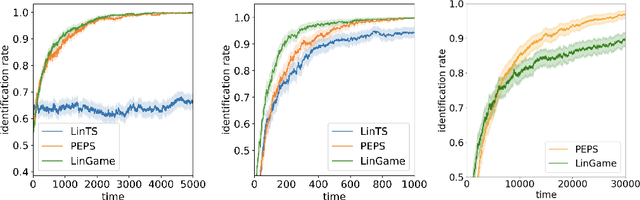
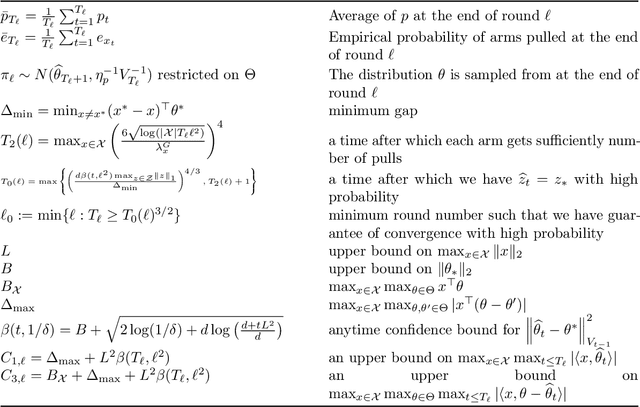
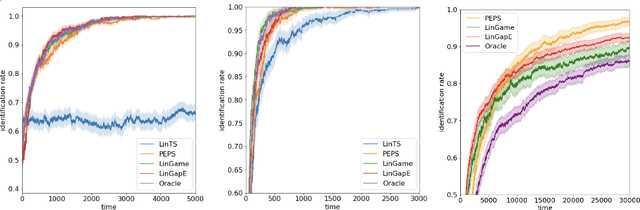
Given a set of arms $\mathcal{Z}\subset \mathbb{R}^d$ and an unknown parameter vector $\theta_\ast\in\mathbb{R}^d$, the pure exploration linear bandit problem aims to return $\arg\max_{z\in \mathcal{Z}} z^{\top}\theta_{\ast}$, with high probability through noisy measurements of $x^{\top}\theta_{\ast}$ with $x\in \mathcal{X}\subset \mathbb{R}^d$. Existing (asymptotically) optimal methods require either a) potentially costly projections for each arm $z\in \mathcal{Z}$ or b) explicitly maintaining a subset of $\mathcal{Z}$ under consideration at each time. This complexity is at odds with the popular and simple Thompson Sampling algorithm for regret minimization, which just requires access to a posterior sampling and argmax oracle, and does not need to enumerate $\mathcal{Z}$ at any point. Unfortunately, Thompson sampling is known to be sub-optimal for pure exploration. In this work, we pose a natural question: is there an algorithm that can explore optimally and only needs the same computational primitives as Thompson Sampling? We answer the question in the affirmative. We provide an algorithm that leverages only sampling and argmax oracles and achieves an exponential convergence rate, with the exponent being the optimal among all possible allocations asymptotically. In addition, we show that our algorithm can be easily implemented and performs as well empirically as existing asymptotically optimal methods.
Instance-optimal PAC Algorithms for Contextual Bandits
Jul 05, 2022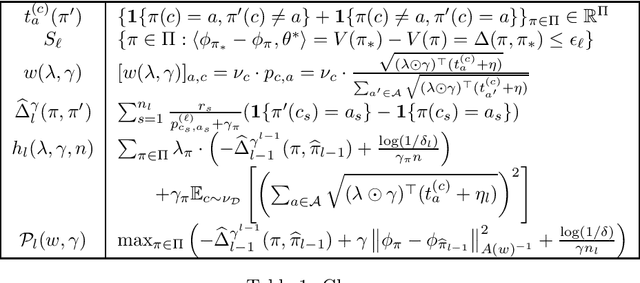
In the stochastic contextual bandit setting, regret-minimizing algorithms have been extensively researched, but their instance-minimizing best-arm identification counterparts remain seldom studied. In this work, we focus on the stochastic bandit problem in the $(\epsilon,\delta)$-$\textit{PAC}$ setting: given a policy class $\Pi$ the goal of the learner is to return a policy $\pi\in \Pi$ whose expected reward is within $\epsilon$ of the optimal policy with probability greater than $1-\delta$. We characterize the first $\textit{instance-dependent}$ PAC sample complexity of contextual bandits through a quantity $\rho_{\Pi}$, and provide matching upper and lower bounds in terms of $\rho_{\Pi}$ for the agnostic and linear contextual best-arm identification settings. We show that no algorithm can be simultaneously minimax-optimal for regret minimization and instance-dependent PAC for best-arm identification. Our main result is a new instance-optimal and computationally efficient algorithm that relies on a polynomial number of calls to an argmax oracle.
Exploration of Numerical Precision in Deep Neural Networks
May 03, 2018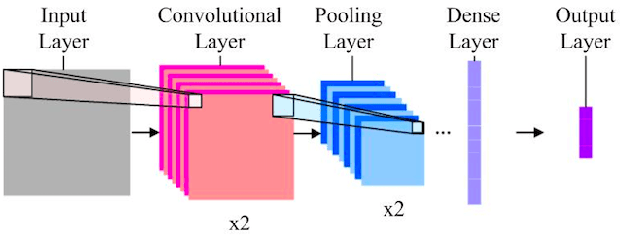
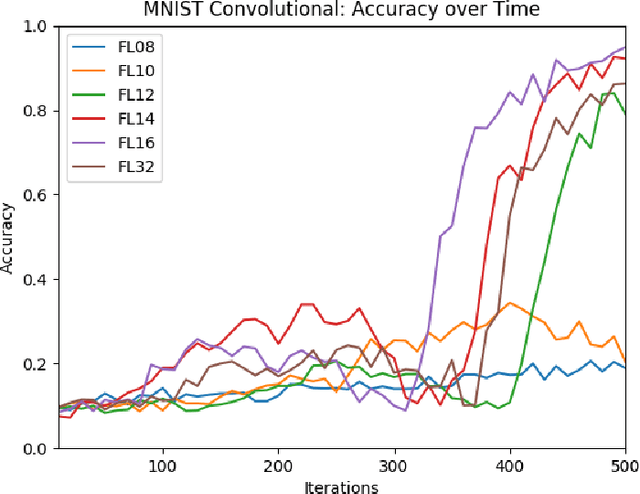
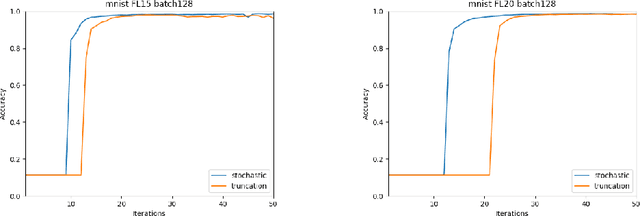
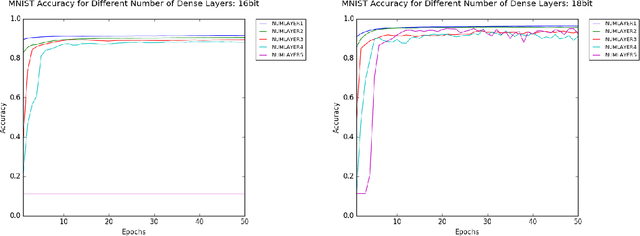
Reduced numerical precision is a common technique to reduce computational cost in many Deep Neural Networks (DNNs). While it has been observed that DNNs are resilient to small errors and noise, no general result exists that is capable of predicting a given DNN system architecture's sensitivity to reduced precision. In this project, we emulate arbitrary bit-width using a specified floating-point representation with a truncation method, which is applied to the neural network after each batch. We explore the impact of several model parameters on the network's training accuracy and show results on the MNIST dataset. We then present a preliminary theoretical investigation of the error scaling in both forward and backward propagations. We end with a discussion of the implications of these results as well as the potential for generalization to other network architectures.