 Add to Chrome
 Add to Firefox
 Add to Edge
FlexAvatar: Flexible Large Reconstruction Model for Animatable Gaussian Head Avatars with Detailed Deformation
Dec 19, 2025


We present FlexAvatar, a flexible large reconstruction model for high-fidelity 3D head avatars with detailed dynamic deformation from single or sparse images, without requiring camera poses or expression labels. It leverages a transformer-based reconstruction model with structured head query tokens as canonical anchor to aggregate flexible input-number-agnostic, camera-pose-free and expression-free inputs into a robust canonical 3D representation. For detailed dynamic deformation, we introduce a lightweight UNet decoder conditioned on UV-space position maps, which can produce detailed expression-dependent deformations in real time. To better capture rare but critical expressions like wrinkles and bared teeth, we also adopt a data distribution adjustment strategy during training to balance the distribution of these expressions in the training set. Moreover, a lightweight 10-second refinement can further enhances identity-specific details in extreme identities without affecting deformation quality. Extensive experiments demonstrate that our FlexAvatar achieves superior 3D consistency, detailed dynamic realism compared with previous methods, providing a practical solution for animatable 3D avatar creation.

SEGA: Drivable 3D Gaussian Head Avatar from a Single Image
Apr 19, 2025Creating photorealistic 3D head avatars from limited input has become increasingly important for applications in virtual reality, telepresence, and digital entertainment. While recent advances like neural rendering and 3D Gaussian splatting have enabled high-quality digital human avatar creation and animation, most methods rely on multiple images or multi-view inputs, limiting their practicality for real-world use. In this paper, we propose SEGA, a novel approach for Single-imagE-based 3D drivable Gaussian head Avatar creation that combines generalized prior models with a new hierarchical UV-space Gaussian Splatting framework. SEGA seamlessly combines priors derived from large-scale 2D datasets with 3D priors learned from multi-view, multi-expression, and multi-ID data, achieving robust generalization to unseen identities while ensuring 3D consistency across novel viewpoints and expressions. We further present a hierarchical UV-space Gaussian Splatting framework that leverages FLAME-based structural priors and employs a dual-branch architecture to disentangle dynamic and static facial components effectively. The dynamic branch encodes expression-driven fine details, while the static branch focuses on expression-invariant regions, enabling efficient parameter inference and precomputation. This design maximizes the utility of limited 3D data and achieves real-time performance for animation and rendering. Additionally, SEGA performs person-specific fine-tuning to further enhance the fidelity and realism of the generated avatars. Experiments show our method outperforms state-of-the-art approaches in generalization ability, identity preservation, and expression realism, advancing one-shot avatar creation for practical applications.
HeadGAP: Few-shot 3D Head Avatar via Generalizable Gaussian Priors
Aug 12, 2024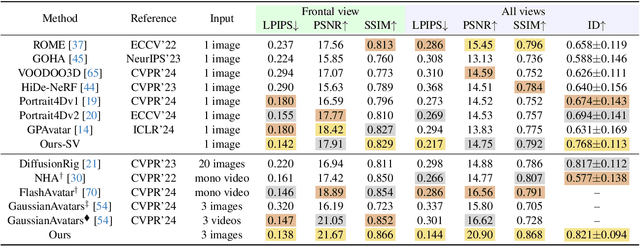
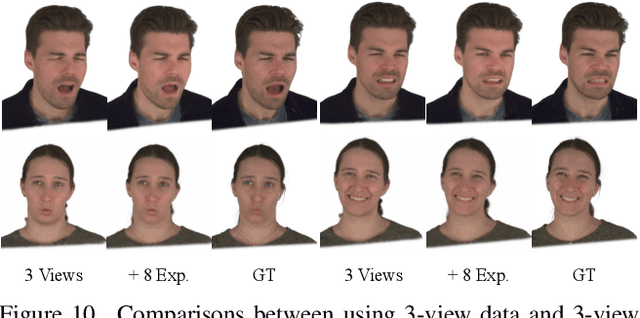
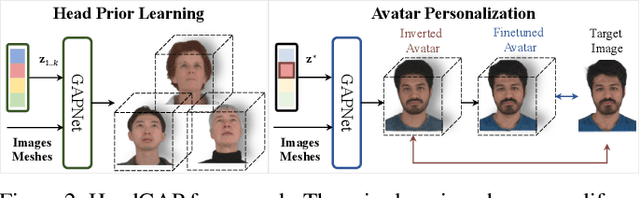
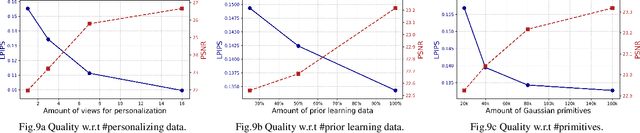
In this paper, we present a novel 3D head avatar creation approach capable of generalizing from few-shot in-the-wild data with high-fidelity and animatable robustness. Given the underconstrained nature of this problem, incorporating prior knowledge is essential. Therefore, we propose a framework comprising prior learning and avatar creation phases. The prior learning phase leverages 3D head priors derived from a large-scale multi-view dynamic dataset, and the avatar creation phase applies these priors for few-shot personalization. Our approach effectively captures these priors by utilizing a Gaussian Splatting-based auto-decoder network with part-based dynamic modeling. Our method employs identity-shared encoding with personalized latent codes for individual identities to learn the attributes of Gaussian primitives. During the avatar creation phase, we achieve fast head avatar personalization by leveraging inversion and fine-tuning strategies. Extensive experiments demonstrate that our model effectively exploits head priors and successfully generalizes them to few-shot personalization, achieving photo-realistic rendering quality, multi-view consistency, and stable animation.
OHTA: One-shot Hand Avatar via Data-driven Implicit Priors
Feb 29, 2024In this paper, we delve into the creation of one-shot hand avatars, attaining high-fidelity and drivable hand representations swiftly from a single image. With the burgeoning domains of the digital human, the need for quick and personalized hand avatar creation has become increasingly critical. Existing techniques typically require extensive input data and may prove cumbersome or even impractical in certain scenarios. To enhance accessibility, we present a novel method OHTA (One-shot Hand avaTAr) that enables the creation of detailed hand avatars from merely one image. OHTA tackles the inherent difficulties of this data-limited problem by learning and utilizing data-driven hand priors. Specifically, we design a hand prior model initially employed for 1) learning various hand priors with available data and subsequently for 2) the inversion and fitting of the target identity with prior knowledge. OHTA demonstrates the capability to create high-fidelity hand avatars with consistent animatable quality, solely relying on a single image. Furthermore, we illustrate the versatility of OHTA through diverse applications, encompassing text-to-avatar conversion, hand editing, and identity latent space manipulation.