 Add to Chrome
 Add to Firefox
 Add to Edge
Implicit Fuzzification via Bounded Noise Injection for Robust Medical Image Segmentation
Jun 03, 2026
Image segmentation remains fundamentally limited by boundary ambiguity arising from sampling-induced information loss and inherent uncertainty in pixel-wise labeling. Although encoder-decoder architectures such as U-Net achieve strong performance, they often produce overconfident predictions that fail to capture transition-region ambiguity. To address this issue, we propose \textbf{NoiseUNet}, a simple yet effective framework that injects bounded perturbations into skip connections to regularize cross-scale feature fusion. This mechanism enforces robustness to local feature variations and promotes boundary-aware representations. Theoretically, the perturbation induces an implicit fuzzification effect, yielding soft, data-driven memberships without requiring explicit fuzzy modeling. We further introduce \textbf{ThyR}, a real-world thyroid ultrasound dataset with inherently ambiguous boundaries. Experiments demonstrate that NoiseUNet consistently improves both segmentation accuracy and boundary fidelity.

Reconfigurable Intelligent Surface Assisted High-Speed Train Communications: Coverage Performance Analysis and Placement Optimization
Oct 19, 2023Reconfigurable intelligent surface (RIS) emerges as an efficient and promising technology for the next wireless generation networks and has attracted a lot of attention owing to the capability of extending wireless coverage by reflecting signals toward targeted receivers. In this paper, we consider a RIS-assisted high-speed train (HST) communication system to enhance wireless coverage and improve coverage probability. First, coverage performance of the downlink single-input-single-output system is investigated, and the closed-form expression of coverage probability is derived. Moreover, travel distance maximization problem is formulated to facilitate RIS discrete phase design and RIS placement optimization, which is subject to coverage probability constraint. Simulation results validate that better coverage performance and higher travel distance can be achieved with deployment of RIS. The impacts of some key system parameters including transmission power, signal-to-noise ratio threshold, number of RIS elements, number of RIS quantization bits, horizontal distance between base station and RIS, and speed of HST on system performance are investigated. In addition, it is found that RIS can well improve coverage probability with limited power consumption for HST communications.
Coverage Probability Analysis of RIS-Assisted High-Speed Train Communications
May 26, 2022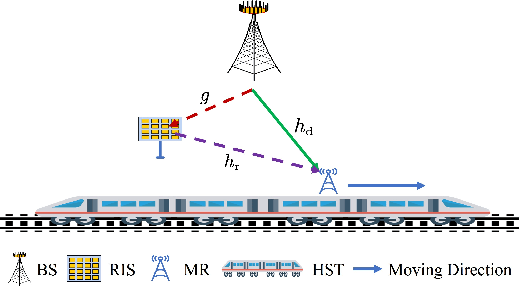
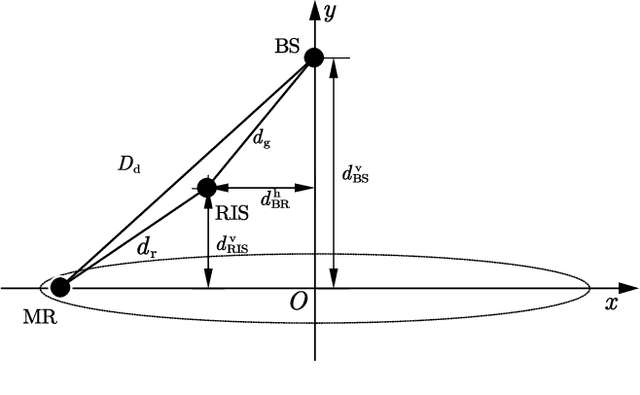
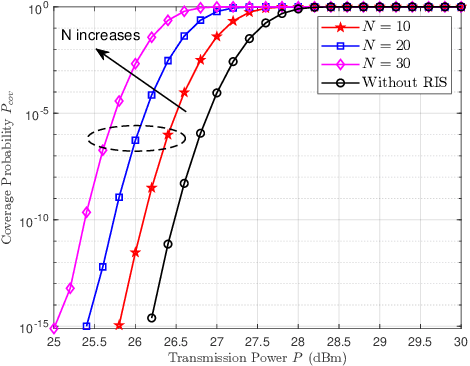
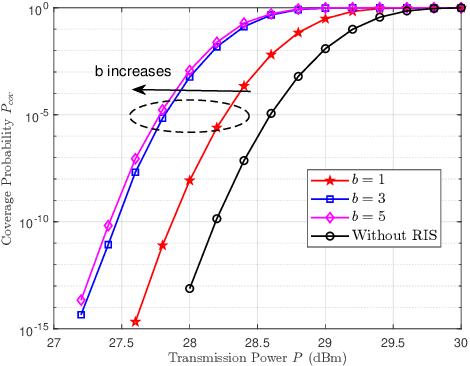
Reconfigurable intelligent surface (RIS) has received increasing attention due to its capability of extending cell coverage by reflecting signals toward receivers. This paper considers a RIS-assisted high-speed train (HST) communication system to improve the coverage probability. We derive the closed-form expression of coverage probability. Moreover, we analyze impacts of some key system parameters, including transmission power, signal-to-noise ratio threshold, and horizontal distance between base station and RIS. Simulation results verify the efficiency of RIS-assisted HST communications in terms of coverage probability.